I was promoted to the position of Under-secretary and moved to the Ministry of Tourism and Wildlife. My Minister was Samuel Onyango Ayodo, a Tom Mboya-leaning man from South Nyanza. Moses Budamba Mudavadi was one of my assistant secretaries.
We were passionate about tourism and wildlife. I was in charge of staff in the ministry. My PS, a fish specialist, spent most of his time everywhere – the Coast, Turkana, Rift Valley or Nyanza. He did not pay much attention to wildlife.
Later, we jokingly referred to some wives as “wild lives” because of the attitudes they exhibited at home when speaking to their husbands. As an Under-secretary, I was first in charge of the Ministry as far as general management was concerned.
The cover page of the book Ekokom: Wings of Ambition, the memoir of Albert Aggrey Alexander (AAA) Ekirapa.
Photo credit: Pool
I had an Assistant Secretary responsible for some departments. Personnel Management was left to me. One of the key areas in management was training locals to replace the expatriates who were leaving. The rules were clear. When, for example, you attained the age of 55, you had to retire. There were no two ways about it.
During the annual review, I discovered an expatriate aged above 70 who was still in the service. This was Major Tembo Boram. He single-handedly controlled the entire Masai Mara ecosystem. He had an office there, which only he could access. He would lock it whenever he travelled out of the country or to the Coast for a holiday. Even his assistant had no access to the office. This assistant, an experienced warden, would be sent on leave when his boss was away.
Despite his experience in wildlife management, the warden was never assigned duties or given responsibility. Later, we found out that the “assistant” position was just ceremonial.
Since no one would tell me why Boram wielded so much power in wildlife management, I decided to relieve him of his duties. In any case, he was over 70, was not training local officers to take over from him, and his activities were suspicious.
The Personnel Manager wrote Boram a letter to relieve him, stating how much leave was due to him. He had never taken full leave – according to his file. He was, therefore, entitled to go on retirement immediately and spend most of the accrued days on terminal leave.
When the Minister for Agriculture, Bruce Mackenzie, and Attorney-General Charles Njonjo came to know about it, all hell broke loose.
“What is this I hear?” screamed Njonjo, “that you have retired Tembo Boram?” He was speaking to my line minister, Ayodo.
“I wasn’t aware of such a development,” Ayodo replied, “but I will get to the bottom of the matter and get back to you.”
On return from Masai Mara, I was informed that Ayodo was looking for me. He had had a meeting with Njonjo and Mackenzie, to discuss the fate of Major Tembo Boram.
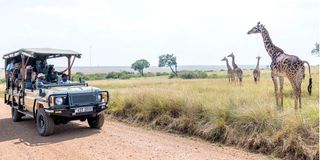
Tour vans entering the world-famous Maasai Mara National Reserve's Sekenani Gate.
Photo credit: Robert Kiplagat | Nation Media Group
Most of us in the office had known why the two ministers were so concerned about the retirement of Boram. My minister wanted to know on whose authority I decided to relieve Major Boram. He called me to his office.
“The public service regulations informed my action sir,” I told him.
“Mark my words. In future, I’ll have to do these things myself. You understand?”
In those days, the code of regulations was strictly followed by the responsible office. In the case of Major Boram, the letter of retirement was copied to the Director of Personnel Management, the Secretary to the Public Service Commission (PSC) and the Treasury for the preparation of the retirement cheque.
There was no possibility of anyone trying to reverse a properly made decision. The decision to relieve Major Boram was thus final.
While they were trying to do damage control, things took another turn. News broke out that Boram had died. It occurred that upon receipt of his retirement letter, he had left Masai Mara for Nairobi and booked himself into the Stanley Hotel.
Information Permanent Secretary David Andere with Assistant Minister of Information AAA Ekirapa (right) in Nairobi.
Photo credit: File | Nation Media Group
I had travelled to Masai Mara – just to check how things were since there was no other manager in-charge of the vast animal reservation. The local elders informed me that the officer (Major Boram) was a law unto himself. There were blocs of land in the reservation reserved only for the rich who occasionally visited to hunt animals for trophies. They paid money for these, but there were no records of the payments. Big hunting has always been dangerous, especially for those employed to guard the animals.
Stories later emerged about President Josep Broz Tito of Yugoslavia, a princess from Indonesia and other famous people coming to Kenya to hunt wild animals. They would be allocated exclusive hunting sites. They would kill big animals and take the trophies with them. There was no record of how much they paid for this privilege.
Taxpayers were being swindled. This was happening, yet we had a law that purported to protect animals against hunters and poachers. Ironically, part of Major Boram’s responsibility was to ensure the enforcement of the laws against hunting in the park!
I did not receive instant reprisals. But they did not escape notice, and it was only a matter of time before somebody or some people thought they had had enough. When that time came, I was transferred to the PSC as its Secretary.