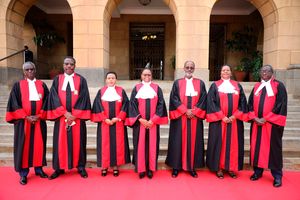
The Supreme Court of Kenya in Nairobi.

In 2025, the Supreme Court of Kenya issued several landmark rulings, significantly impacting public participation, inheritance rights, the role of the Senate, and land ownership.
These decisions set crucial legal precedents that harmonize religious laws with constitutional rights and emphasise the importance of due diligence in land transactions.
The decisions in 2025 have shaped key aspects of Kenya's legal landscape as the rulings reinforced constitutional rights, clarified the roles of legislative bodies, and emphasised the importance of due diligence in land ownership.
By harmonizing religious laws with constitutional principles and ensuring that public participation is meaningful, the court has helped solidify the foundations of democratic governance and human rights in Kenya.
Inheritance rights for children born out of wedlock
In June 2025, the Supreme Court made a historic ruling affirming that children born out of wedlock to Muslim fathers are entitled to inherit their father's estate.
The case, FAAF vs RFM, centered on whether such children should be excluded from inheritance under Islamic law, which traditionally denies them this right.
The court ruled that denying inheritance based solely on birth status violates the constitutional principles of equality and the best interests of the child.

A seven-judge bench unanimously agreed that it would be discriminatory and unlawful to treat children differently based on whether they were born within or outside of marriage.
The full seven-judge bench unanimously agreed that it would be discriminatory and unlawful to treat children differently based on whether they were born within or outside of marriage.
Chief Justice Martha Koome, leading the decision, noted, “Denying children born out of wedlock the same benefits as those born within wedlock, on the basis of the alleged ‘sins’ of their parents, is unreasonable and unjustifiable.”
The case arose when FAAF sought to exclude RFM (who had cohabited with the deceased prior to their Islamic marriage) and her children from inheriting the estate of her late husband.
FAAF argued that Islamic law should prevail, which excludes children born outside of wedlock.
However, the Supreme Court found that constitutional guarantees of equality and child protection cannot be overridden by personal or religious laws.
“This therefore means that any attempt to exclude children born out of wedlock from benefiting from their father’s estate fails the proportionality test envisaged by the phrase “qualified to the extent strictly necessary” which is a condition under Article 24(4) of the Constitution,” said the court.
This ruling established that all biological children of a Muslim father are entitled to inherit, provided paternity is acknowledged, irrespective of the marital status of the parents. The decision harmonized Islamic succession law with Kenya’s Constitution, particularly the principles of equality (Article 27) and child protection (Article 53).
Land ownership and due diligence
In another significant ruling, the Supreme Court addressed the issue of land ownership and due diligence in the transfer of property titles.
There have been cases where plots owners in Nairobi have lost their possessions as fraudsters in cahoots with officials of the land ministry target plots whose leases are about to expire or have expired.
The case involved Harcharan Singh Sehmi and Jaswarana Sehmi, who had occupied land in Nairobi’s Ngara area after their lease expired in 2001. The land was later allocated to Rospatech Limited, then transferred to Tarabana Company Ltd.
The Court of Appeal had ruled in favor of Tarabana, stating that it was an innocent purchaser. However, the Supreme Court disagreed, emphasising that a registered title deed alone does not constitute absolute ownership.

The court ruled that ownership must be established through a clear and verifiable chain of legal documents. It also stressed that titles acquired illegally, unprocedurally, or through fraud cannot defeat prior legal interests, even if the buyer acted in good faith.
The ruling clarified that property buyers must conduct thorough due diligence to ensure the entire history of the property is legitimate. The Supreme Court also reaffirmed that true ownership requires a legally valid chain of title deeds tracing back to an original, lawful owner.
The Senate’s role in legislation process
The Supreme Court also addressed the role of the Senate in the legislative process, particularly in relation to the National Assembly, especially the budget-making process.
The case stemmed from a dispute over several bills passed by the National Assembly without Senate participation, contrary to the Constitution.
In November 2019, senators staged a walk from Parliament buildings and matched to Milimani Law Courts where they filed a case challenging National Assembly’s decision to ‘exclude the Senate’ in considering 23 Acts of Parliament.
In the petition, the senators sought the court’s interpretation on the extent of the legislative authority of each House.
The senators argued that during the 12th Parliament, the National Assembly curtailed its legislative role in two significant ways.
And in March, the Supreme Court settled the ‘sibling rivalry’ and on the contentious issue of enactment of money Bills, with the apex court noting that the Constitution excluded the Senate from the consideration and enactment of money Bills.

Supreme Court judges (from left) Isaac Lenaola, Dr Smokin Wanjala, Philomena Mwilu, Chief Justice Martha Koome, the late Mohamed Ibrahim, Njoki Ndung'u and William Ouko.
Regarding money bills, the court confirmed that the Senate has no role in their enactment, as these must originate in the National Assembly.
The Court clarified that the Senate’s oversight role is limited to national revenue allocated to county governments, but does not extend to locally generated revenue.
“The exclusion of Article 114 from the scope of Article 96(2) clarifies that the Senate does not participate in the enactment of money Bills. When a Bill falls within the category of a money Bill, it removes the power of the Senate to introduce and consider such a Bill,” said the judges.
The court added that the exclusion of the Senate from participating in the enactment of money Bills was not an anomaly but deliberate, as it aligned with established legislative practices in other asymmetrical bicameral systems.
The Supreme Court said that recognising the critical role of financial legislation in ensuring the smooth functioning of the state and the effective delivery of public services, many constitutions prescribe specific legislative procedures for money Bills.
The court ruled that the Senate must be involved in the law-making process for bills concerning county governments, as stipulated under Article 96(2) of the Constitution.
The apex court emphasised that for such bills, the concurrence of the Speakers of both the National Assembly and the Senate is mandatory. Failure to do so renders the resulting legislation unconstitutional.
The court went ahead and invalidated three Acts that were passed without Senate input, while upholding 21 others that did not require Senate participation.
Follow our WhatsApp channel for breaking news updates and more stories like this.