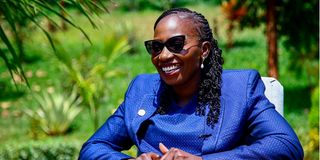
As the sun sets for Faith Odhiambo at the helm of the Law Society of Kenya (LSK), she mostly spends her days racing against time to put up the new office and complete what she terms her legacy projects.
She, in her tenure, experienced both hate and love in equal measure. In fact, there was a time she stood at a crossroads when an offer from the government she had consistently criticised came knocking. Accepting it was not easy. Neither was declining.
But, like many other Kenyans, still finds it hard to speak about Raila Odinga — the man who endorsed her before many believed in her — in the past tense. Sometimes, it feels surreal that he is no longer with us, she said.
She knows Raila as a Pan-Africanist and peacemaker who greatly shaped governance, democracy and the rule of law in Kenya. After winning the LSK presidency, they once shared breakfast. That moment still lives rent-free in her mind.
She becomes one of the two female presidents of LSK. As the curtains draw on her reign, she says, it may take another four to six years before another woman takes the helm.
She leaves knowing that there’s also a growing number of young advocates who need hope, opportunities and new practice spaces. But of all else, she hopes to be remembered as a leader who inspired real change in the legal space and was always available.
She spoke widely on a variety of issues. Here are the verbatim transcriptions of the interview, edited only for brevity.
I’d give myself 85 percent. I say this because my agenda was on protection of the rule of law, stability of the bar, progress in practice, the bar, and welfare, which I think are pretty much tried to adhere to.
I give myself 85 percent because we have not cracked on just ensuring secretariat are able to be more responsive.
However, we have put in a new ERP (Enterprise Resource Planning) system which had teething problems from when it was launched last year. But now there's more fluidity in terms of access to documentation, a better outlook of the website, and better ease in terms of them being able to access services.
Law Society of Kenya's new President Faith Odhiambo takes her oath of office at the Rift Valley Sports Club in Nakuru on March 22, 2024.
Photo credit: Boniface Mwangi | Nation Media Group
We are grown to 27,000 members and the old system could not support the numbers.
In terms of rule of law, I think this is one of the stellar reasons.
The image of the LSK, its perception, knowledge of the importance and possibility that LSK has risen.
Many now understand that LSK is now available all over the country based on how members were able to respond during the Gen Z protest of 2024 and subsequently during the different demonstrations.
We've filed quite a number of public interest litigations challenging not only the finance bill, but also the housing levy and certain policy projects government has put in place that have not gone through the rigorous processes as provided under the law when, for example, the Adani deals.
LSK played a huge role in protecting Article 37 on the right to protest — including police conduct, the non-use of live bullets and proper identification. We also pushed back on court order disobedience and raised concerns on intimidation of the judiciary.
We also pushed back on court order disobedience and raised concerns on intimidation of the judiciary.
Under rule of law, I think we did exceptionally well. On parliamentary engagement, it’s been a crazy time. Laws are passed overnight, sometimes circumventing public participation.
On stability of the bar, we’ve kept the council united despite loud disagreements.
On welfare, we launched the LSK medical car.
We addressed harassment of advocates by police and DCI officers — raids, arrests and intimidation.
We met the Inspector General of Police and demanded bare minimum respect for advocates. Things have since improved since then.
On practice, there’s challenge including delays in rulings, backlog, too many conferences, and “Jurispesa” notion. These affect justice and daily work.
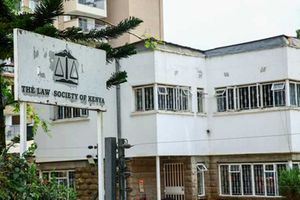
Law Society of Kenya headquarters pictured on April 30, 2025.
Photo credit: Wilfred Nyangaresi | Nation Media Group
Challenging. Because you have two very strong competing interests. You balance professional needs of members and public expectations for LSK to speak against government abuse.
When you do more for the public, members complain. When you focus on members, the public says LSK is quiet.
Given your experience, what would you want to tell your successor?
Brace yourself. 2027 is coming and I don't think it's going to be any easier. LSK will be needed as a voice of reason and protector of rule of law. LSK participates in presidential election petitions as an amicus curiae. Your voice will be needed at that particular time, as a voice of reason to protect the rule of law.
There’s also a growing number of young advocates who need hope, opportunities and new practice spaces. There'll be need for a lot of young lawyers to find hope that they can't settle in the profession and earn income. And therefore, the need to push for drive of new practice spaces, how to equip them to be able to pick up into this challenging profession and how to settle them will be a huge challenge that you'll have to bear.
I'm focusing on finishing my legacy project. I already finished the ERP system, which was just to ensure better service delivery and, and now the Wakili Towers at Gitanga Road.
When we called upon advocates around the country to come out and support during the Gen Z protests by offering services for free. They came out in droves.
I remember distinctively, the on the night after the breach of parliament, I was getting all these calls particularly those who had been picked up the night that wee hours of the morning, my PA being one of them, and we couldn't literally reach people.
Advocates organised themselves drafting pleadings, collecting evidence, going to police stations. We had people working almost on a 24-hour system, writing to the chief justice asking for the courts to be open for longer periods for purposes of hearing, bail applications, and that was allowed.
I remember when we had 188 accused persons and we stayed in court almost till 1am. That energy, that push, that drive, that passion that people had to make a difference, for me, it reminded me of the humbling reality that lawyers make a positive impact in our country.
They were not demanding anything. They were actually asking; how can they help and What can they do.
I found that the most humbling moment. Because I felt the power of sitting in this position and that you can use this position for good.
On the flip side, what was your very lowest moment?
That happened when I accepted to sit on the compensation panel for victims and just seeing a lot of the people that I've walked with in this journey lashing out. And maybe I should understand, maybe the fear that someone they looked up had been bought.
But I was thinking of victims who lost loved ones and limbs. But just seeing that, the negative outpouring, for me was a very low moment. I remember asking myself certain moments that was always worth it.
No. People really assume or think the president always picks up his phone call to tell you this. But I made the decision to accept after discussing with some of my comrades who are with human rights space and just asking ourselves, what are the scenarios, if this doesn't happen, what do you do?
Of course, there's someone to tell you against it and someone who support it. Because it drugged for quite a bit before I agreed because I was still thinking of the scenarios. Some warned me.
First of all, I’m human. I vented like any other person would vent… I couldn't believe. Especially certain abuses. I leaned on my husband and friends.
They encouraged me that it's part of leadership, that it is for to growth, that I had only experienced being loved and never experienced the flip side of it.
[That] it's a passage of fire that you have to experience as well. I felt angry. It’s like stages of mourning. But I got to accept it eventually.
I don't believe it was a wrong decision to join because at the end of the day, I was thinking about what will happen to the victims.
Compensation processes were slow, and most of the times evidence missing… and bullets retrieved by officers. As such many victims couldn’t prove cases. The idea was to create an administrative process under Kenya National Commission of Human Rights (KNCHR) for reparations.
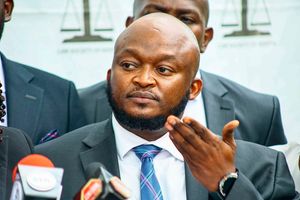
Law Society of Kenya president Faith Odhiambo (center) flanked by vice president Mwaura Kabata (second right) and members of the council address journalists at LSK offices in Nairobi on June 18, 2025.
Photo credit: Billy Ogada | Nation Media Group
It taught me that tough decisions have to be made. And I'll say without a doubt that even despite the challenge, I would still take up leadership positions because I believe that I will go to a positive impact. I would say do it with a clear conscience irrespective of the outcome.
If you stand by what is right and you believe you're pushing for the right thing to help as many people as possible then stay there irrespective of the noise, keep doing what you can for the good of the human being and for justice.
Following the June 25th protest, you were at the front line. Did you, at any point, fear for your life? And did you feel you're being trailed? And did you have to put special considerations for your security?
Yes. Because in the evening we were trailed. And I remember us having to separate. Actually, five of my council members, sought a safe house to stay through our network of human rights.
I wanted to go somewhere else, but I ended up not going because I asked my husband and he was like, no, I don't think they can come pick you in the house. I feared because where I live there's no escape route. I feared for such scenarios, having a child, what would happen and how would it look?
I remember where we were all going to congregate, there was actually a rider trailing the cars. And so when we separated, they only were followed one.
In hindsight, it was a good decision. And, yes, I got security for myself. I’ve had them ever since and maybe I should hand them over to the new president.
Raila for a lot of us is a hero that we got to see in our time. He is a leader that I’ve come to learn and experience at a personal level.
And to be honest, sometimes it still feels surreal that Raila is not with us or amongst us. Because for the longest time in our political lives, Raila has always been there. His voice was always booming, encouraging people, and bring crowds together.
He's someone that I've looked up to, admired his leadership style. To date, I find it hard to accept that it's no longer with us.
He shaped democracy, governance and the rule of law. We wouldn’t be debating this constitution without him. He pushed for judicial independence, devolution and separation of powers. His election petitions shaped democracy. He put the country above himself.
I, like many out there, still find it hard to believe that Baba is not with us. But we hope to continue living his legacy by fighting for the rule of law in this country and better governance.
On a more personal level, in your relationship with him, do you perhaps have a moment that still leaves rent-free in your mind?
After I won, a friend called him. He laughed and said people told him I wouldn’t win. But he said it didn't matter for him as long as he believed in me, that's all that mattered. He was the kind of person you enjoy sitting and sharing and discussing with.
People can argue different things. But, maybe, people are guessing it from the reality that Raila felt strongly about those who have suffered atrocities, starting from the Maandamanos after elections. So this was, I'm sure, something that he held me nearly yearly that’s why the guesses are there.
Protests Victims Compensation Panel Chairperson Prof Makau Mutua (left), member Irungu Houghton and Vice Chair Faith Odhiambo.
Photo credit: Wilfred Nyangaresi | Nation Media Group
We wait and see. Political landscape keeps changing. I’ll want to wait and see how the dust settles before I make my mind on what’s the way forward.
So, you're not closing out on joining the government?
Well, that's not my thoughts right now.
We have we've had very few female LSK presidents. After you, how long do you think it will take to get another female president?
Maybe another four or six years. but I think, there’s strong possibility that we’ll have another female president. I hope my reign has been positive enough to encourage the legal professionals to trust this helm to another female president.
There are quite a number of upcoming determined, young leaders. Some of them, in my view, could possibly be really great presidents.
In the next General Elections, what is the place and fate LSK?
There’s continued abuse by police and growing surveillance. Something that I keep saying is that every revolution was born out of oppression. And if people are pushed to the back to a point they cannot express themselves then there will always be an explosion. It’s ticking timebomb. People just need a trigger because absence of war doesn't mean this peace.
When our country was in the brink of destruction, it took Raila to stand up and support the government to restore peace. Not having the face of baba to ensure peace in our country is a bit destabilising.
It appears as though East African nations are going rogue to some extent. What do you think of this?
It's quite unfortunate and something. At least as a country, we have some semblance of democracy. The kind of clump down eating the other states is quite unfortunate. And sometimes you feel that there’s unholy union in East Africa
Focus is now on young lawyers. They command numbers. Even if you look at the face of the leaders, we have a younger face in the council as compared to years before where we had a majority of the voters are the younger generation. Of course, we have seniors who are still participating in events of the LSK but not as energetic like the young lawyers, and now they command the numbers.
The difference is you see more campaign manifestos and slogan tuned to solve or meet the needs and demands of the younger generation that are joining the legal profession. Even the mantras are skewed to fit into that particular demography.
There are some that I fear… [But] let the voters make their choices. But choices have consequences. They'll make that decision.
However, yes, the some that I fear will not pick up and make things better. But some other others I have strong confidence that they'll be able to push and ensure things are made better.
From where you sit, what are the main factors that really shape LSK elections?
I’m waiting to see how this one span out. But majority of the factors that affect would be the candidate’s accessibility, fight for practice matters and welfare for members, and LSK voice running strong, particularly on rule of law issues.
The LSK voter has always been against any pro government candidate. That is something that has always characterised, particularly the president, that any candidates that has an ounce of government, they’ll vote against them strongly.
But I still have hope and faith that our members will make the right decision to vote a leader who's responsible, who will be able to stand to ensure they protect the rule of law.
During your tenure, what challenge stood out for you?
The Gen Z movement. For me that was a challenging time in terms of being able to respond to every single one. I find it hard not to pick up someone's phone. But it's equally frustrating when you cannot respond to their need.
At the height of also the same (Gen Z-led protests) for me, was fear and frustration and how do I protect my members.
I wish to be remembered as a good leader who was able to change the face on the LSK with regards to how we handle rule of law issues, strengthening the institution of the society…
I’d also like to be remembered as a responsive leader; someone who people were always able to easily access and was able to respond to their needs.