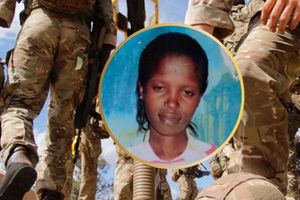
When Esther Njoki landed at London’s Heathrow Airport on Sunday, she carried more than a suitcase; she carried her aunt’s memory and a demand for justice.
Her aunt, Agnes Wanjiru, was murdered in 2012 in a hotel in Nanyuki, allegedly by a British soldier who was recently identified as Robert James Purkiss. In September this year, a Nairobi Court issued a warrant of arrest against Purkiss, but he is yet to be arrested.
The case remains unresolved, despite multiple confessions reported within the British Army barracks and renewed public outrage.
Agnes Wanjiru, who was found dead in 2012 after she went missing.
Photo credit: Pool
Ms Njoki’s visit to the United Kingdom marks the first time a member of Wanjiru’s family has travelled there to press for accountability directly, meeting human rights lawyers and lawmakers who have pledged to revive pressure on both the Kenyan and British governments.
“We have waited long enough,” she told the Nation . “If justice cannot come to Kenya, we will go and find it ourselves.”
She revealed that they had secured an appointment with Secretary of State for Defence John Healey. In April, Mr Healey became the first UK official to have a meeting with Wanjiru’s family to discuss justice for her killing.
“Apart from meeting with Healey, we shall also have an event at the House of Commons where political leaders in UK will be attending,” she said.
Esther Njoki 20, niece of the late Agnes Wanjiru, when she appeared before the National Assembly Committee on Defence Intelligence and Foreign Relations on September 3, 2024.
Photo credit: Dennis Onsongo | Nation Media Group
Several members of the British parliament have called for a fresh inquest into the Wanjiru case, citing failures by the Ministry of Defence to act on known evidence.
Human rights lawyers in London have also linked the case to broader concerns about the accountability of overseas military deployments, urging reforms to laws that currently protect soldiers from prosecution abroad.
The Kenya and Britain defence cooperation has come under growing scrutiny. From the murder of Kenyan women to cases of abandoned children fathered by British soldiers, the shadow of impunity continues to stretch across the two nations.
Wanjiru’s body, which had stab wounds, was found in a septic tank at the Lions Court Hotel in Nanyuki, a town that hosts the British Army Training Unit in Kenya (Batuk).
Wanjiru’s family has endured over a decade of silence, bureaucratic delays and diplomatic excuses.
But Wanjiru’s case is not isolated. In an incident uncovered by Declassified UK, a young Maasai woman named Mantoi Lekoloi was allegedly killed by British soldiers during training exercises at Archers Post, Samburu County in 1997. Her injuries were severe—seven broken ribs, a punctured lung and blunt force trauma—according to post-mortem examination findings.
In both cases, British military authorities have refused to release internal investigation reports, citing “operational security”. Meanwhile, local police have struggled to gather sufficient evidence—partly because most of the suspects had already left the country.
Human rights campaigners argue that these deaths expose the inherent imbalance in the Kenya–UK defence agreement, where foreign soldiers operate with significant immunity and limited oversight by Kenyan authorities.
“The Batuk arrangement was meant to strengthen security cooperation,” said security expert Kelvin Moenga. “Instead, it has turned into a shield for soldiers who commit crimes on Kenyan soil.”
Ms Rose Wanyua Wanjiku holds the portrait of her slain sister Agnes Wanjiru at her home in Majengo Estate, Nanyuki Town on Sunday, November 5, 2023.
Photo credit: Mwangi Ndirangu | Nation Media Group
While Wanjiru’s family fights for justice in death, other Kenyan women are seeking justice for life—for the children fathered by British soldiers and then abandoned when the troops returned home.
Earlier this year, a group of Kenyan women won a landmark case in the UK, allowing them to pursue compensation and child support from the UK Ministry of Defence and Batuk.
“For many families, [this] marks the end of an incredibly difficult journey that for so long felt impossible. Children and young people who previously only had questions, now have answers,” lawyer James Netto, who represented the Kenyan women, said.
Unresolved cases involving British soldiers
The women told the court how soldiers stationed in Nanyuki formed relationships with them, only to disappear without acknowledgement or support once their training rotations ended.
“They promised marriage, education and care,” one of the women testified in court. “Then they left without a word.”
The UK court’s decision marks the first time British military authorities have been forced to confront such claims abroad, setting a potential precedent for other women in former colonies.
Mr John Kamungu and his wife Rose Wanyua, a sister to Agnes Wanjiru who met her death while in the company of British soldiers in Nanyuki ten years ago display photos of their slain kin at their home in Majengo Estate in Nanyuki
Photo credit: Mwangi Ndirangu I Nation Media Group
In Nanyuki alone, local non-governmental organisations estimate that dozens of such children exist, many living in poverty while their fathers’ regiments continue to train nearby under government protection.
Kenya continues to rely heavily on the British Army’s training programme, which injects millions of pounds annually into local economies and bilateral aid. The UK prefers to treat military misconduct as an internal disciplinary issue. The result is a culture of quiet complicity, where justice is stalled under the guise of diplomacy.
Despite the pressure, in a new Kenya-UK deal not so many changes were made. In July, the two countries renewed their strategic partnership, outlining a five-year plan (2025–2030) to strengthen cooperation in trade, investment, security, climate action and technology. The agreement seeks to double bilateral trade while unlocking investments worth more than Sh427 billion.
In defence, the two countries reaffirmed the Defence Cooperation Agreement, focusing on counterterrorism, regional stability and joint military training. The UK-Kenya Intergovernmental Liaison Committee will oversee progress to ensure transparency and stronger community engagement around British military activities in Kenya.
However, Kenya’s growing list of unresolved cases involving British soldiers—from murders to paternity claims—now threatens to stain a partnership hailed as mutually beneficial.
“The British Army may leave Nanyuki after every training season,” says Mary Muthoni, a Nanyuki-based activist, “but their actions stay behind, in the graves, the courtrooms and the faces of abandoned children.”
For Ms Njoki and the families left behind, this is not just about one murder or one court ruling—it’s about reclaiming dignity from decades of silence.
As she meets legal experts and campaigners in London, her message is simple: justice delayed is justice denied.
Until both governments confront the truth, the ghosts of Agnes Wanjiru—and many others—will continue to haunt the fields of Laikipia, and the corridors of Whitehall.