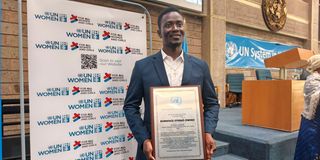
Bornface Otieno Owino, a 29-year-old farmer from Homa Bay County, was named the UN in Kenya Person of the Year yesterday (Monday) at a ceremony held at the UN headquarters, Gigiri.
He was recognised for using agriculture to fight poverty, strengthen rural livelihoods and create opportunities for young people and women. He is the first person under the age of 30 to receive the honour.
In an exclusive interview with Nation , Owino said the recognition was both a personal milestone and an opportunity to expand his work with rural communities, where agriculture remains a source of food, income and employment for thousands of households.
“I am very delighted to be recognised as the 2026 UN in Kenya Person of the Year. I am very happy. I am very proud and happy about this recognition,” he said.
His work centres on agroecology, climate-resilient agriculture and sustainable development through Bonifarm Enterprise Limited, an agribusiness dedicated to advancing sustainable agriculture, horticulture, poultry production, aquaculture, environmental conservation and climate action.
Through these initiatives, he works with farming communities, schools, churches and organised groups, helping people use agriculture to improve their livelihoods.
In his telling, he has reached 12,674 farmers, with 81 per cent of them being young people. His activities include training farmers, mentorship, the provision of agricultural resources and support for community enterprises.
“I started small, with a quarter of an acre, but I have expanded my farming activities to about 25 acres. My ambition is to cultivate more than 100 acres,” he said.
His journey began long before he established his farming enterprises. Growing up in a family that depended on agriculture and small-scale trade, he learnt early how food production could shape household welfare and community development.
“My father was a farmer, while my mother was a grocer. I used to accompany my father to the farm, where I participated in agroforestry activities. I also saw him teaching university students. My father was my first mentor, and I learnt a lot from him,” he said.
The experience exposed him to farming as both a livelihood and a body of knowledge that could be shared to improve other people’s lives.
He also remembers the difficulties of growing up in poverty, an experience that continues to shape his approach to community development. His early experiences, he says, strengthened his commitment to supporting people facing economic hardship. His involvement in community work began in childhood and has remained central to his life.
“When I started engaging with communities in my village, many people doubted me and wondered how I would manage partly because of my age. However, this work has been part of my life since I was five years old. It is not something I started today,” he said.
His enterprise also serves as a practical learning centre for farmers seeking to improve their agricultural practices. He promotes climate-smart approaches, including the use of certified seeds, efficient irrigation, integrated pest management and soil conservation. Amid climate change shocks, these practices are intended to improve yields, manage production risks and protect farmland from degradation.
For farmers, the youthful farmer said, in the Lake Victoria basin where changing weather patterns, unreliable rainfall and limited access to productive resources can threaten agricultural incomes, such approaches are particularly important. By promoting sustainable farming methods, Owino seeks to help communities strengthen their resilience while improving food production and household incomes.
Instead of concentrating his activities on his own farm, Mr Owino has developed a community-based model through which farming groups establish and manage their own enterprises. In every community he works with, he sets aside one acre for a farming project. “I establish groups to manage the farms, and they retain the profits they generate,” he said, explaining that he then moves to another community to replicate the model. Currently, 25 communities are participating in the initiatives.
Aquaculture as a livelihood
Through a weekly programme promoting agriculture among male and female farmers, Owino has also provided more than 500,000 fish fingerlings, according to the United Nations. The initiative supports aquaculture as a livelihood option for communities around Lake Victoria, where fish production can contribute to household incomes, employment and food security.
Speaking during the recognition ceremony, Dan Bazira, Deputy Country Representative to Kenya at UN Women, said Owino’s approach showed how grassroots leadership could translate global development commitments into practical benefits for communities.
“He has shown how local leadership can translate the Sustainable Development Goals (SDGs) into tangible community benefits. As a farmer, entrepreneur, mentor and gender equality champion, he links agriculture with service delivery, creating opportunities for women and young people while advancing food security and sustainable livelihoods,” he explained.
Through the Joint Devolution Programme, UN Women works with the United Nations Development Programme, the United Nations Children’s Fund, the Council of Governors and county governments to strengthen gender-responsive and inclusive governance, planning, budgeting and service delivery. The programme is supported by the Swedish International Development Cooperation Agency in Kenya.
Ms Zainab Bangura, UN Under-Secretary-General and Director-General of the United Nations Office at Nairobi, applauded the young farmer, noting that he had demonstrated how determination and innovation could transform lives.
“Leadership is not defined by age, but by purpose; not by vocation, but by the impact one has on the lives of others, and not by the years lived, but by the lives touched,” she offered.
The award ceremony marked its 81st anniversary, and was also attended by Dr Korir Sing'oei, Principal Secretary in the Ministry of Foreign and Diaspora Affairs, and Ida Odinga, Kenya’s Permanent Representative to the United Nations Environment Programme.
They also congratulated Owino, describing his work as an example of how agriculture could create opportunities for women, young people and local communities. His recognition comes as agriculture continues to occupy a central position in Kenya’s economy.
According to the Kenya National Bureau of Statistics' Economic Survey 2025, agriculture, forestry and fishing contributed an average of 21.8 per cent of gross domestic product between 2000 and 2024.
Kevin Wekesa from western Kenya was also recognised as a runner-up for the award. Through Play Green, the rugby player promotes environmental sustainability by using sport as a platform for climate action. Wekesa, 26, estimates that a single rugby tournament in Kenya generates about 850 kilogrammes of plastic waste.
During sporting events, he champions environmental conservation by collecting discarded plastic materials, helping raise awareness about pollution and responsible waste management.