“Our wives are innocent. They were silent partners in the business.”
That was the plea by former Kiambu governor Ferdinand Waititu and businessman Charles Mbuthia Chege as they asked a Milimani anti-corruption court to spare their wives from punishment over a Sh588 million road tender scandal.
Ex-Governor Waititu pleads for leniency for his wife in Sh588m money laundering case
Waititu and Chege, a director of Testimony Enterprises Limited, urged the court to be lenient when they appeared for mitigation on Tuesday, with both men insisting their spouses, Susan Wangari Ndung’u and Beth Wangechi Mburu, had played no meaningful role in the transactions that led to their convictions for money laundering.
Their plea came after the High Court overturned their acquittals on money laundering charges linked to the award of road construction tenders during Waititu’s tenure as Kiambu governor.
Through his lawyer, Waititu argued that Susan was merely a silent partner in the companies associated with the business and did not control their operations or participate in decisions on the tenders.
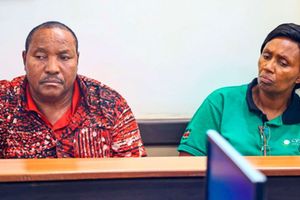
Former Kiambu County Governor Ferdinand Waititu (left) and wife Susan Wangari Ndung’u at the Milimani Law Court on February 13, 2025, before they were sentenced in a Sh588 million corruption case.
Photo credit: Wilfred Nyangaresi | Nation Media Group
“The court will note that Susan was a silent partner in the two companies. She was not a signatory or a decision maker. Her role was peripheral and purely to conform to the Companies Act at the time of incorporation,” his lawyer submitted.
The advocate said the prosecution had presented no evidence that Susan received financial benefits or made decisions concerning the tenders, arguing that her involvement was limited to being listed as a company partner.
“The same goes to the 5th accused (Beth). Besides the fact that she signed the initial form for the incorporation of the company, she had no hand to play in any of the affairs of the company. Her crucifixion is purely by association,” the lawyer said.
Waititu, who is already serving a 12-year prison sentence for corruption-related offences, asked the court to consider the punishment he and his co-accused had already undergone.
“Consider the fact that they have already been punished. Punishment is meant to rehabilitate and not to cripple. In so doing, give them a second opportunity, which will not be achieved by crippling the accused persons,” he said.
His lawyer also urged the court to consider an audit report produced by the prosecution, arguing that it showed no public money had been lost and that the dispute concerned the process through which the contract was awarded.
According to the defence, the contracted road works were completed, with the irregularity lying in the procurement process rather than the execution of the projects.
The lawyer further pleaded for leniency for Beth, describing her as a young mother whose children were minors and depended on her care.
He argued that sending both parents to prison would affect the children, who had no role in the offences.
“They are asking for forgiveness from the court. Any decision, whether for their acts of omission or commission, willingly or unwillingly, they are really sorry for it,” he said.
Chege also took responsibility for the transactions, asking the court to spare his wife, whom he said owned only one share in the company and was not a signatory to its bank accounts.
He told the court that he had been fined Sh296 million or faced 11 years in prison in default, a sentence he is currently serving.
Chege added that his wife had struggled to raise Sh1.4 million to pay a fine imposed after she was convicted by the lower court.
The prosecution opposed the plea for leniency, urging the court to treat each accused person according to their individual responsibility and the seriousness of money laundering.
“We must understand that money laundering is a very distinct offence and that Kenya is a signatory and has ratified the UN Convention against Corruption and the UN Convention against Transnational Crimes. They form part of our laws. The laws call states to criminalise money laundering,” the prosecution submitted.
The prosecution argued that the spouses had been convicted in their individual capacities and should face the consequences prescribed by law.
“Again, they (spouses) are here in their individual capacity and the court should treat them as such. They were convicted of money laundering. The punishment should apply equally to them. They should carry the full weight of the law as prescribed,” the prosecution said.
The case follows a ruling by High Court judge Rose Ougo, who overturned the acquittals on money laundering charges after finding that the trial court had misapprehended the facts and the law.
“Accordingly, the Court sets aside the acquittals on Counts 10, 11, and 12 and convicts the Appellants and the 2nd Respondent on all money laundering counts as charged,” Justice Ougo ruled.
The judge upheld the convictions of Waititu, Chege and Luka Waihinya over the irregular procurement of road works, finding that the prosecution had proved their involvement in the fraudulent award of the contract.
Waititu was convicted of corruptly receiving Sh25 million from Testimony Enterprises, which had secured a Sh588 million contract from the county government.
Allowing the State’s cross-appeal, Justice Ougo said investigators had traced funds from the irregular tender through entities associated with the accused and into asset acquisitions.
“The evidence demonstrates a classic pattern of placing, layering, and integrating illicit funds through corporate entities and asset acquisitions,” she said.
The judge also upheld the fines and prison terms imposed by the trial court, ruling that mandatory fines under the Anti-Corruption and Economic Crimes Act were lawful and could not be reduced by relying on general sentencing provisions in the Penal Code.
Waititu had challenged the fines and prison terms, while his co-convicts disputed the computation and legality of their penalties. Justice Ougo, however, said an appellate court could interfere with a sentence only in specific circumstances, including where it was illegal, based on erroneous legal principles or manifestly excessive or inadequate.
The court heard that Waititu had already spent more than a year in prison, while Chege was serving his second year.