The High Court in Nairobi has ordered the forfeiture of a boat linked to a Sh8.2 billion methamphetamine haul with six Iranian nationals aboard in Mombasa last year, allowing the State to take ownership before the criminal trial ends.
Justice Benjamin Musyoki ruled that MV Igor, also known as Mashaallah, was used to commit an offence and should be forfeited to the government through the Assets Recovery Agency (ARA).
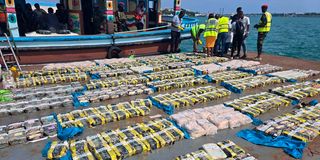
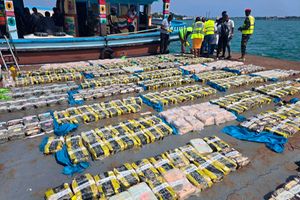
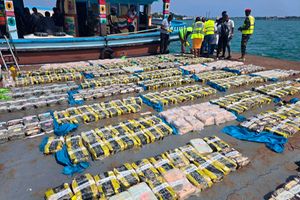
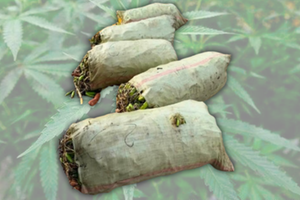
Some of the 1,024 kilogrammes of synthetic drugs seized from six Iranian crew members aboard a vessel. The haul, estimated to be worth Sh8.2 billion, was seized about 650 km off the shore of Mombasa.
Photo credit: Wachira Mwangi | Nation Media Group
The dispute was whether the boat could be confiscated despite having no known registered owner and while six Iranian nationals accused of trafficking the drugs face a separate criminal trial.
The forfeiture ordered followed an application by ARA seeking to have the vessel forfeited to the government because it was allegedly used to transport narcotics. ARA argued that the vessel was an instrument of crime because it had no known registered owner, flag, cargo manifest or ship documentation. It asked the court to forfeit the boat to the government and transfer it to the Kenya Navy.
The court heard that the vessel carried 1,036.044 kilogrammes of methamphetamine when authorities intercepted it in October 2025.
The judge ordered the Director-General of the Kenya Maritime Authority to register the boat in ARA’s name. He declined to order its direct transfer to the Kenya Navy, as ARA had requested, because the Navy had not participated in the proceedings.
“The respondent is liable for forfeiture for being an instrumentality of crime,” Justice Musyoki said.
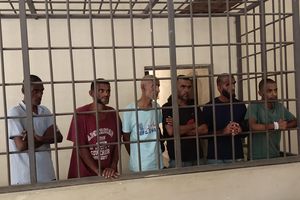
Iranian suspects found in possession of substances suspected to be methamphetamine valued at Sh8.2 billion at the Mombasa Port on October 25, 2025.
Photo credit: Pool
ARA told the court that a multi-agency team comprising officers from the Directorate of Criminal Investigations' Anti-Narcotics Unit, the Kenya Navy and the Coast Guard Services intercepted the vessel on October 20, 2025, after receiving information about suspicious activity in the Indian Ocean.
It said the boat flew no flag and had no manifest, cargo list or sailing documents. Six men were aboard, with Jaseem Darzadeh Nia identified as captain.
Investigators obtained court orders to board and search the vessel. They reported finding packages of whitish crystalline substance in six compartments and on deck.
The Government Chemist later identified the substance as methamphetamine with 98 per cent purity, ARA said.
The Kenya Maritime Authority’s inspection report found no ship documents or statutory certificates on board. The vessel’s port of registry, flag, state and ownership could not be established. Despite a public notice in the Daily Nation on June 8, 2026, no one claimed it.
Captain Nia opposed forfeiture, arguing that ARA had not proved its case and that a final order before the criminal trial ended would prejudice his rights. He said the allegations remained contested and no finding of guilt had been made against him or the other accused.
The judge said key evidence had not been challenged. He rejected the argument that the State had to wait for the criminal case to conclude.
“The validity of an order under subsection (1) is not affected by the outcome of criminal proceedings,” the court said quoting Section 92(4) of the Proceeds of Crime and Anti-Money Laundering Act.
The court explained that civil forfeiture requires proof on a balance of probabilities, while prosecutors in a criminal trial must prove guilt beyond reasonable doubt.
The forfeiture decision, Justice Musyoki said, did not determine whether Captain Nia or his co-accused were criminally responsible.
The judge noted that Captain Nia had not claimed ownership of the boat or explained its origin. He said the failure of any owner to come forward, alongside the lack of registration and evidence about the consignment, supported forfeiture.
“I am convinced on balance of probabilities that whoever the owner of the respondent is, must be an accomplice or complicit in its illegal operations,” Justice Musyoki said.
The six Iranian nationals face a separate drug trafficking case at Shanzu Chief Magistrate’s Court. On September 11, 2026, the trial court found that the prosecution had established a case requiring the six to present their defence after 12 witnesses testified.