Up to the late 1990s, pyrethrum was a highly valued fresh farm produce that was regarded as Kenya’s white gold.
But the sector, which provided livelihoods to farmers in 19 counties, is now a mere shell of its former self, with repeated failed attempts to revive it.
The Pyrethrum Processing Company of Kenya (PPCK) is reeling from Sh3.8 billion in debts, with farmers owed Sh22.5 million for supplies of their produce.
The company, a government parastatal domiciled in the Treasury, owes former employees, most of them pensioners, over Sh2.2 billion, excluding accrued interest since 2007, which, when factored in, would escalate the amount.
In the 90S, the country produced around 70 per cent of the global market, bringing in an average of Sh10 billion annually in foreign exchange, with the then Pyrethrum Board of Kenya (PBK), a company established in the 1930s, running the show.
The Pyrethrum Processing Company of Kenya was established on January 21, 2025, following the merger of the Pyrethrum Board of Kenya (PBK) with research units as the government moved to consolidate some of the parastatals with duplicating roles.
The Pyrethrum Processing Company of Kenya head office in Nakuru County on March 14, 2025.
Photo credit: Boniface Mwangi | Nation Media Group
Mr Edward Ochele, the acting chief executive officer, admitted that the company is cash-starved, making it impossible to deliver on its core mandate, hence the need for a government bailout.
“The company is reeling from cash flow challenges with Sh3.8 billion debt. Farmers have not been paid Sh22.2 million for supplies in the last seven months,” Mr Ochele told Natio n in an interview on Thursday.
Mr Ochele said: “We have 146 million metric tonnes of dry flowers in PPCK silos that are yet to be processed as a result of the financial crunch we are faced with.”
Pyrethrum from Kenya, which is organic and has high efficacy levels, is used to make pesticides and sprays against bedbugs and mosquitoes, among others. It has a huge global demand, but it is a paradox that supplies have been dwindling over the years.
Apart from the inability to pay workers on time and the debts to pensioners, the PPCK has not remitted statutory deductions for several months to the Kenya Revenue Authority (KRA), National Social Security Fund (NSSF) and Social Health Authority (SHA), among others.
The company is charged with conducting research, providing laboratory tests and quality control services, undertaking innovations, producing certified seeds, providing seedlings to farmers, registering growers and purchasing produce from farmers.
The cash-starved parastatal also converts dry flowers into pyrethrin powder, extracts and natural insecticides.
Nakuru, Nyandarua, Embu, Laikipia, Meru, Kericho, Bomet, Narok, Kisii, Nyamira, Bungoma, West Pokot, Kiambu, Murang’a, Uasin Gishu, Baringo, Nyeri and Elgeyo-Marakwet are the counties where the crop, which does well in the highlands, is grown.
Currently, the PPCK has set the buying price for pyrethrum, depending on the pyrethrin content, at between Sh250 and Sh375 per kilogramme.
Pyrethrum from West Pokot has the highest pyrethrin content, according to laboratory tests done by PPCK, but Nakuru produces higher volumes of flowers, albeit with lower pyrethrin content.
Commercial nursery operators had been onboarded, but funding has been a major issue, with bills unsettled to date despite their supplying seedlings to farmers.
Allan Njuguna, a former pyrethrum farmer from Subukia shows a section of his 160 bushes of avocado on his farm where he used to grow pyrethrum.
Photo credit: Boniface Mwangi | Nation
Processors have been forced in the past to take the dry flowers to the United States, China and Madagascar, yet the Pyrethrum Processing Company of Kenya (PPCK) has a refinery that is lying idle, with a capacity to process 100,000 metric tonnes of the produce.
Countries such as Tanzania, Rwanda, Japan, China, Australia and the United States have increased production of the crop, filling the void that Kenya used to supply even as high global demand persists.
Kenya, on the other hand, has been grappling with non-payment to farmers for their supplies by PPCK, an asset-rich but cash-starved parastatal.
Mr Peter Monda, the national chairman of the Pyrethrum Growers Association (PGA), recently said the government should channel resources towards revitalising the sector to the benefit of farmers.
“The government should fully implement the recent Task Force Report on the pyrethrum sector and return it to profitability. A well-thought-out bailout of the PPCK should be implemented by the government immediately. There has been so much talk and little action,” Mr Monda said.
The Office of the Auditor-General has in the past fingered the organisation for mismanagement and failure to pay suppliers, workers and pensioners. The pensioners, for example, are owed over Sh2.2 billion by the company, with a number of its properties having been attached for auction.
The PPCK has properties spread across the pyrethrum-growing zones, but it does not have title deeds to some of them, and they have not been utilised over the years. For example, it has 860 acres in Ol Joro Orok, 50 acres in Kisii, hundreds of acres in Nakuru County, and farms and plots in various towns.
Audit reports also reveal that the company has assets worth over Sh5.5 billion that were lying unutilised, with the risk of them being grabbed by land speculators.
“It is true that we have properties that we have owned for decades, but PPCK does not have land title deeds for them. We have engaged the Ministry of Lands to have the issue sorted,” Mr Ochele said.
The CEO said the Ethics and Anti-Corruption Commission (EACC) has been instrumental in recovering some of the land that had been grabbed by private developers over the years, with one of the cases currently in court.
“To secure some of the properties, we have had, with the advice from EACC, to lease them out so as to have them occupied and ward off grabbers while earning an income from them,” Mr Ochele stated.
Farmers agree with the management that the government should bail out the PPCK to revive the industry, which has high economic potential.
“While the government has repeatedly bailed out farmers in the coffee sector, and has currently allocated Sh7.1 billion to the tea sector for mechanisation of Kenya Tea Development Agency (KTDA)-managed factories, the pyrethrum sector has for decades been abandoned,” Mr Joseph Mainek, a former director of the defunct Pyrethrum Board of Kenya (PBK), said.
Mr Mainek said in an interview in Bomet that the problem with the sector is mismanagement of the processor, with the government not giving it the attention it requires, yet it lays the golden egg in terms of job creation and foreign exchange earnings for the country.
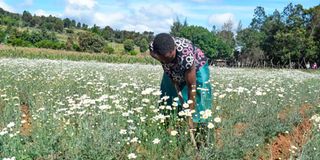
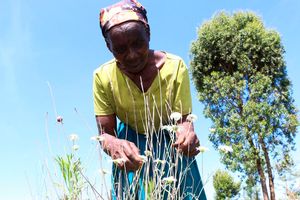
A farmer in Eburu, Gigil sub-county tends to her pyrethrum crop in her farm. Production of the crop is dwindling due to poor market prices and lack of government's support.
Photo credit: Boniface Mwangi | Nation
He said a special audit should be undertaken on the company to establish its financial status, confirm the asset base and determine the amount of money required to be pumped into turning the outfit around.
In the 2017-2018 financial year, for example, the organisation, according to the Auditor-General’s report, paid Sh20 million to casual workers for work not done, digging a hole in its books of accounts.
“If the government is serious about making agriculture economically viable and creating job opportunities, the pyrethrum sector is a low-hanging fruit, as all the farmers require is seedlings and assurance that they will be paid regularly for the delivery of their produce,” Mr Mainek said.
Mr Joseph Mwangi, the Nakuru Pyrethrum Growers Union chairman, said low-quality seedlings, poor agronomic practices, low prices for the flowers and delayed payments had discouraged farmers from engaging in large-scale production.
“The government should re-look at the operations and funding of the pyrethrum sector, give it the attention it requires and, within a short time, the results will be tangible, far more than in other sectors in the agribusiness chain,” Mr Mwangi stated.
The government is seeking to revitalise the industry, with the draft Crops (Pyrethrum) Regulations, 2026, being spearheaded by the Agriculture and Food Authority (AFA) before Parliament.
It intends to cure issues related to the registration of all stakeholders, licensing, mainstreaming of markets and importation of pyrethrum products.
Dr Paul Kipronoh Ronoh, the Principal Secretary for Agriculture, said strategic investments in pyrethrum were already providing tangible improvements in productivity, with huge potential for farmers to expand the land under the crop and increase their earnings.
“The government is committed to streamlining the operations in the company, helping farmers [with] certified seedlings, highly productive clones, expanding market access, paying farmers on time and improving their livelihoods,” Dr Ronoh said at Kapkoros Tea Factory in Bomet County a week ago as he pitched for diversification in farming.
Dr Ronoh said the PPCK was responsible for the production of certified seeds and seedlings for farmers and registration of growers.
The county governments have been roped into efforts to revitalise the sector by supplying farmers with seedlings.
Mr David Kones, the Nakuru Deputy Governor, said recently that Sh146, 411,264 worth of seedlings had been supplied to 10,995 farmers in the last five years.
Similar efforts have been made in Bomet, Kericho and West Pokot counties, but with far less funding for the sector.
Placing PPCK in the Treasury has been an issue, with stakeholders stating that it should revert to the Ministry of Agriculture.
But the argument in government is that the company is being repositioned to become commercially viable and beneficial to farmers.