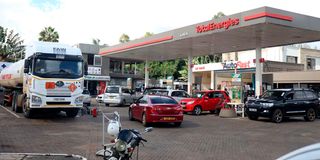
A creeping fuel shortage is taking hold across parts of Kenya, with motorists in several regions reporting empty pumps, rationing and long searches for petrol and diesel, even as the government maintains that national reserves remain stable.
In Nairobi along Langata Road, one of the capital’s busiest corridors, several petrol stations have run dry or resorted to rationing supplies. Motorists are moving from one station to another in search of fuel, often without success.
“I have had to go to close to five petrol stations. This is where I have finally found fuel. There is an acute fuel shortage,” said Marvin Ogeta, a taxi driver who eventually located a station along Lang’ata Road with limited stock.
At another station, an attendant who requested anonymity as he is not allowed to publicly comment, said petrol was unavailable, with only diesel remaining in stock for now. Fresh deliveries, they said, were expected but not guaranteed. The shortage has forced drivers to adjust their routines, with fewer trips, more cautious driving and growing concern over costs.
“There is certainly a need to adjust on the driving habits and the number of trips that you make as a motorist. I am also becoming keen on the number of trips that I make to ensure everything adds up at the end of the day,” Mr Jon Mutua, a motorist in Karen said.
Even as these scenes unfold, Energy Cabinet Secretary Opiyo Wandayi has maintained that the country’s fuel supply remains secure. The Government to government import arrangements, he said, continue to hold despite disruptions in the Middle East.
The Petroleum Outlets Association of Kenya, the national umbrella body representing stakeholders, declined to comment on the reports of fuel shortages in some petrol stations. CEO John Njogu and Chairman Martin Chomba referred the Nation to the Energy and Petroleum Regulatory Authority, which did not immediately respond to our enquiries.
Total Energies Petrol Station in Karen, Nairobi on March 21, 2026.
Photo credit: Bonface Bogita | Nation Media Group
In the North Rift, the shortages are more severe and more consequential. Across towns including Eldoret, Kitale, Kapsabet, Bungoma and parts of West Pokot, diesel is in short supply, with many filling stations exhausting their reserves entirely.
The timing is difficult for farmers who are in the middle of the planting season. Many depend on diesel powered machinery, and without it operations are slowing or stopping altogether.
“The unexpected fuel shortages have significantly affected our operations,” said Thomas Kwambai, a large-scale farmer near the Elgeyo border. “We require a steady supply to power our machinery during this planting season.”
Public transport is also affected. Matatu operators and boda boda riders are cutting trips or halting services as fuel becomes harder to find.
“It is increasingly becoming difficult to get fuel,” said John Korir, a boda boda rider in Eldoret. “We are being forced to reduce trips or suspend operations. That will increase fares and hurt passengers.”
For many motorists, the effects are immediate. There is reduced income, higher costs and growing uncertainty. Fuel station operators attribute the shortage to supply disruptions, including delays in deliveries from depots, though few can identify a specific cause.
“It is increasingly becoming difficult to get fuel forcing us to reduce number of trips or suspend operations. The shortage will result in increase in fare which will hurt passengers,” said John Korir, a boda boda raider in Eldoret city.
“Most of us depend on this business for survival and the fuel shortage means there is no income to support our families,” added Mr Korir.
In Kisumu, Homa Bay and Kisii counties, a spot check at most petrol stations showed normal traffic, with attendants saying they had not reported any shortages.
At Kisii Mashauri Total Petrol Station, an attendant who declined to be named said they had been receiving fuel as usual despite concerns over a possible rise linked to the war in other parts of the world.
Motorists refuel their vehicles at a Shell petrol station in Karen, Nairobi on March 21, 2026.
Photo credit: Bonface Bogita | Nation Media Group
In Homa Bay, most petrol stations were operating normally with no sign of a fuel crisis, as boda boda operators and public service vehicles lined up to refuel. Geoffrey Odhiambo, a supervisor at IMI Energy in Rodi Kopany, said their current supply would last about three days, adding that they had asked their supplier to deliver more fuel before stocks run out.
“We have told our supplier to bring more fuel on Wednesday when we expect our stock to run out,” he said.
Mr Odhiambo added that their suppliers have not told them or potential crisis following the war in Asia.
“We have our fingers crossed that it will not get to a point where fuel stations run dry,” he said.
He said suppliers had not indicated any looming disruption linked to the war in Asia and expressed hope that the situation would not deteriorate to the point of stations running dry.
At the same time, global pressures are tightening. Rising tensions in the Middle East, particularly the ongoing conflict involving Iran, are threatening shipping routes and increasing the risk of supply interruptions. The Strait of Hormuz remains a critical oil transit corridor. Industry analysts warn that logistical costs could rise, with wider effects on the economy.
“The geopolitical conflict will make Kenya lose over 20 percent of its Middle East export market,” said George Omuga, managing director of the East African Trade Association.
Such disruptions could also affect tea exports, especially if key buyers in Iran, Pakistan and the Gulf reduce purchases.
At the Port of Mombasa, early warning signs are emerging. Fuel transporters say they have been alerted to possible shortages at the Shimanzi petroleum depot in the coming days, particularly if incoming vessels fail to dock and offload on schedule.
“Wholesalers are rushing to secure their share,” said Abdi Hassan, a transporter. “We have been informed of the problem ahead.”
Hass petrol station in Karen, Nairobi on March 21, 2026.
Photo credit: Bonface Bogita | Nation Media Group
Shipping schedules offer little reassurance. Of roughly 60 vessels expected over a two-week period, only two tankers are carrying petroleum products.
These vessels expected include 23 container vessels, 24 conventional vessels mainly shipping iron and steel, vehicles, wheat and fertiliser, four feeder vessels, four tankers (2 petroleum products and palm oil), and another four transhipment cargo vessels and back loading.
Similarly, in the South Rift counties of Bomet, Narok and Kericho, fuel availability remains stable and prices unchanged. But even in these areas, caution is emerging.
“We have supply that will last for at least three days,” said Geoffrey Odhiambo, a station supervisor in Rodi Kopany. “We have asked for more fuel, but we are watching the situation closely.”
Reporting by Ndubi Moturi, Anthony Kitimo, Barnabas Bii, Vitalis Kimutai, Ruth Mbula, George Odiwuor