Kenyans are staring at a petrol shortage crisis beginning the end of this month, as the wave of global ramifications from the Iran war starts to hit home.
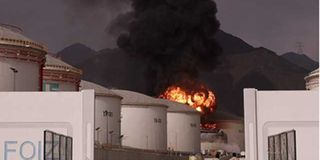
A major Abu Dhabi National Oil Company (Adnoc) refinery that produces Kenya and Uganda’s fuel supplies was hit in the ongoing war between the US, Israel and Iran, prompting its indefinite closure.
The company invoked the “force majeure” clause in the supply contract, indicating its inability to produce fuel for its clients.
The closure, coupled with fears over safety of ships sailing the Strait of Hormuz, has prompted a flurry of meetings in Nairobi this week as the Ministry of Energy and Petroleum and the fuel importing firms seek to avert a looming crisis.
Multiple petroleum industry sources have told Nation that Kenya could be less than three weeks away from a biting fuel shortage, going by the current stocks as shared in a daily report by the Kenya Pipeline Company. Being a landlocked country, Uganda also imports fuel through Kenya, putting Kampala in the same predicament with Nairobi.
US Navy sailors prepare for flight operations on the flight deck of the Nimitz-class aircraft carrier USS Abraham Lincoln in support of the Operation Epic Fury attack on Iran from an undisclosed location March 4, 2026.
Photo credit: Reuters
An industry executive at one of the leading oil marketing companies (OMCs) said the energy ministry is now pushing to get emergency supplies from India, Oman and Al-Fujairah as a stop-gap measure, with a vessel expected in the country in the first week of next month.
“For petrol, we do not have enough stocks to last us beyond March 28 and this could trigger a shortage unless a solution is found,” said one of the executives who sought anonymity to avoid reprisals from the government.
“We have been informed that a vessel carrying petrol is expected at the port around April 7. But the government is trying to get a solution to plug this gap by the end of March.”
Adnoc supplies petrol, while Saudi Aramco supplies diesel under a government-to-government deal that was signed in March 2023.
The G-to-G deal allows Kenya to import fuel on a credit period of 180 days. The Emirates National Oil Company is the third company in the G-to-G deal.
The three Gulf oil majors handpicked local firms to import the fuel on behalf of the industry, in the pact that was initially meant to avert a supply crisis of fuel at the peak of dollar shortage in the country in 2023.
Industry insiders say that one of the suppliers was expected to deliver a vessel with 85 million litres of fuel, but instead supplied 60 million litres after the ship failed to top up the fuel cargo due to the safety concerns along the Strait of Hormuz.
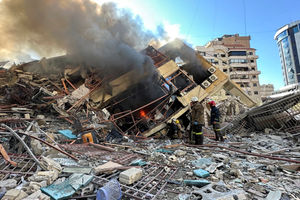
Smoke rises following an explosion, after Israel and the US launched strikes on Iran, amid the US-Israel conflict with Iran, in Tehran, Iran, March 2, 2026.
Photo credit: Majid Asgaripour | Reuters
The Energy and Petroleum Cabinet Secretary, Opiyo Wandayi, did not respond to Nation queries on the current fuel stock levels, or whether Kenya is looking for alternative suppliers in the wake of the escalation in the Middle East conflict.
Mr Wandayi is said to have held emergency meetings with the local oil companies that import fuel on behalf of Kenya under the G-to-G deal.
The Energy CS is said to be actively engaging the three Gulf oil giants for contingency plans to avoid disruption in supplies amid the escalating war in the Middle East, a conflict that also possesses a significant safety threat to vessels using the Strait of Hormuz.
An estimated 20 percent of the fuel used globally passes through the Strait of Hormuz. Iran has targeted the route in retaliatory attacks that have seen a vessels damaged in drone and missile attacks.
The Middle East war is a litmus test for the G-to-G deal that Kenya extended to 2028. The key questions is whether the contracts with the three Gulf firms can guarantee the country's supply of the critical commodity in times of crises.
Energy and Petroleum Cabinet Secretary Opiyo Wandayi.
Photo credit: Dennis Onsongo | Nation Media Group
Kenya currently lacks strategic reserves for fuel to outlast global shocks. The government relyes on Oil Marketing Companies (OMCs) that are required to have supplies to last at least 15 days.
An escalation of the war and a paralysis of vessel movement along the Strait of Hormuz could see the OMCs deplete all stocks for petrol, diesel and kerosene, triggering a full-blown crisis in the next one month.
US President Donald Trump has been sending mixed signals on the expected duration of the Iran attacks.
Details of the G-to-G deal have remained a heavily-guarded secret even as the country is exposed in the wake of skyrocketing global prices of crude oil. Under the deal, only premiums and freight are fixed, while the actual costs of the product are pegged on the prevailing global prices.
Global oil prices surged over $119 (Sh15,379.56) per barrel on Monday as major producers cut supply and fears of shipping disruptions mounted, setting the stage for costly fuel for the monthly pricing schedule from April 14.
Saudi Arabia, the United Arab Emirates and Bahrain have come under heavy attacks from Iran, with their oil refineries being targeted.
The attacks have prompted a resolution sponsored by the Gulf Cooperation Council (GCC) demanding that Iran stops attacking its Arab neighbours. The United Nations Security Council was expected to vote on the resolution yesterday.
Qatar's energy minister, Saad al-Kaabi, last week warned that the Gulf countries could shut down fuel exports within weeks if the Iran conflict continues and drives oil to upwards of $150 (Sh19,386) a barrel.
The Energy and Petroleum Regulatory Authority (Epra) will set the fuel prices for the month to May 14, 2026 based on this month’s global fuel prices. This means that consumers face costly fuel in a month’s time unless the government taps the fuel subsidy.
It is not clear if new fuel prices that are set to be announced on Saturday and remain in force for a month to April 14 will be impacted by the conflict, given that the supplies were sourced before the war started.