A court fight over the impeachment of Deputy President Rigathi Gachagua has brought to light the underlying governance structure of Kenya Kwanza, with petitioners arguing that President William Ruto’s administration was built on a “government-by-shares” policy that traded public office for political loyalty.
Thirty co-petitioners have amended their court filings, submitting the Kenya Kwanza coalition agreement as evidence to support their claim that the shareholding model Gachagua referenced was not mere rhetoric but official policy.
Part of the accusations leading to Gachagua’s 2024 impeachment concerned his remarks that the Kenya Kwanza administration was a “government of shareholders.”
“The charges of tribalism and ethnic polarization leveled against the fist Petitioner (Gachagua) are misplaced on account of the fact that whilst he may have made statements considered as polarizing by the society, in practice the sixth respondent – H. E. Respondent William Ruto – is and was more responsible for the ethnically skewed appointments of senior state and public officers,” reads the amended petition.
The petitioners argue that Article 21 of the coalition agreement, titled "Sharing of National Government Responsibilities," reveals that state appointments were allocated using political calculations rather than constitutional principles.
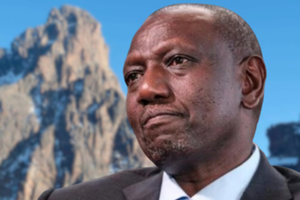
President William Ruto addresses worshippers at AIC Pipeline in Nairobi on February 08, 2026.
Photo credit: PCS
Signatories to the agreement included President Ruto, Ford Kenya leader Moses Wetang’ula (now Speaker of the National Assembly), and ANC leader Musalia Mudavadi (Prime Cabinet Secretary). Their positions in the government –Speaker and Prime CS- are captured in the agreement under “Sharing of National Government Responsibilities.”
The petitioners contend that the President enforced this agreement as a governing doctrine, ultimately leading to Gachagua’s impeachment—a move they seek to have declared unconstitutional.
"The signatories agreed to share public offices and resources. Upon the inauguration of President-elect William Ruto and Deputy President-elect Rigathi Gachagua, a government was established reflecting the shareholding concept outlined in the Kenya Kwanza Coalition Agreement," petitioner Peter Koira states in an affidavit.
A clause from the document reads: "ANC and FORD-Kenya shall have a 30% share of positions in the National Government, including Cabinet Secretaries, Principal Secretaries, Ambassadors/High Commissioners/Heads of Diplomatic Missions, Chairpersons of State Corporations, Directors of State Corporations, and Chairpersons and Commissioners of Constitutional Commissions."
The High Court case reframes Gachagua’s impeachment not as a personal dispute but as a broader conflict over governance principles.
The petitioners assert that the coalition agreement, signed before the 2022 elections, established a power-sharing formula based on electoral contributions from each partner. They argue that this arrangement solidified into governing policy once Kenya Kwanza assumed office.
"The government-by-shares principle was foundational to Kenya Kwanza’s governance," the affidavit states, claiming it dictated appointments and influence distribution across the state offices. The petitioners add that Gachagua’s “shareholding” remarks were consistent with how Kenya Kwanza actually governed.
Supporting their argument, the petitioners submitted comparative tables of appointments made in September 2022 and October 2024, covering Cabinet secretaries, principal secretaries, and heads of state agencies.
They allege these appointments followed coalition arithmetic rather than constitutional mandates of inclusivity, equity, and merit—a pattern that persisted even after Gachagua’s impeachment.
Additionally, the petitioners accuse President Ruto of tribalism, contending that the shareholding model fostered ethnic exclusion.
They attached data on over 500 presidential appointments, linking them to disproportionate representation of certain communities—a violation, they argue, of constitutional principles on national unity.
"Disparities in ethnic representation have been highlighted in National Cohesion Commission reports. None of the above National Government officeholders were appointed or nominated by the first petitioner (Gachagua)," the affidavit notes.
The petitioners also cite campaign-era remarks by the President to demonstrate that the shareholding concept was publicly promoted as Kenya Kwanza’s organising principle.
They assert that these statements, alongside the coalition agreement and appointment records, reveal a systematic conversion of political support into control over state resources.
Central to the case is whether Gachagua’s impeachment was a constitutional process or a political manoeuvre to enforce coalition discipline and redistribute influence.
The petitioners urge the court to examine whether a president can lawfully pressure Parliament to remove a deputy, warning that such actions undermine democracy and distort constitutional succession rules.
“The impeachment of the first Petitioner was secured through bribery and inducements. It was sponsored and engineered by the sixth respondent (President Ruto). In the premises the said impeachment is unlawful null and void for being an executive presidential project enabled by a Parliament that has been captured and lost its independence and autonomy,” reads the petition.
Their further arguments invoke constitutional provisions on sovereignty, national values, separation of powers, and institutional independence, asserting that appointments and removals must adhere to legal—not political—standards.
They maintain that the Constitution does not recognise "shareholders" in government and that treating public office as spoils erodes democratic integrity.
The Senate building in Nairobi on May 24, 2020.
Demographic data cited by the petitioners alleges skewed representation in senior offices, exacerbating divisions the Constitution seeks to heal.
Respondents—including the President, National Assembly, Senate, and Attorney-General—have yet to file their replies.
The petitioners seek declarations that the impeachment was unconstitutional, an injunction against electoral authorities acting on it, and a judicial affirmation that appointments must comply with constitutional—not coalition—standards.
They are asking for a ruling defining the boundaries between political agreements and constitutional governance, imposing stricter limits on translating coalition deals into state power. Oral hearings are set to begin on April 14, 2026.