To understand the underworld of Nairobi’s booming motor vehicle spare parts theft syndicate, one must first grasp the geography that feeds it; the maze of crowded back streets, dingy alleys and the many informal settlements wrapped around the capital’s commercial heart.
Curiously, all stakeholders— motorists, insurers, police and legitimate dealers — admit that theft of vehicle parts is getting worse, but none of them has access to accurate numbers.
From the chaotic corridors of Grogan and Kirinyaga Road to the hidden pathways of Ngara’s Kariuwa area, an invisible supply chain thrives daily, linking “expert” gangs, drug addicts, mechanics, hawkers and carefree spare parts dealers in a criminal enterprise that is leaving motorists counting losses.
Lately, the Toyota Harrier grill has become one of hottest parts in the thriving illicit trade.
A genuine Harrier grill fetches up to Sh80,000 but insiders familiar with the trade revealed that thieves who snatch the prized part from motorists often walk away with as little as Sh1,000.
“In fact, if someone gets Sh2,000, then that one must have negotiated very well,” a seasoned trader at Grogan who spoke to the Nation, on condition of anonymity for fear of being targeted, said last Thursday.
“Buyers know these boys are addicted to drugs and desperate for money. Sh1,000 is enough to keep them going for a few days... If anyone knows I am talking to you, then just know I may never be found again. This is serious business,” he added.
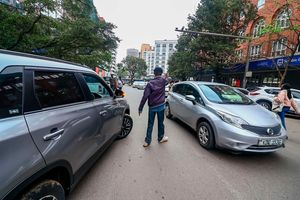
Preliminary investigations by police into the recent theft of a grill from a UN worker's vehicle have revealed that this syndicate relies on mechanics and hawkers for surveillance. Some are genuine mechanics and hawkers, others are purely spies checking on police presence, and give feedback to the criminals who usually target rush hour traffic or parked vehicles.
Nairobi Regional Commander Issa Mohamud said he has instructed his officers to go after this cartel.
One of his officers, who spoke in confidence, told the Nation that grills and side mirrors are currently the most targeted parts.
An Insurance Regulatory Authority (IRA) official said most of the targeted spare parts do not meet the financial threshold for cover, hence motorists are often left to foot replacement costs.
This also means that the industry regulator does not have an accurate database of parts most stolen, or vehicle models targeted by the syndicate.
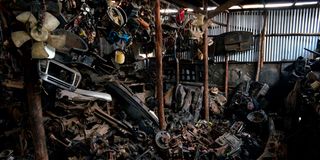
Motor vehicle spare parts discovered after a raid on a garage located along Outering Road in Nairobi.
Photo credit: Francis Nderitu | Nation Media Group
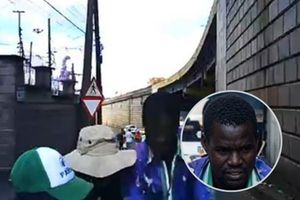
The spare parts dealer, who requested anonymity, took a Nation team through some of the streets that feed Nairobi’s black market spare parts network.
The journey began along Kirinyaga Road before snaking through Grogan — once Nairobi’s dominant second-hand spare parts hub.
Disruption from floods in March was not enough to wash away this hub, as business continues uninterrupted.
Mechanics, hawkers, street families and gang members mingle freely in the narrow pathways. Conversations appear casual, even friendly. But beneath the cordial interactions lies a highly organised criminal ecosystem.
“When mechanics need specific parts, they quietly alert these boys,” he explained as we navigated the crowded alleys. “Within hours, someone somewhere in town loses that part. Maybe while parked in town or stuck in traffic.”
Thieves are mostly young men, many battling drug addiction. Yet, some of the dashcam and CCTV cameras in compounds made public over the years show that they possess remarkable precision and speed when dismantling vehicle parts.
“They know exactly where to pull, where to hit and how to remove these parts in seconds,” the parts dealer said.
Thieves acquire this skill through orientation by mechanics. Repairmen, in collaboration with spare parts dealers, dictate which parts of specific vehicle models are in high demand.
From Grogan, the trail led toward Ngara, through a cabro-paved road bordering an informal settlement ominously known as Tsunami.
Many of the street families operating in Grogan, Kirinyaga Road and River Road sleep in Tsunami’s cramped structures.
Hidden among the shacks are houses allegedly used as “cleaning points” where stolen spare parts are repainted, polished and repackaged as imported “ex-Japan” products before re-entering the market.
The next stop was Nyayo Market in Ngara, a chaotic marketplace packed with thousands of spare parts, particularly Toyota components.
Here, transactions involving stolen parts happen discreetly and with military precision.
Suddenly, a young man approaches them briefly before disappearing. Minutes later, he returns, receives cash and vanishes again.
Only then does an attendant emerge from the shop carrying a spare part that had not been displayed publicly.
“What you just saw is a complete transaction,” our guide whispered.
“Most of these shop owners send these young boys to look for specific parts. Right now, grills are in high demand.” According to insiders, mechanics and traders often place “orders” for parts before thefts are executed.
Thefts are, therefore, rarely random. Instead, gangs operate according to market demand.
The iron-sheet structures cling tightly to the perimeter walls of tall buildings along Kipande Road. Narrow footpaths twist between the houses like tunnels.
Our guide pointed to a particularly narrow pathway linking Kariuwa A and B. The passage is barely wide enough for two people to squeeze through.
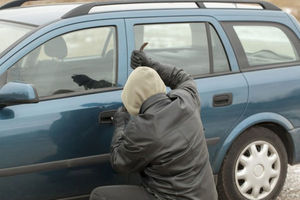
A thief breaking into a car.
Photo credit: Shutterstock
“Once a thief jumps into that path with your side mirror or grill, you will never catch him,” he said.
Victims who pursue suspects into the maze-like alleys often emerge empty-handed, if at all.
For motorists across Nairobi, the syndicate’s operations have become alarmingly brazen.
Peter Murima, chairperson of the Motorists Association of Kenya, said cases of vehicle vandalism and spare parts theft have escalated sharply in recent months.
“It is not just side mirrors and grills anymore,” he said. “They are now removing headlamps, rear lamps and even engine components. These people appear specially trained.”
In some incidents, parts are stolen in broad daylight within metres of police stations or during traffic jams on major roads.
A recent case involved a diplomat whose Toyota Harrier grill was ripped off along Ojijo Road, only a short distance from Nairobi Central Police Station.
Mr Murima identified a number of hotspots where motorists are increasingly vulnerable. These include Outering Road, Landhies Road near Machakos Country Bus Station, Globe Cinema Roundabout, sections of Waiyaki Way near the ABC area, Ojijo Road, Lang’ata Road and Limuru Road.
“The thieves now hop onto waiting motorcycles and disappear, mostly riding against traffic,” Murima said.
“There is need for more undercover officers on the streets so these criminals cannot easily identify who is police and who is not,” he added.
“This level of confidence suggests some form of political patronage because nothing meaningful is being done,” he said.
Asked on what is being done to curb the crimes being observed in the country, Traffic Commandant Fredrick Ochieng said these particular cases are of "criminal nature which do not fall under my docket Traffic department), but under the dockets of the General duties Police".
"Such cases are not reported to the traffic but to the stations (General duties) there l do not have the data of their commissions and as such can not tell whether it is on the increase or the decrease," he said.
Further follow-up with detectives handling the cases revealed that the syndicates involved are highly coordinated.
Officers say gangs rely heavily on informers disguised as mechanics, hawkers or roadside vendors who conduct surveillance and monitor police presence before alerting thieves.
An officer familiar with ongoing investigations said the criminals recently exploited reduced police deployment during the Africa Forward Summit.