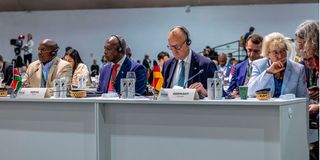
Deputy President Kithure Kindiki delivered Kenya’s impassioned plea for climate justice to a fractured global audience on Friday, at the 30th Conference of Parties which opened in Brazil’s Amazon gateway city against a backdrop of absent superpowers, logistical chaos, and fresh tragedy at home.
Speaking just days after devastating landslides in Elgeyo Marakwet claimed 32 lives and 17 others remain missing, Prof Kindiki painted a stark picture of a nation caught in climate change’s crosshairs.
“In Kenya, a once-in-a-century cycle of extreme droughts now alternates with devastating floods, wiping out lives, livelihoods and reversing hard-won development gains,” Prof Kindiki told world leaders gathered at the summit.
The Elgeyo Marakwet tragedy, the latest in a series of climate-linked catastrophes to strike Kenya, is among the human costs of what Kindiki described as broken promises and bureaucratic inertia.
“Every dollar delayed, every bureaucratic obstacle and every failed commitment has a human cost,” the DP declared, his words carrying the weight of fresh grief from the landslide that buried homes and families in the Rift Valley highlands.
Kenya arrived at COP30 with impressive credentials. The country has achieved 93 per cent renewable green energy from solar, wind and geothermal sources, with electricity access now reaching 75 per cent of the population, and 10.6 million of the nation’s 15.6 million households are connected.
The target, Kenya said, is to achieve 100 per cent green energy and universal electrification by 2030, while phasing out biomass cooking by 2028.
Yet these achievements stand in sharp contrast to the huge financing gap the country faces. Prof Kindiki revealed that of the $62 billion Kenya needs by 2030 to implement its climate commitments, only $50 million has been secured — a mere 0.08 per cent.
“The gap between promise and delivery is huge,” Prof Kindiki said, calling on the world to “cease to see Africa as an investment risk and see it as an economic opportunity.”
At a Leaders’ Roundtable chaired by Brazilian President Luiz Inácio Lula da Silva, Prof Kindiki pressed further, urging COP30 to address fossil fuel phase-out with clear timelines, establish a just transition mechanism, and plan for investment in renewable energy and green minerals.
He warned that current Nationally Determined Contributions put the world on “a glide path toward up to 2.7°C of catastrophic global warming.”
The Deputy President’s message was similar at a separate event at the COP marking 10 years since the Paris Agreement: developed countries must increase climate financing, structure it as grants rather than loans, and “forestall making the victims of climate change pay for their future survival.”
He warned that the $2 trillion funding gap threatening Kenya and Africa’s climate commitments could trigger “a climate-induced sovereign debt crisis.”
His appeal came a day after UN Secretary-General António Guterres opened the World Leaders’ Summit with an equally urgent warning.
“The hard truth is that we have failed to ensure we remain below 1.5 degrees,” Guterres said on Thursday, announcing that a “temporary overshoot beyond the 1.5 limit, starting at the latest in the early 2030s, is inevitable.”
Yet the message of urgency was delivered to a notably incomplete audience. Conspicuously absent were leaders from four of the world’s five largest polluters: China, the United States, India and Russia.
The US administration sent no representative at all, with top officials instead appearing in Greece alongside ExxonMobil as the company signed a new offshore gas exploration deal. This sparked backlash from the leaders in the room, who castigated US President Donald Trump for his remarks at the UN General Assembly referring to climate change as a hoax.
“Too many corporations are making record profits from climate devastation, with billions spent on lobbying, deceiving the public and obstructing progress,” Guterres said. “Too many leaders remain captive to these entrenched interests.”
Colombia’s President Gustavo Petro was more direct: “Mr Trump is against humanity. His absence here demonstrates that.”
Ireland’s Prime Minister Micheál Martin added: “If we are not prepared to tell our citizens the truth about this, we are failing them and this planet in the most profound way.”
The diplomatic discord was compounded by logistical nightmares. Many delegates, including the chairman of the African Group of Negotiators, remained stranded in São Paulo due to connecting-flight issues, while insufficient accommodation in Belém left those who did arrive scrambling for lodging. The conference venue itself is still under construction ahead of next week’s full summit opening.
Still, some saw opportunity in the chaos. “Without the US present, we can actually see a real multilateral conversation happening,” said Pedro Abramovay, a former Brazilian justice minister.
For Kenya and other African nations, however, the stakes are too high for diplomatic manoeuvring.