‘Care work is valuable work’: Experts call for adoption of National Care Policy

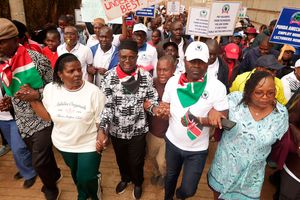
From left: Principal for Children Welfare Services Carren Achieng Ageng'o, Gender Cabinet Secretary Hannah Wendot Cheptumo and Gender and Affirmative Action Principal Secretary Anne Wang'ombe arrive at the KICC Amphitheatre, Nairobi, on the International Day of Care and Support, October 29, 2025.

What you need to know:
- Kenya is taking bold steps to value unpaid care work through the draft National Care Policy 2025 and new partnerships led by the State Department of Gender and UN Women.
- Gender PS Anne Wang’ombe shared her childhood memories of unpaid care work during Kenya’s celebration of the International Day of Care and Support.
- The event spotlighted efforts to formalise care work, promote gender equality, and recognise caregivers as pillars of the nation’s social and economic wellbeing.
She was always weighed down by endless care duties that consumed much of her childhood in the village. This was the reality for Gender Principal Secretary (PS) Anne Wang’ombe.
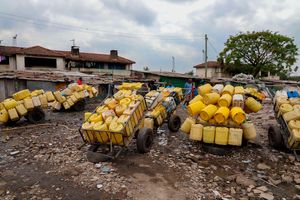
Anne recalled how she was tasked with caring for her grandmother. “While growing up as a young girl, I was often confronted by a lot of care work—fetching water, cleaning, and tending others. Much of this work is done by women and girls—unpaid, undervalued, and unseen,” she said on Wednesday during celebrations to mark the International Day of Care and Support at KICC in Nairobi.
The PS noted that women and girls continue to shoulder the bulk of unpaid care work, leaving them with little time for paid employment, education, or leadership roles. “Care work is valuable work. It is important that we share it equally between men and women. We must recognise all caregivers as we build a culture of care in the country—and men must be involved as allies and supporters of care work,” she emphasised.


Her experience mirrors that of millions of women across Kenya who continue to bear the invisible burden of unpaid care work. According to the Kenya National Bureau of Statistics, women spend three hours and 36 minutes more on unpaid care and domestic work than men each day. Among working populations, women spend three hours and 18 minutes more per day on such work than their male counterparts. Globally, women and girls perform more than three-quarters of all unpaid care work.
This year’s global celebration was held under the theme “Care and Support for All: Realising Human Rights of All Those Providing and Requiring Care and Support.” The Kenyan event brought together state and non-state actors to spotlight the economic and social importance of care work.
Faith Tsuma, a research officer at the International Centre for Research on Women (ICRW), urged that care be treated as essential infrastructure—recognised, resourced, and embedded in law and budgets. “That is how we unlock women’s economic power, expand decent jobs, and strengthen families across generations,” she said.
Faith noted that Kenya has already shown leadership through market-responsive care solutions, employer partnerships, and expansions in social protection. But she stressed the need for accelerators such as a clear legal anchor, dedicated budget lines, and a strong coordination unit to ensure sustainability across ministries and counties.
“Care jobs are skilled jobs. We must say it—and pay for it,” she declared, calling for competency frameworks, certification, recognised career pathways, and inclusion in labour law and social security.
She further recognised the significance of the Social Protection Act, 2025, which acknowledges unpaid and unsupported caregivers as beneficiaries. “At ICRW, we are committed to generating evidence and momentum for a robust care economy through initiatives like the Evidence to Policy for the Kenya Care Economy Project, which champions policies that enable women’s participation in the workforce and promote shared caregiving,” she added.
Edith Murogo, founder of the Centre for Domestic Training and Development, underscored that care work remains essential yet invisible, undervalued, and often unpaid or underpaid. She called for enhanced research and data on care work to measure the hours, needs, and value of the care economy in Kenya.
“We also need investment in care systems—government and private sector must fund subsidised childcare, eldercare, and disability care so that caregivers can engage in economic activity. This is not charity; it is smart economics,” she said.
Edith also urged the government to explore subsidised or part-time care facilities, similar to those in developed countries, to allow caregivers to work as dependants receive quality care.
Caregivers and activists at the event called for the ratification and implementation of International Labour Organisation (ILO) Conventions 189 and 190—addressing decent work for domestic workers and protection against workplace violence and harassment. The government reaffirmed its commitment to making care a cornerstone of socioeconomic development.
At the heart of this effort is the draft National Care Policy 2025, built around the Five Rs of Care—Recognise, Reduce, Redistribute, Reward, and Represent—a transformative framework to turn care from an invisible burden into a driver of gender equality and inclusive growth.
“Care work is not just a private responsibility; it is a public good and a cornerstone of national development,” said Hanna Wendot, the Cabinet Secretary for Gender.
Labour Principal Secretary Shadrack Mwandime confirmed that the process to ratify the two ILO conventions has begun. “We expect the conventions to be ratified soon. This will help protect our domestic workers both locally and abroad,” he said.
In May 2025, UN Women Kenya, in collaboration with the State Department for Gender and Affirmative Action, launched the Evidence to Policy for Kenya Care Economy Project across Kitui, Laikipia, and West Pokot counties. Supported by the Bill & Melinda Gates Foundation, the initiative promotes the Five Rs of Care and aims to make unpaid work visible, recognised, and rewarded.
The project is implemented with Village Enterprise(West Pokot), Hand in Hand Eastern Africa (Laikipia), and Anglican Development Services Eastern (Kitui)—building momentum for a fairer and more gender-equitable society.
Antonia N’Gabala Sodonon, UN Women’s Representative in Kenya, summed it up: “Care work remains undervalued, yet women and girls perform 85 per cent of it globally. Investing in care is not charity—it is a true driver of dignity, prosperity, and poverty reduction.”