'I'll be there for you': How abusive men use charm to manipulate women

Abusive men may appear kind, warm and humorous at first, making it difficult for women to recognise controlling behaviour.

What you need to know:
- Abusive men may appear kind, warm and humorous at first, making it difficult for women to recognise controlling behaviour.
- Counsellor Lundy Bancroft explains that abusive men use manipulation, blame and control to avoid responsibility for their behaviour.
One of the obstacles to spotting ongoing mistreatment in relationships is that many abusive men do not look like abusers. They have many good qualities, including kindness, warmth and humour, which hide their harmful behaviour, especially early in the relationship.
An abusive man is good at showing warmth at the start, by often making his partner feel special. This perfect beginning is part of almost every abusive relationship. There is an early pull of niceness that makes the victim feel comfortable and unsuspecting enough to lower her guard.
It is the power of those early months that hooks her and gets her attached. The charming start of a relationship with an abusive man can trap a woman. Like anyone in love, she tells her friends and family about her great man and his good points, and after praising him so much, she feels embarrassed to admit his later mistreatment.

When he starts abusing her, given how wonderful he seemed before, she assumes his abuse is something wrong inside him. She struggles to let go of her dream, since she believed she had found an amazing man. She starts wondering if she did something wrong or if something is deeply wrong with her, and easily looks for the problem within herself.
Also read: Does he love you or does he manipulate you?
A question people often ask psychiatrists is: When an abusive man is charming at the start, is he deliberately planning to hook her and mistreat her later? According to Lundy Bancroft, who has worked with abusive men for almost 40 years as a counsellor, evaluator and investigator, the answer is no.
As an abusive man falls in love, he dreams of a happy future together, just as the woman does. He pictures a future where the woman meets all his needs, is attractive and sexy at all times, has no needs of her own, and admires his brilliance and charm.
He wants a woman who will look after him and never complain about anything he does, or bring him down with her own frustrations and unhappiness. The abusive man is mostly unaware of these selfish fantasies.
He has no way of knowing that he is looking for a servant, not a partner. He uses the language of togetherness, which convinces his partner. “We are going to be really good for each other,” “I really want to be there for you,” “I'll help you study so that you can get that promotion.”
He believes his own promises, because he wants to see himself as a caring partner who does not use and disrespect women. When he begins to control her, he finds endless ways to convince himself it is not happening, or that it is her fault. Abuse is not his goal, but control is, and he ends up using abuse to gain control, which he deeply believes he is owed.
Lundy gathered deep knowledge and insight from more than 2,000 cases, before writing the bestselling domestic violence book, Why Does He Do That? Inside the Minds of Angry and Controlling Men. He began working with abusive men, alone and in groups, in 1987, while starting a programme called Emerge, the first agency in the US to offer special services for abusive men.
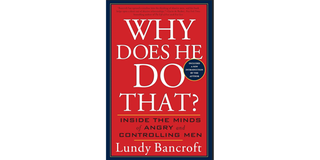
Cover of Lundy Bancroft's bestselling domestic violence book, Why Does He Do That? Inside the Minds of Angry and Controlling Men.
The men Lundy worked with used far more verbal and emotional abuse than physical violence, though most had been physically threatening or violent at least once. Just as important, the female victims of violent men described the same pain in their lives that Lundy saw in women who had suffered psychological abuse—showing that different forms of abuse cause similar damage.
One common, unhealthy pattern in an angry and controlling man is that he keeps telling you what to think, and tries to get you to doubt and ignore your own views and beliefs.
An abusive man builds the kind of relationship he wants through charm and lies, and expects to keep it that way forever. When he starts to put her down and frighten her, he blames her and paints her as the villain for not letting him lie and manipulate his way. Worse, he doesn't see manipulation as abuse.
Abusive men are clever, calculating, and avoid admitting the harm they have caused women and children. They blame the victim, lie outright, shift blame and twist the truth to justify their actions, and have habits of mind that stop them from treating women with respect.
Most abusive men only agree to join a counselling programme when their partners threaten to leave. They then twist their counselling sessions to suit their own hidden purposes, instead of taking responsibility and looking honestly at their own flaws. An abuser wants to stop his partner from seeing the real causes of his behaviour. So he will dodge, lie, and convince the people around him, including his counsellor, that he isn't to blame for the abuse.
An abuser wants to stay a mystery, to escape the consequences of his behaviour and avoid facing his problem. Part of how he avoids facing it is by twisting the truth and convincing his victim, with total confidence, that she is the cause of his controlling behaviour.
When he cannot control people or keep winning them over, he skillfully creates confusion to shift attention away. He will go to great lengths to convince everyone he is not at fault, and keep misleading people through clever, manipulative tricks. Going to therapy and claiming he is now a devoted Christian are just more tricks he uses to escape responsibility, avoid judgment, and keep abusing.
The writer is a novelist, Big Brother Africa 2 Kenyan representative and founder of Jeff's Fitness Centre (@jeffbigbrother).