‘If we're not counted, we don't count’: Crystal Asige demands special census for persons with disability

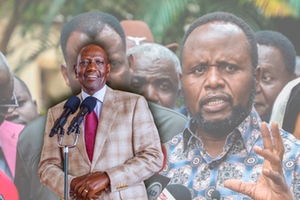
Senator Crystal Asige during a committee sitting at Bunge Tower, Nairobi, on April 10, 2025.

What you need to know:
- Comparisons between the 2009 and 2019 census reports reveal a sharp and unexplained decline in Kenya’s recorded disability population.
- Senator Asige now demands a standalone disability census, saying the true number of PWDs is far higher and that undercounting undermines planning, inclusion, programming, and rights-based policy implementation.
- She has secured buy-in from key stakeholders and now urges the government to swiftly roll out a national disability census to ensure that all Kenyans with disabilities “are counted".
Nominated Senator Crystal Asige, the sponsor of the Persons with Disabilities Act (2025), has embarked on a fresh campaign to push for a special census of persons with disabilities (PWDs) across Kenya.
During a media breakfast meeting on November 12, Senator Asige said the current national data does not reflect the true number of Kenyans living with disabilities and makes it difficult for the government to plan, budget, and implement inclusive programmes effectively.
Her call stems from the low number of PWDs reported in the last census. According to the 2019 Kenya Population and Housing Census, 916,692 people aged five years and above, equivalent to 2.2 per cent of the population, were recorded as having disabilities. Of these, 523,184 were women and 393,451 were men.


In contrast, the 2009 Census recorded 1,330,366 persons with disabilities, representing 3.5 per cent of the population, with women again forming the majority with 682,651, compared to 647,715 men.
“We absolutely must undertake this important data collection exercise,” she emphasised. “A special census will be the cornerstone for efficient and responsive programming, planning, budgeting and strategic execution of disability-related rights outlined in the new law. Without it, we can’t.”
Ms Asige contends that accurate data is the bedrock of inclusion. “If we are not counted, we do not count,” she asserted. “Only reliable data can provide the basis for good implementation by the Cabinet and all other relevant bodies.”
She described the disability community as one that embodies Kenya’s diversity and unity. “The disability voting bloc is not about gender or geography, county or class. It represents men, women, youth, orphans, the elderly, and all demographics. We must no longer agonise; we must now organise,” she said.
Since 2024, the senator has been laying the groundwork for the proposed census while popularising the newly enacted law. She said she has written to and met with key stakeholders, including the Kenya National Bureau of Statistics, President William Ruto, the Ministry of Labour and Social Protection, international partners, and public and private sector allies.
“I have shown them the research and the Sh1 billion budget required to make this happen. By and large, all of these people see the gaps and understand the importance,” she said. “So, there is buy-in, but at the end of the day, it is for the government to put its money where its mouth is and roll out a special census immediately.”
Her advocacy is informed by personal experience. Born with full eyesight, she gradually lost her vision during high school and university. “That means I have lived on both sides of the street as an undisabled girl and now as a disabled woman,” she said. “The journey from one side to the other has been both my heart and my knee, my confusion and my clarity, my prison and my hell.”
She recalled facing systemic barriers from inaccessible public buildings to social attitudes that treated disability as an afterthought or a source of shame. “I also watched my parents carry the emotional and financial burden of my healthcare, mobility, and education,” she added.
Those experiences, she said, shaped her resolve when she took the oath of office in 2022. “I wanted to turn this pain into policy,” she explained. “To draft something that didn’t just acknowledge our existence but actively contributed to our rights, independence, and dignity.”
Now, she said, the focus must shift from celebration to implementation. “Disability itself does not discriminate. It is just an identity like being black, like being a woman,” she said. “The time has come for us to count and to be counted.”