'We want girls to see themselves as scientists': How coding and mobile labs close Kenya’s gender Stem gap
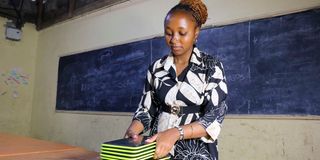
Linet Kamotho, co-founder of Space Shift Initiative, holds tablets at Kilimo Junior School in Njoro, Nakuru County, on March 18, 2026.

What you need to know:
- Young Kenyan women are using coding, innovation and Stem education opportunities to challenge inequality and transform communities nationwide.
- Mobile science laboratories are helping girls in rural Kenya improve Stem performance and pursue careers in technology fields.
Linet Kamotho’s journey into digital rights advocacy and activism was unexpected and accidental. It all began when the 22-year-old biochemistry student at Egerton University, wanting to keep busy and earn some money during a long holiday, told her aunt she planned to try online writing.
Instead, her aunt encouraged her to explore other digital skills, sending her the application link for the African Girls Can Code Initiative. “When I received the call that I had been accepted, I did not even know what coding was, and neither did my mum. I told her it was something like the coded language used by police officers,” she recalls.
Despite the initial confusion, her parents were supportive. However, the boot camp proved challenging as she often felt left out, surrounded by peers who seemed far more experienced. Linet struggled at first until she began seeking support from fellow learners and mentors. That is when something was ignited in her.


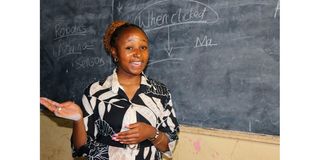
Linet Kamotho, co-founder of Space Shift Initiative, instructs her Grades 8 & 9 'Girls in Robotics' students at Kilimo Junior School in Njoro, Nakuru, on March 18, 2026.
The experience, alongside her role as a mentee and peer mentor, led her to the Siemens EmpowerHer programme, which sparked her passion for technology and youth empowerment. Soon, she no longer saw only the power of technology, but also its dangers. This realisation led her to co-found Space Shift, an initiative that raises awareness of cyberbullying, cybersecurity, digital skills, and access to online jobs for young people.
The African Girls Can Code Initiative helps girls embrace science, technology, engineering and mathematics (Stem). It is a UN Women-led programme in partnership with the African Union Commission and the International Telecommunication Union and equips girls and young women aged 17 to 25 with digital literacy, coding, robotics, and leadership skills. Launched in 2018, it aims to close the digital gender divide by promoting ICT careers for women across Africa.
Core activities of the initiative include camps involving intensive 10-day residential training sessions focusing on coding, design, robotics, artificial intelligence (AI), and cybersecurity. The programme also supports curriculum integration by mainstreaming coding and gender issues into national school curricula. In addition, it focuses on networking and mentorship by providing an online platform that connects participants with women working in ICT.
Participants gain technical skills and develop digital solutions to local problems, such as creating websites addressing social issues. Since 2018, the programme has trained hundreds of young women, supporting career development and digital literacy. It also promotes the safety of women and girls online by addressing technology-facilitated gender-based violence.
By October 2025, about 213 girls and young women in Kenya had directly benefitted from the African Girls Can Code Initiative since its launch in the country in 2022. Annmaria Kerubo, a software engineer and beneficiary of the initiative, describes it as godsend, saying it opened doors for her in the technology industry. The initiative also opened her eyes to the realities of the digital gender gap and the need for greater representation of women in technology.
“Engaging in the initiative truly reignited my passion for developing solutions that support women and advocating for girls pursuing careers in technology,” she says.
Her passion for solutions supporting women later became evident through her work on Malaica, a platform designed to ensure safer and more joyful pregnancy journeys for women in Kenya.
Dan Bazira, Deputy Country Representative for UN Women in Kenya, says that through initiatives such as the African Girls Can Code Initiative and Digital Platforms Kenya, his organisation, working alongside partners, is expanding access to digital skills, innovation spaces, and mentorship opportunities.
“This is enabling girls to use AI to solve real-world challenges in their communities. When they are given opportunities in tech, they do not just close gaps; they create new paths and redefine what innovation looks like,” he says.
The Girls Excel Initiative
The initiative, spearheaded by Echo Network Africa Foundation in partnership with the School Equipment Production Unit, seeks to enhance girls’ uptake of Stem subjects in primary and secondary schools. It was launched last year, and the foundation has already donated 13 mobile laboratories to 12 schools across 12 counties.
The mobile laboratories are expected to play a key role in helping girls undertake science practical lessons and embrace science subjects. The initiative also involves establishing Hesabu clubs in participating schools to help girls embrace mathematics and demystify science subjects. In addition, Stem kits are awarded to girls who excel in science to motivate them further.
According to statistics from the Ministry of Education, only 40 per cent of schools have computer laboratories. Government data also shows that girls remain underrepresented in Stem subjects, a situation linked to unequal gender norms.
“We want girls to begin seeing themselves as scientists. They have what it takes. For years, we have complained that girls are not taking up science subjects. It is time we act and change that narrative,” says Dr Jennifer Riria, chief executive officer of Echo Network Africa Foundation.
The mobile laboratories allow schools in remote areas to share resources, giving students hands-on experience in science. “It is exciting to carry out research and discover something at the end. These labs will help girls learn by doing,” Dr Riria adds.
Research conducted by Echo Network Africa Foundation at Kangaru Girls’ High School has already shown promising results. “In three years, girls who previously scored D+ grades in science improved to B grades. Five of them even joined university to pursue science courses,” Dr Riria says, stressing that empowering women is key to building a strong nation while calling on well-wishers to donate mobile laboratories to schools of their choice.
Sarah Muhoya, Chief of Party at Echo Network Africa Foundation, called for partnerships to sustain the programme. “There are more than 28,000 public primary schools, yet this first donation will only cover 15. This is just a drop in the ocean. The government alone cannot do it. We all have a civic duty,” she says.
More than 1,200 students have already received hands-on Stem education through the deployment of mobile science laboratories and dignity kits in 14 schools across 12 counties. Many schools in rural Kenya continue to face challenges caused by a lack of laboratories and proper equipment, making practical lessons almost impossible.
Elizabeth Kigia, a teacher in Nairobi, says the lack of laboratories has forced teachers to become innovative in conducting practical lessons. “When I was trained as a teacher, I was taught to be innovative. So when we lack the necessary equipment, we try to improvise and see whether we can still carry out some of the practical lessons,” she says.
Evelyn Owoko, Director of Basic Education Quality Assurance, says Stem accounts for 60 per cent of the new competency-based curriculum. “We, therefore, expect all learners to actively engage in Stem. All institutions of learning from Grade 10 onwards will be offering Stem courses,” she says.
Allan Weche, a representative from the School Equipment Production Unit, says the mobile laboratory is an idea whose time has come, noting that it is affordable for many schools. “The mobile laboratory concept offers a local solution in the absence of permanent laboratories to bridge the gap. They can be used anywhere, including under a tree or inside a tent,” he says.
One of the programme’s key impacts has been improved academic performance. At Mung’etheele Primary School, a recipient of one of the laboratories, the number of top scores in integrated science rose from zero to four within a single term after the laboratory was delivered.
“We observed a significant shift in career aspirations. Students who previously aspired to become English teachers are now choosing Stem pathways, hoping to become doctors and integrated science teachers,” Sarah says.
The organisation notes that the mobile laboratories have already transformed Stem learning in 16 schools across 14 counties. “We need more support to scale up this impact across the country and ensure every girl in Kenya has the opportunity to engage in Stem and shape her own future,” she adds.
About 1,600 public senior secondary schools in Kenya lack functional laboratories, a major challenge to the transition to competency-based education. Reports further indicate that more than 90 per cent of junior schools do not have science laboratories.


