‘We want girls to see themselves as scientists’: Inside Kenya’s bold Stem push
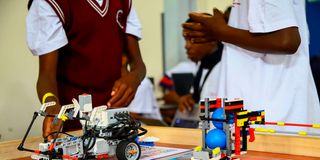
Young innovators at Nova Pioneer School in Tatu City, Kiambu County, on June 28, 2025.

What you need to know:
- New initiative equips rural schools with mobile labs, encouraging girls to pursue science and mathematics.
- Stereotypes, poor infrastructure hinder girls in Stem; practical tools and role models offer solutions.
Despite progress in narrowing gender disparities in access to education, a new study reveals that girls and women in Kenya continue to be underrepresented in science, technology, engineering, and mathematics (Stem) subjects and leadership roles.
The study, conducted by the African Population and Health Research Centre, surveyed 4,662 learners across 250 schools in 10 counties. While access to education has improved overall, participation by female learners and teachers in Stem remains critically low.
A key barrier identified is the persistence of gender stereotypes – beliefs that Stem is better suited for boys, while girls are naturally inclined toward languages and humanities. These stereotypes appear to influence subject choices, especially during the transition from Form 2 to Form 3 under the outgoing 8-4-4 curriculum.


Findings show that fewer girls than boys intend to pursue physics in upper secondary school—only 20 per cent of girls expressed interest, compared to 33 per cent of boys. In contrast, 85 per cent of girls reported plans to take Christian or Islamic Religious Education, compared to 78 per cent of boys.
The low enrolment of girls in Stem has sparked ongoing debates among educators, policymakers, and gender advocates. However, a new intervention may offer a glimmer of hope. The Girls Excel Initiative, spearheaded by Echo Network Africa Foundation in collaboration with the School Equipment Production Unit (Sepu) under the Ministry of Education, is working to improve girls’ participation in Stem at both primary and secondary school levels.
This initiative aims to dismantle stereotypes, provide necessary resources, and encourage more girls to envision a future in science and technology. Echo Network Foundation has donated 13 mobile laboratories to 12 schools across 12 counties. The mobile labs will be instrumental in helping girls to do their science practical and making them to embrace science subjects. The initiative also entails establishment of Hesabu clubs to help girls embrace mathematics and to demystify sciences. It includes awarding Stem kits for girls who excel in sciences with a view to motivating them.
According to statistics from the Ministry of Education, only 40 per cent of schools in Kenya have computer laboratories. Government data shows that girls are underrepresented in Stem subjects, a situation traced to unequal gender norms. “We want girls to begin seeing themselves as scientists. They have what it takes. For years, we have complained that girls are not taking up science subjects. It’s time we act and change that narrative,” said Dr Jennifer Riria, the CEO of Echo Network Africa Foundation.
The mobile labs will allow schools in remote areas to share resources, giving students a hands-on experience in science. “It’s exciting to carry out research and find something at the end. These labs will help girls learn by doing,” Dr Riria added.
Research by Echo Network Africa at Kangaru Girls’ High School has already shown promising results. “In three years, girls who previously scored D+ in science improved to B grades. Five of them even joined university to pursue science courses,” she revealed.
Empowering women
Dr Riria stressed that empowering women is key to building a strong nation. She asked well-wishers to donate one mobile laboratory to the schools of their choice.
Sarah Muhoya, the chief of party at Echo Network Africa Foundation, called for partnerships to sustain the programme: “There are over 28,000 public primary schools, yet this first donation will only cover 15. This is just a drop in the ocean. The government alone cannot do it. We all have a civic duty.”
Each mobile laboratory costs about Sh200,000. “This is achievable. Corporates, individuals, and counties can step in. Let’s stop complaining and start creating solutions,” Ms Muhoya said.
Through the initiative, Echo Network Foundation envisions a bright future where more sensitization, through mentorship, will be made to ensure equal access, quality education and empowerment for girls and women in Stem. The initiative also entails strengthening of Stem clubs (Hesabu clubs) to give girls hands-on Stem skills creating problem solvers, critical thinkers and self-confident girls.
Many schools in rural Kenya have been experiencing challenges, with lack of laboratories and proper equipment making practical lessons almost impossible. Evelyn Owoko, the director of quality assurance at Basic Education, revealed that Stem accounts for 60 per cent in the competency-based education. “We expect all learners to be active in Stem. All institutions of learning in the country from Grade 10 onwards will be offering Stem courses,” she said.
Allan Weche, a representative from Sepu, observed that the mobile labs are an idea whose time has come. He said mobile laboratories are affordable, hence it’s easy for many schools to acquire. “The mobile laboratory concept is coming as a local concept to offer solutions in the absence of permanent laboratories to bridge the gap. They can be used anywhere including under a tree and in a tent,” he said.
Some of the students, who attended the launch, lamented that lack of laboratories in schools has hampered science studies. “Lack of requisite laboratory apparatus has been making us only have theory lessons in sciences. We have not been having practical lessons, which are part and parcel of learning and integral part of the national exams. This has been disadvantageous in comparison to schools with laboratories,” said a student who attended the launch.
One of the teachers said lack of laboratories has forced them to be innovative to conduct practical lessons. “When I was being trained as a teacher, I was taught to be innovative. So, when we lack the necessary equipment, we try to innovate and see if we can carry out some of the practical lessons,” he said.


