After the gunshots: Women rebuilding lives scarred by banditry
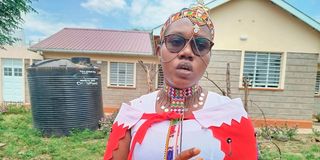
Angela Nachipai, a member of the minority Ilchamus community in Kiserian village, Baringo South. She was among the hardest hit by banditry-related insecurity, forced to separate from her parents when the family scattered.

What you need to know:
- One night in 2011, dozens of armed criminals stormed the insecurity-prone village and stole hundreds of livestock belonging to several homesteads.
- Irine and her family sought refuge in a nearby bush as gunshots rent the air for hours.
- The bandits shot her uncle dead and drove away his goats and cows.
For Irine Kiplagat, 25, the sound of something falling is enough to make her heart skip. It is a reflex built over years of living through bandit raids in Ramacha village, Baringo South, which killed her uncle, wiped out her family's livestock and scattered her community.
One night in 2011, dozens of armed criminals stormed the insecurity-prone village and stole hundreds of livestock belonging to several homesteads. Irine and her family sought refuge in a nearby bush as gunshots rent the air for hours. She says fleeing to a safer place, including hiding in bushes, is often a better option than staying put in the house during a raid.
That night, her uncle, Daniel Kipkulei, had just returned home after a long day herding livestock when he heard screams from the neighbourhood. Before he could work out what was happening, the bandits were already at his doorstep. They shot him dead and drove away his goats and cows.


Ramacha's exposure to repeated attacks has long forced residents to flee when raids strike and return only when calm is restored. After the attack that killed her uncle, villagers fled to neighbouring Karma and Kapindasum villages, save for a few who stayed behind to guard their homes.
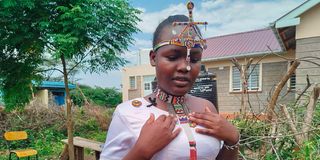
Irine Kiplagat, a resident of the once porous Ramacha village in Baringo South, during an interview at Marigat Integrated Primary School on August 2, 2025. She recounted the trauma she endured from incessant banditry attacks, which forced her family into displacement, stripped them of their livelihood, and claimed the lives of some of her relatives and neighbours.
"We lived some distance from my deceased uncle's house and the other villagers who were attacked that fateful evening. Though the affected people fled the village that night, my father insisted that we remain behind because we could not drive away the hundreds of livestock we had then," Irine says.
"The fleeing villagers had driven their livestock far away. Our homestead was the only one remaining with livestock in the village. I remember people feared sleeping in our home at the time because they claimed the criminals would come for the livestock. We would cook our evening meal very early, and by 5pm we would lock ourselves inside the house waiting for any eventuality," she adds.
A second, deadlier raid
More raids followed, but 2013 brought the worst of it. More than 100 armed criminals descended on the village and killed three people, including a young boy, before driving away hundreds of livestock.
"On that particular night, more than 100 bandits had struck our village and other neighbouring villages at once. The locals wailed, alerting people to flee for safety following the killings. We fled to Karma village, but on seeing us, the villagers there also fled, fearing the bandits would follow us to our destination. There was confusion everywhere. After three days, all our livestock were also stolen," Irine recalls.
"It was very disturbing because I was barely 13 years old at the time, and the boy who had been killed was my schoolmate at the neighbouring Kapindasum Primary School. The raid left my father badly shaken after the loss of more than 500 goats and cows. For a week he stayed in the bush, refusing to face reality, until he came to terms with the fact that the animals were gone," says Irine, the second-born in a family of seven.
The attack scattered the village, with relatives and neighbours going their separate ways; some settling in Marigat, Kimalel, Kimorok, Mochongoi, and other areas. Her family sought refuge in Kabel village, tens of kilometres away, where they rented a house after losing all their livelihood to the raiders.
"We were unable to carry anything after the attack, and for several years it was very difficult to cope because all our livestock had been stolen. We parted ways with our neighbours and relatives as everyone went in different directions. We had to adjust to a new life, struggling even to secure the basics," she says.
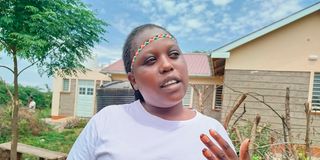
Salina Lekireu, a resident of Mukutani in Baringo South, during an interview at Marigat Integrated Primary School. She lost all her family's livelihood to banditry and stock theft in the past, and was forced to flee her home due to persistent insecurity in the area.
The frequent raids and killings left a lasting mark.
"The killing of my uncle and the schoolboy, together with the spate of raids and gunfire, affected me deeply. When night fell, I would relive the events, fearing they would happen again, even after we moved to a safer village. Even now, when something falls, my heart skips because of the gunshots we heard as children. I have never truly known peace because of what I endured in my childhood," she explains.
Losing her friends and relatives to the scattering that followed the attacks made things worse, she says. Many families in the area were left not only without their livestock, their main source of livelihood, but also without their kin, fuelling widespread trauma among locals. Irine remembers the countless nights they were forced to sleep in the bushes when bandits struck.
"It has taken me several years to adjust to living in a new place. I often think about how my childhood friends back in the village are coping, where they moved to, my teachers, and even some of my relatives. I sometimes harbour bitter feelings when I remember the bandits who turned our world upside down," she says.
It was only recently, at a forum in Marigat town that brought together more than 50 women from insecure villages battling mental health struggles that Irine got the chance to speak about what she had been carrying.
She says she had never received any psychosocial support since her family was displaced 12 years ago, and that the forum marked the start of her healing process, giving her a chance to share her problems with others who had lived through the same thing.
"Several people in the banditry-prone villages are struggling with mental health issues because of what they witnessed and endured. My cousin was forced to drop out of university after developing mental health problems, as her family had been reduced to paupers by the raids and could no longer afford her fees. One of my uncles has also turned to alcohol after losing all his peers, who were shot dead by bandits in the grazing fields," Irine says.
"This forum has helped me a lot, because I have had the chance to share my worries and also receive counselling. We have shared this forum with women from neighbouring communities who have also borne the brunt of banditry. We have vowed to help each other rise above our problems, and help others in banditry-prone villages who are still battling trauma," she adds.
Women left to carry the burden
Salina Lekireu, from the banditry-prone Mukutani area, says her community has endured near-constant attacks for the last two decades, a burden that falls hardest on women, since they are the ones left at home with children when men head out to confront the raiders.
"During attacks, men mostly pursue the attackers, and women are left behind with children, forced to cope under difficult conditions, including sleeping in the bushes without basic necessities like food and clothing. It is during these times that they undergo a lot of trauma, owing to the challenges," Salina explains.
She says she suffered trauma after bandits stole all her family's livestock. They fled their home for safety, and their empty house was vandalised and torched by the attackers.
“This trauma and healing training has helped us greatly, especially women who have borne the brunt of banditry, to become our sisters’ keepers. Some people cannot cope with the challenges and may sink into depression, develop mental health issues, or even resort to suicide. By sharing our problems, we realised that others face even bigger struggles. I feel healed, and I have made a promise to reach out to others facing similar challenges," says Salina, a mother of three who was forced to raise her children single-handedly through it all.
A school morning, shattered
Angela Nachipai, from Kiserian in Baringo South, also suffered trauma from repeated attacks and livestock theft in the area, which led to the killing of dozens of people and the displacement of many others.
She recalls an attack in 2005, when bandits struck the village one morning while she was at school.
"The bandits had struck the village a few minutes after the morning break, and it was helter-skelter for everyone as gunshots rent the air. During the raid, several people were killed and livestock driven away. Locals also fled the village to safer areas," Angela says.
She was separated from her parents after the attack and was hosted by relatives, alongside her younger siblings, before the family was reunited.
"It is the worst experience that I don't want to remember, because when we fled the attack that happened while we were at school, we were forced to wear our school uniform for months, since that was the only clothing we had. We didn't get time to go back home for our things," she says.
"The displacement also affected our studies, because we kept moving from place to place until sanity was restored. It remained a scar, and each time I remember what happened, I cry. Our parents lost all their livestock to the incessant raids. The psychosocial support in this training has helped a lot in turning around a bad experience and moving forward. I also want to reach out to my fellow villagers," she adds.
Support finally reaching the women
The women's accounts emerged during a training for young mothers drawn from the banditry-prone Baringo North and Baringo South sub-counties, held at Marigat Integrated Primary School and organised by Action Aid.
Susan Wamalwa, managing director of the International Centre for Peace, Human Rights and Development, says the training targeted young women affected by conflict-related trauma, in a county where insecurity has taken its heaviest toll on young women, girls and children.
"We are looking at how conflict contributes to trauma in the affected villages. Our approach is engaging young women as champions to address conflict-related trauma within their communities, by creating spaces for healing and equipping them with the skills to train other people," Wamalwa says.
Neline Rulia, a project officer with the African Women Voices for Peace project, run by Action Aid, says the training was meant to build a pool of women trainers who would go on to reach other affected women in their communities.
"In this first training, we targeted 50 women who will go on to be trainers in the community. We want them to heal psychologically and rebuild their lives," Neline says.
She adds that more than 480 women in the affected areas have been widowed by banditry, after their husbands were killed by bandits.
For Irine, Salina and Angela, the raids of 2005, 2011 and 2013 remain years apart in the calendar but close together in memory. Displaced, widowed or orphaned, they now carry the further work of piecing their lives, and their peace, back together.


