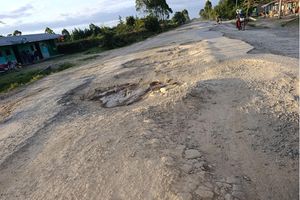
In Turkana’s Suguta Valley, a classroom can be a roofless shell battered by desert winds, a health centre can be a fragile shelter of sticks and branches and a simple search for water can mean walking into territory haunted by bandit attacks.
For the families of Nadome, Kamuge, Ng’ilukia and Lomelo villages, life is not only shaped by insecurity but defined by what is missing because here, development remains a distant promise.
In Nadome, children continue to report to school every morning despite harsh conditions and persistent insecurity that has for years shadowed the valley.
An aerial view of manyattas at Lomurek Village in Suguta Valley, Baragoi. Despite being semi-arid, this region is frequented by tourists travelling to experience its beautiful landscape.
Photo credit: File | Nation Media Group
Their determination reflects the hopes of parents who have embraced government calls to surrender illegal firearms and ensure their children remain in school under the 100 per cent transition policy.
Of the school's three permanent classrooms, two lost their roofs to strong winds. The only remaining classroom now serves as a learning space, staffroom, library and food store all at once.
With no trees in the vast, arid landscape to provide shade, pupils are exposed to the full force of scorching heat during the day and sudden storms when the weather shifts. Learning takes place under conditions that many schools elsewhere would consider impossible.
Several kilometres away in Kamuge village, residents speak of a different challenge.
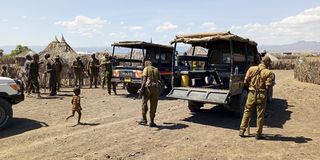
Their lives revolve around the Lokori–Kapedo road, a key corridor that has effectively become a controlled security zone as authorities intensify operations against banditry in the Suguta Valley.
Homesteads lie on either side of the road but movement is restricted through designated entry and exit points. What should be a vital trade and transport route has become a heavily monitored space, limiting economic activity and access to essential services.
For residents, daily life has become a delicate balance between security concerns and the need to earn a living.
In neighbouring Ng’ilukia village, the absence of healthcare is most painfully felt during emergencies.
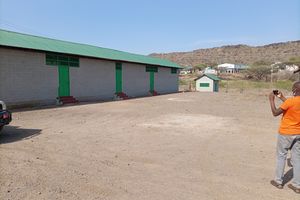
An unfinished building intended to serve as a health centre stands abandoned, a symbol of stalled promises. In its place, residents rely on a temporary structure built from dry tree trunks and branches.
East African Community, Arid and Semi-Arid Lands (Asals) and Regional Development Cabinet Secretary Beatrice Askul commissioning the first ever water project at Ng'ilukia village in Suguta Sub-County within the dreadful Suguta Valley on June 13, 2026.
Photo credit: Sammy Lutta | Nation Media Group
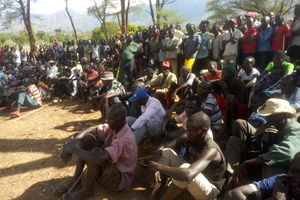
The makeshift shelter doubles as a venue for public meetings and community gatherings — a stark illustration of how residents are forced to stretch limited resources to meet multiple needs.
Across the Suguta Valley, stories of neglect are common.
Communities say they have endured years of isolation and abandonment, watching public projects stall, deteriorate or fall victim to vandalism. To many residents, the unfinished structures scattered across the region have become monuments to a widening development gap.
Derrick Ebenyo, a resident of Nadome, says insecurity remains one of the biggest obstacles to progress.
He points to Napeitom Primary School which was earmarked for renovation by the Kenya Defence Forces under Operation Maliza Uhalifu but remains unrepaired after being vandalised in 2022.
“Insecurity has made it difficult for us to access basic services. Bandits sometimes vandalise critical projects built by both county and national governments,” he says.
In Lomelo, educator Joseph Ekorkou believes the conversation should go beyond constructing new buildings. For him, the real challenge lies inside Early Childhood Development Education (ECDE) centres, many of which lack basic learning materials and furniture.
He argues that investments in desks, books, feeding programmes and food storage facilities would have a greater impact on enrolment and retention than simply putting up new structures.
“Children stay in school when the learning environment is supportive,” he says.
Turkana East Deputy County Commissioner Moses Karueki says ongoing multi-agency operations are targeting armed criminal groups in a bid to restore stability across the region.
He says the creation of the new Suguta Sub-County carved out of Turkana East, is expected to improve service delivery and strengthen security through increased deployment of government personnel.
Residents of Ng'ilukia village in Suguta Sub-County at one of their first ever community borehole constructed by Kerio Valley Development Authority under the Ministry of East African Community, Arid and Semi-Arid Lands (Asals) and Regional Development on June 13, 2026.
Photo credit: Sammy Lutta | Nation Media Group
As part of those efforts, Ng’ilukia village is set to receive five additional National Police Reservists who are currently undergoing vetting and training.
The project, funded by the Kerio Valley Development Authority (KVDA) at a cost of Sh8.2 million, is expected to benefit more than 3,000 residents who previously trekked long distances across the valley in search of water, often exposing themselves to bandit attacks.
Mr Karueki says improved access to water could significantly reduce movement-related insecurity while supporting more stable settlement patterns, particularly for families with school-going children.
Cabinet Secretary for East African Community, Asals and Regional Development Beatrice Askul says regional development agencies are increasingly being used to deliver services to historically marginalised areas.
She notes that the authority has drilled boreholes in Kaloporor, Kootokapel and Nakirokony, while also maintaining the Lomelo desalination plant.
“These interventions are part of the government’s commitment to reach all citizens and address their challenges through regional development bodies,” she says.
KVDA Acting Managing Director Moses Kipsang says the Ng’ilukia borehole produces approximately 6,000 litres of water every hour, enough to serve more than 3,000 people.
Beyond domestic use, he says the project has the potential to support small-scale farming and strengthen drought resilience across Turkana, Baringo, Elgeyo Marakwet, West Pokot and Samburu counties.
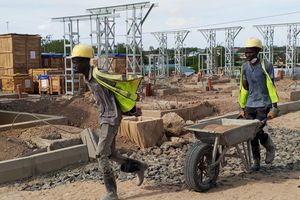
An incomplete health facility under construction at Ng'ilukia village in the dreadful Suguta Valley on June 13, 2026.
Photo credit: Sammy Lutta | Nation Media Group
For Turkana East MP Nicholas Ngikor, access to water is directly linked to security. He says women and children often bear the burden of travelling long distances in search of water, exposing themselves to attacks.
The lawmaker also notes that insecurity continues to disrupt education across the constituency, with schools repeatedly affected by banditry and displacement.
More than ten schools, including Lokosmekori, Lotiman, Kakiteitei, Kakolet and Lodapang’ora, have been affected by insecurity, while several NG-CDF projects remain stalled.