A year ago, travelling along the Lemurek-Yatya road in Baringo North was a gamble with death.
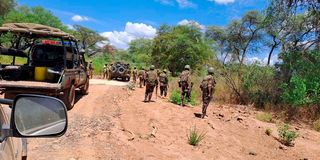
Every journey through the dusty stretch demanded an armed police escort and convoys of civilian vehicles snaked behind armoured personnel carriers as heavily armed security officers scanned the surrounding hills for bandits lying in wait.
Sometimes, officers disembarked to comb bushes with drones before allowing motorists to proceed, fearful of deadly ambushes that had become almost routine.
The road had earned a terrifying reputation as motorists were robbed in broad daylight, passengers shot at without warning and innocent travellers killed.
A national police reservist escorts pupils of Kapindasum Primary School in Arabal, Baringo County to Chemorongion trading centre to board a bus to their homes.
Photo credit: Nation
Fear emptied schools, silenced markets and forced hundreds of families to abandon their homes.
Entire villages became ghost settlements as livestock raids, shootings and killings turned daily life into a nightmare.
Today, however, the transformation is almost unbelievable. On Saturday morning, dozens of boda boda riders, private motorists and public vehicles cruised freely along the once dreaded road, ferrying hundreds of residents to Yatya Secondary School for the commissioning of the area's first school bus.
There was no police convoy, no armored vehicle, and no security officers stopping to inspect bushes.
Instead, children laughed as they walked to school, traders displayed their merchandise outside shops, and villagers strolled through shopping centres that only months earlier had echoed with gunfire.
The transformation marks one of the achievements that years of insecurity in Baringo North's Saimo Soi Ward are slowly giving way to normal life following an intensified intelligence-led security operation and disarmament campaign targeting illegal firearms.
In February 2024, mourners escorting the body of the visually impaired 55-year-old Kagir Primary School Head Teacher Thomas Kibet for burial had to travel under tight military protection after he who was shot dead by armed bandits at Namba while heading to a school function at neighbouring Kipcherere Secondary School.
Thomas Kibet during a past interview with Nation.
Photo credit: File | Nation Media Group
The funeral procession itself resembled a military operation as a convoy comprising the military, General Service Unit (GSU), Rapid Deployment Unit (RDU), police officers and National Police Reservists escorted the hearse from Kabarnet County Referral Hospital through the dangerous Lemuyek- Kagir road.
At several points, security officers stopped to deploy drones and inspect nearby bushes before allowing the convoy to continue, wary of bandits hiding in the rugged terrain.
Even after the burial, mourners were ambushed and shot at as they travelled home. Such attacks had become common in the area.
By last year, more than 17 people, including Tiaty Chief Victor Sebei, had been killed in Baringo North alone, while many others survived with gunshot wounds. Hundreds of families abandoned their homes, schools were closed indefinitely and livestock theft became a daily reality.
Entire villages, including Kosile, Lobotbuch, Chemongoi, Koitukum, Kamenjo and Nyalilbuch were deserted as frightened residents fled to safer areas such as Chebarsiat, Rondinin, Endao, Moinonin, Kampi Samaki, Barkipi, Kimorok, Kipsaraman and Kerio Valley.
At the time, markets collapsed, farms lay unattended and silence replaced the bustle of daily life.
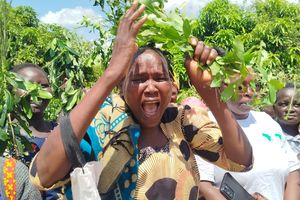
Dozens of women on the border of Baringo South and Baringo Central sub-counties protest at Sesia village on June 13,2026 over rising cases of insecurity.
Photo credit: Florah Koech | Nation Media Group
Today, that silence has been replaced by the sounds of people rebuilding their lives.
At Yatya Shopping Centre, groups of men relax outside shops waiting for the school function to begin while some savour plates of lunch from a nearby hotel as others chat casually, simple moments that were, until recently, a distant memory.
Months ago, this same shopping center was deserted, a grim reminder of conflict.
The area had turned into a battleground, forcing residents to flee as armed bandits launched repeated attacks, raiding villages, stealing livestock, and leaving death in their wake.
For years, fear dictated life here. Families abandoned their homes under the cover of darkness, seeking safety in neighbouring regions.
Markets closed, schools emptied, and grazing fields were left unattended. Silence, broken only by gunfire, became the norm.
The runaway insecurity also led to the loss of livelihoods and the displacement of hundreds of people, who fled to safer areas for fear of more attacks.
For many residents, these are ordinary moments they never imagined would return. More than 20 schools that had been closed because of insecurity have since reopened, among them Kosile, Yatya, Tuluk, Ng'aratuko and Kagir primary schools.
The normalcy followed a shift in government strategy. Rather than relying solely on forceful disarmament, security agencies adopted intelligence-led operations targeting armed criminals while simultaneously recovering illegal firearms from civilians.
Richard Chepchomei, an elder from Chemoe village, says the difference is nothing short of extraordinary.
“It is a miracle that the once dreaded Lemuyek-Yatya road is now passable. Highway attacks were once the order of the day and many people lost their lives. Today you can even walk at night or travel by boda boda without fear. Because of this peace, we are even receiving the first school bus in this region. Our children no longer have to rely on police trucks whenever they travel for school activities,” said Mr Chepchomei.
He said the restoration of peace has also enabled schools to reopen and businesses to flourish once again.
For Targok Chemase of Ng'aratuko village, peace means reclaiming a life interrupted by violence over the years.
She recalls fleeing countless times after attacks, losing more than 50 goats in a single raid and being forced to seek refuge in safer villages whenever bandits struck.
“After every attack we would abandon our homes with the livestock that remained. Today we sleep peacefully in our houses and I can go to my farm without armed police reservists accompanying us,” said Ms Chemase.
She fled in March 2024, barely a day after head teacher Thomas Kibet was killed, joining hundreds of displaced residents who sought shelter in temporary tents in Moinonin, more than 15 kilometres away.
It was there, amid uncertainty and harsh conditions, that she gave birth at refuge center.
“We never imagined we would return home. I gave birth while living in a temporary camp because we feared returning to our village. Today we are back home with our children and slowly rebuilding our lives,” said Ms Chelang’a.
Moses Cheptumo, a professional from Baringo North, said the security operation has given the region a chance to recover after years of bloodshed.
“Without peace there can never be development. Schools cannot operate and people cannot build their lives. We thank the government for silencing the guns and we hope every illegal firearm will be recovered so that we never return to those dark days,” said Mr Cheptumo.
He also appealed for the establishment of nomadic schools in the remote areas to keep children in school and reduce the risk of recruitment into criminal activities.
For the first time in the area’s history, the school received its own bus through the National Government Constituencies Development Fund (NG-CDF), a milestone residents said would have been impossible during the height of insecurity.
Baringo North MP Joseph Makilap at a past event.
Photo credit: File
He noted that learner enrolment at the school had risen from just 26 during the peak of insecurity last year to more than 368 after calm returned.
“In 2024 when we came for the burial of a primary school head teacher, we travelled under heavy security and I had to board an armoured police vehicle because the situation was extremely dangerous. Today, I drove along the same Lemuyek-Yatya road without a single police escort. We even stopped to the photographs along the way. That shows how much this area has changed,” said MP Makilap.
He said the government, working with the national council for nomadic education in Kenya (Naconek), plans to construct a Sh115 million model primary school in Moinonin that will bring together learners from pastoralist communities across the North Rift to promote unity and peaceful coexistence.
As hundreds of villagers danced, sang and celebrated the arrival of the school bus, the scene offered perhaps the clearest symbol of Baringo North’s recovery and a return of hope.
Only months ago, the same villages stood deserted, their roads patrolled by armed officers and haunted by fear but now, children once again walk to school, traders reopened their businesses and motorists drive through the once infamous Lemuyek-Yatya road without looking over their shoulders.