Closing the care gap: lessons from men who changed their routines
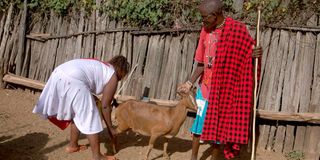
Nicholas Kodei holds a goat as his wife, Lydia Wangui, milks it in Arjiju village, Laikipia County, on July 3, 2025. Kodei, a champion for unpaid care work, encourages men to take a more active role in domestic and caregiving responsibilities and often helps his wife with chores at home.

What you need to know:
- Women spend billions of hours on unpaid care work, prompting calls for men to take a greater share of household responsibilities.
- Care champions say challenging cultural stereotypes and involving boys early can help change attitudes towards caregiving.
What is Kenya's care gap?
It is the enormous, mostly invisible imbalance in who does the unpaid work that keeps a household running: cooking, cleaning, fetching water and firewood, caring for children, the sick and the elderly. In Kenya, this work falls overwhelmingly on women.
According to a Kenya National Bureau of Statistics report, The Economic Value of Unpaid Domestic and Care Work in Kenya, women put in 25.8 billion hours of unpaid care work, against just 4.8 billion hours by men, roughly 15.7 per cent of the total. That is well below the global average, where men still do less than 25 per cent of unpaid domestic and care work.


What does that look like day to day?
Emily Chemung, a mother of six from Parasinda village in Kapenguria, West Pokot County, near the Kenya-Uganda border, is up by 5am to get her children ready for school. She then walks three of them five kilometres to get there, a route she will not let them take alone.
"The area is sparsely populated and forested, and there are wild animals such as elephants and hyenas, among others. I always have to escort them and ensure they pass the dangerous area before I return home. In the evening, I also have to go for them," she tells Nation.
Back home, her day does not let up: milking cows, sweeping the compound, cooking, washing dishes, farming, fetching water from the river, collecting firewood, and repeating several of these chores before bed.
"I retire to bed at 11pm, after everybody else. All my days are usually heavy and tiring. There is nothing that I can do, as I have to undertake all those duties," she says.
Why don't men take on more of this work?
Nicholas Kodei, a certified care work champion in Laikipia trained by the non-governmental organisation Hand in Hand, says the resistance is largely cultural. He describes his own Maasai community as deeply patriarchal, which makes it difficult to persuade men to embrace care work.
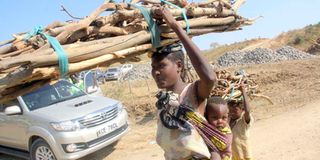
A woman with her children head back home after collecting firewood. Women carry the heavier burden of unpaid domestic and care work.
But he believes change is possible through three things: using clear gender data to challenge cultural stereotypes, involving boys in caregiving from an early age, and backing this with supportive policies and initiatives such as HeForShe, which encourages men and boys to take on a share of daily household responsibilities.
Also read: Balancing the scales of unpaid care work: Men lead in pet care and home repairs, survey shows
He has personally sensitised 50 men on the issue.
"Things are slowly changing. I am encouraged to see some men gradually changing their attitudes and taking a more active role in household responsibilities. You cannot expect someone to change simply by telling them what to do. Change begins with your own actions; you lead by example, and that can inspire others to follow," he says.
He adds that reaching more men with the message, and showing them clear numbers on how unequal workloads limit women's participation in public and economic life, is key to shifting attitudes further. He also points to a practical entry point: involving men early, such as by accompanying expectant fathers to health clinics and parenting classes, so they build caregiving habits from the start.
Has this worked for anyone?
John Kapalei, one of Nicholas's converts, says he never understood the weight of unpaid care work until his wife fell ill and he had to fetch water for their animals himself. "It was tiring. I realised how tiring it was for my wife, who was doing that daily. I then decided that I would help her with some of the domestic chores. I also connected piped water to my home to lessen the burden."
What is being done about it at a policy level?
UN Women has in recent days been leading a campaign to entrench gender equality in unpaid care work, encouraging men's engagement in the care economy through the redistribution of household tasks such as cooking, cleaning and caring for children or elderly family members. It also supports programmes that dismantle the stereotype that caregiving is exclusively "women's work" while men are expected to be breadwinners, and backs institutional changes such as equitable parental leave and public care infrastructure to make caregiving easier and more culturally acceptable for men.
Last year, the Kenyan Cabinet endorsed the National Care Policy to formally recognise, reduce and redistribute unpaid care and domestic labour. It is the first comprehensive policy of its kind in Africa, and seeks to shift care from an invisible burden to an acknowledged public good.
Antonia N'Gabala Sodonon, the UN Women Representative in Kenya, says women and girls have been the greatest casualties of this imbalance because they are required to shoulder most of the burden. "We have a scenario where women are participating in the care economy without any monetary benefit. The cost of caring for the elderly and the sick is usually passed on to women. These are the things that we hope the care policy will address," she says.
She argues that unpaid and underpaid care work is not a social side issue but an economic driver whose recognition determines how fast, and how fairly, the country grows. "Care is a source of job creation. Childcare, eldercare, disability care and domestic services can become growth sectors, especially for women and youth."
What does the policy actually propose?
The National Care Policy was drafted by the State Department for Gender in collaboration with the Ministry of Labour, with support from UN Women. It provides a coordinated framework for the care sector while promoting gender equality, aiming to recognise, reduce, redistribute, reward and represent care and domestic work, most of which is carried out by women and remains unpaid and invisible.
Among the institutional frameworks it proposes are well-equipped childcare centres, elderly care facilities and training programmes for caregivers, with a focus on compensating tasks such as cleaning, domestic work and caring for the elderly, sick or children.
Is this a big deal?
Crispin Afifu, a gender specialist at the International Centre for Research on Women, says the policy is a historic step for Kenya and a breakthrough for gender equality and inclusive economic growth. He notes that, for the first time, the government has formally recognised care as essential social and economic infrastructure, critical to productivity, employment and national development.
"This policy gives visibility and value to the unpaid and underpaid care work that has sustained households and the economy for generations, especially for women," he tells Nation.