Kenyans in the lower income tax bracket are set for financial relief as the National Treasury prepares to table the Tax Laws (Amendment) Bill, 2026, in the National Assembly next week.
While the proposed tax cuts offer households relief amid the high cost of living, they present a difficult balancing act for a cash-strapped National Treasury already grappling with a Sh1.2 trillion budget deficit.
Previous models for Pay As You Earn (PAYE) reforms have estimated that expanding the tax-free threshold could cost the State upwards of Sh35 billion annually.
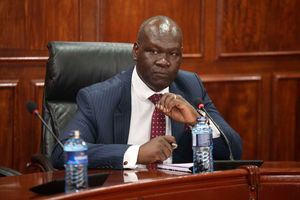
National Assembly Finance Committee chairperson Kuria Kimani (Molo) told the Nation that the House expects to receive the Bill next week, subject to Cabinet approval.
National Assembly Finance and National Planning Committee chairperson Kuria Kimani.
Photo credit: File | Nation Media Group
The proposed legislation seeks to give legal effect to the tax cuts President William Ruto announced during his Mashujaa Day address, targeting low-income earners, small-scale property buyers and consumers of mobile phones.
“We will be expecting the Bill next week,” Mr Kimani said, adding that it would incorporate the President’s tax relief proposals “in a bid to make life easier” for Kenyans.
Under the current PAYE structure, the first Sh24,000 earned monthly is taxed at 10 per cent, the next Sh8,333 at 25 per cent, the next Sh467,667 at 30 per cent, the next Sh300,000 at 32.5 per cent, and income above Sh800,000 at 35 per cent.
The Bill’s introduction will set off a race against time for the National Assembly, which will have to fast-track public participation and stakeholder consultations within a tight legislative timetable.
Mr Kimani said the urgency was driven by changes to the national budget calendar ahead of the August 10, 2027 General Election.
“These relief measures must be cleared quickly before the Finance Bill 2027 comes to the House early next year,” he said.
At the centre of the proposed changes is a revision of PAYE that would exempt workers earning Sh32,333 a month or less from income tax.
Mr Kimani said the proposed zero-rating of this income bracket was intended to increase disposable income for millions of households struggling with the high cost of living.
Beyond salaries, the Bill proposes changes to the Stamp Duty Act to make smaller property transactions cheaper.
Under the proposal, transactions valued at Sh1 million or less would be exempt from stamp duty, reducing the cost of formal property ownership for ordinary Kenyans.
The government is also seeking to scrap the 25 per cent import duty on mobile phones, a move intended to lower retail prices, reduce the cost of accessing technology and widen access to digital and e-commerce opportunities.
The Finance Bill 2026 had proposed consolidating taxes on mobile phones, with excise duty of 25 per cent and import duty of 25 per cent imposed at the point of activation, while zero-rating Value Added Tax (VAT), the Import Declaration Fee (IDF) and the Railway Development Levy (RDL).
The proposal was eventually dropped after the National Treasury failed to clarify what constituted taxation “at the point of activation”.
Mobile phones currently attract VAT at 16 per cent, excise duty at 10 per cent, import duty at 25 per cent, IDF at 1.5 per cent and RDL at two per cent.
According to Mr Kimani, implementing the proposed import duty relief would require an amendment to the East African Community Customs Management Act (EACCMA).
The process would have to be initiated by the National Treasury and approved by the East African Community Council of Finance Cabinet Secretaries at a special meeting in Arusha, before the National Assembly ratifies the decision.
Mr Kimani said the proposed revision of the PAYE bands was intended to improve tax equity and increase the disposable income of salaried workers, in line with the government’s revenue strategy.
However, the Treasury is also considering measures to offset the anticipated revenue losses, including scrapping personal relief tax credits and reviewing other tax exemptions.
Documents from the National Treasury submitted to the Finance Committee indicate that scrapping personal relief would help cushion government revenue against the impact of the proposed changes.
“The Bill will eliminate the standard monthly personal relief,” the Treasury documents state.
This would mean that while workers earning Sh32,333 or less would be exempt from income tax under the proposal, taxpayers in higher income brackets would lose their personal relief credits even as the existing marginal tax rates of between 25 and 35 per cent remain in place.
The proposed changes would therefore shift part of the cost of the relief towards higher-income earners, although the precise impact would depend on the final legislation and how the revised tax bands are structured.
The Treasury is also reviewing other tax incentives under the government’s broader Medium-Term Revenue Strategy (MTRS), with insurance reliefs emerging as a potential target as the State seeks to plug revenue gaps.
The MTRS for the 2024/25 to 2026/27 financial years emphasises improved progressivity and the alignment of personal income tax rates.
During consideration of the Finance Bill 2026, the Law Society of Kenya (LSK), the Kenya Bankers Association (KBA) and the Institute of Certified Public Accountants of Kenya (ICPAK), among other stakeholders, raised concerns about disparities in the tax system.
They argued that the gap between the highest personal income tax rate of 35 per cent and the corporate income tax rate of 30 per cent, coupled with differences in how the two tax bases are treated, raised questions about fairness.
More than 362,000 formal sector workers will stop paying income tax under Treasury proposals that raise the untaxed monthly income threshold to Sh32,333.
Photo credit: Shutterstock
The organisations said rationalising the tax bands would improve equity, strengthen voluntary compliance and reduce incentives for tax avoidance.
However, the Kimani-led Finance Committee did not adopt their proposals in its report on the Finance Bill 2026, despite acknowledging that it had received several submissions calling for changes to the PAYE structure.
The committee said the National Treasury was exploring ways of “improving progressivity in the Personal Income Tax system without having a significant shock in the reduction of tax revenues”.
In their submissions, stakeholders proposed widening the PAYE bands by raising the tax-free threshold from Sh24,000 to Sh30,000 a month and increasing monthly personal relief from Sh2,400 to Sh3,000.
They argued that the existing structure placed a disproportionate burden on middle-income earners, reducing their disposable income at a time when statutory deductions and the cost of living were rising.
Revising the PAYE framework, they said, would boost household purchasing power, stimulate consumer spending, support small and medium-sized enterprises (SMEs) that depend on domestic demand, and advance the government’s revenue strategy objectives on equity and economic growth.
“Kenya’s PAYE tax bands are narrow and steep, with high marginal rates applying at much lower incomes than in peer countries,” KBA chief executive Raymond Molenje said in a memorandum to the committee.
He added: “A five per cent PAYE cut expands the economy, creates jobs and increases the country’s tax revenue.”
The stakeholders’ proposals were also informed by the growing burden of statutory deductions on employees’ gross pay, including contributions to the Social Health Insurance Fund (SHIF), the Affordable Housing Levy and the enhanced National Social Security Fund (NSSF), which they said had contributed to a decline in real wages.
SHIF contributions are set at 2.75 per cent of gross salary, while the Affordable Housing Levy takes 1.5 per cent of an employee’s monthly gross pay, matched by a similar employer contribution. Enhanced NSSF contributions of up to Sh6,480 took effect in February 2026.
A KBA simulation found that a uniform five per cent reduction in PAYE across all income bands would release Sh28.1 billion into the economy annually, generate Sh42 billion in immediate GDP output, create 36,000 jobs a year and unlock Sh140 billion in formal lending capacity.
The association further argued that the resulting economic activity could generate between Sh27.1 billion and Sh31.5 billion in additional government revenue, potentially recovering the revenue lost through the tax reduction in the first year.