How AI and digital platforms are revolutionising farming in Homa Bay
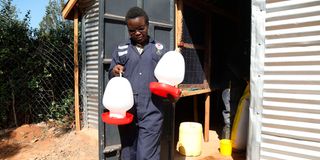
Neremy Mboya prepares waterers on her group's farm in Kotieno village, Rachuonyo South, Homa Bay County, on September 8, 2026.


What you need to know:
- From TikTok farming tutorials to AI-powered advice, digital platforms are transforming how Kenyan farmers manage diseases, learn modern agricultural practices, market produce and access credit.
- Women farmers face barriers to digital agriculture, including limited smartphone access, poor network connectivity and digital illiteracy, highlighting the need for gender-inclusive agricultural technology programmes.
After feeding her poultry and making sure they have enough water to drink, Neremy Mboya retreats to rest. However, resting does not mean she sits and does nothing. On her palm is a mobile phone, which has become part of the tools she needs for successful poultry farming. Neremy does not only use her phone to communicate. It has formed part of the entire production chain—from sourcing of raw materials to marketing.
She even learns new ideas through her phone. Without it, her farm could face hurdles that may be hard to overcome. “As a poultry farmer, I can admit that mobile phones have become one of the most important farm tools,” she says.
Neremy keeps 500 chicks on a farm in Kotieno village in Kasipul, Homa Bay County. She belongs to a poultry group called Future Seed, which is made up of young people. Here, she is one of the lead farmers. Before she adopted digital platforms, everything was manual and tiresome.


“Previously, I would do things physically and with difficulty. I could walk to get different materials like medicine and sell the chickens. I had not thought that I could make a call and everything would be done at the doorstep without me leaving.”
Her biggest digital revolution is TikTok, which has become her unexpected agricultural extension officer. On this social media platform, she searches for and finds farmers who share their videos on how to ensure successful agribusiness.
Neremy says her biggest change before adopting digital farming was marketing. She would walk all the way to the market to sell her produce. “With the digital platform, you can post what you have on social media platforms and you get your buyers from there, which is easier. I post the chickens on WhatsApp status and groups before I get replies from customers,” she says.
She notes that initially customers were suspicious. After posting about her product, some people would think it was a scam. But with more people accepting the digital platforms for marketing, it becomes easier to showcase her product on social media. Her first time using artificial intelligence (AI) on the farm was during a disease outbreak. “I didn't understand the specific disease affecting the chicks. I just took a photo, then sent it to AI, and got an answer,” she says.
Today, she finds buyers through farming groups online. Neremy got into several online groups. Whenever her chickens are ready or when she has eggs, she takes pictures and shares them in groups. She often gets customers for her birds or eggs.
Scrolling through online video has taught her lessons that directly improved production, she says. “I realised there are things that I was not doing right or I was not well-educated about. And by viewing TikTok pages, I got to understand how to do things differently, which has made me get more produce. For my case, I have more eggs. It has also helped me reduce mortality,” she says.
At some point, she recorded a high mortality rate. She later understood where the problem was and did things differently, thus reducing the mortality rate. She also used AI to solve a crop problem. A piece of land at her parents’ home, previously covered with eucalyptus trees, would not support maize production. “I didn't know what to plant there because we used to plant maize and it was not doing well. So I just took a photo and sent it to AI and asked, which plant could do best in that specific area. I tried spinach and banana and it really did well,” she says.
For payments, she relies on mobile money because most clients are online. “We cannot meet to get the physical exchange of cash. So I use digital platforms to receive money and send whenever I want inputs,” Neremy says.
Digital finance has also helped her access credit. Through M-Pesa, she can apply for mobile loans to grow her business. The most important techniques she learned online are biosecurity and vaccination. “Failure to put biosecurity measures top-notch is what causes high mortality rates in chicks. I watched some tutorials online, which enabled me to enhance cleanliness and biosecurity. That helped me reduce mortality rates. I also realised I should ensure routine vaccination.”
Digital platforms also help her cut costs. Neremy has reduced her farming costs. She does not spend money on transport. At the moment, when she faces a problem, AI is her go-to. “Sometimes you find that you can call a vet and it takes time before he or she comes. It is also costly to get vet services. So with the use of technology or AI, it becomes easier to handle these cases as they come,” she says.
She uses Farmer Chat and ChatGPT. The limitation, she admits, is accuracy. Sometimes AI is not accurate. Neremy says as much as she uses AI, sometimes she has to also consult an expert so that she can compare the two ideas. “There was a time when AI gave me an answer, but when I consulted a practitioner in the vet space, I got two different things.”
She controls her own phone and money. Digital tools have helped her separate funds. Until now she has not experienced scams but says AI unreliability remains the main challenge. “I wish to have access to a reliable platform where farmers can easily sell their produce. Sometimes you have surplus and you lack where to take them. So having a platform where farmers can easily showcase or can easily sell their produce and get a readily available market,” she says.
In Homa Bay, farmers use digital agricultural resource kits. The National Agricultural Value Chain Development Project (NAVCDP) Coordinator in Homa Bay, Henry Nzinga, says each of the 40 wards has one kit. “It is the duty of the ward agricultural officer to make schedules on how the kit will be used. They have to move from one location to another as they educate farmers,” he says.
The tablets have preloaded videos, pictures and other agricultural information. In Homa Bay, the NAVCDP deals with five value chains—rice, banana, dairy, coffee and cotton. Henry says the information contained in the digital gadgets ranges from planting, weeding, and fertiliser application, among other practices. “The tablet is connected to a projector, which displays the information. All that farmers have to do is to identify a hall where they can sit and watch the videos and the agricultural officer explains further. They pick on a topic they want to learn before it is displayed on the wall,” he says.
The tablets have preloaded videos, pictures and other agricultural information. Henry says extension officers use flipcharts to explain certain agricultural practices. The explanation was based on what the officer knew. “The information they offered was standard. But some farmers were struggling to understand what was being said,” he notes.
Now the agricultural officers walk with backpacks that contain the kits. When they want to teach about conservation agriculture, they do not just describe it, they play videos of farmers in other regions digging zai pits. When they teach about aflatoxin in maize, they show a clip of mouldy grains under a microscope and the farmers get it instantly. Farmers say visuals close the gap between description and reality. Henry says digital platforms allow farmers to access the market easily. “With agripreneurs closer to farmers, the struggle is less for whoever is interested in getting information. Farmers can also seek information from experts without meeting them face to face,” he says.
Hurdles
He says the only obstacle is failure by farmers to embrace digital platforms. Homa Bay County deputy director for Agriculture Charles Nyayiera says farmers turn to digital platforms when they want to ensure maximum production. He says some of the key information farmers seek includes market information and linkages, using digital platforms to know where to sell their produce and at what price. Farmers can also seek answers on good agricultural practices. He says organisations use USSD, mobile apps and SMS to disseminate information on agricultural best practice.
Charles adds that weather forecasts and early warning can also be accessed online. “Digital solutions are effective for early warning systems. The Kenya Meteorological Department disseminates forecasts through SMS, WhatsApp groups and emails,” he says.
Farmers seek information on how to manage crop pests and livestock diseases through the same platforms. However, he says several barriers prevent farmers from fully benefitting. “Some areas have issues of poor network connectivity. Not all farmers have smartphones, so they are limited, especially those digital solutions that require smartphones like apps, WhatsApp groups and other social media. There is also digital illiteracy among many farmers.”
He says women farmers are more disadvantaged compared to men. In most cases, he notes, men control the resources. In a homestead, it is easier for a man to have a smartphone compared to the female farmer. “If farming is their main livelihood, it is likely that a man would get a smartphone faster than a woman, or the woman may just access the man's phone on rare occasions,” the expert says.
Gender mainstreaming
Charles calls for gender mainstreaming to address the inequality. He wants agricultural programmes to be tailored towards gender mainstreaming where there should be equity in terms of access to opportunities for both female and male farmers. “If an organisation wants to offer opportunities, it is good to give women the same equal opportunities as men,” he says.
Charles suggests enforcing a one-to-one ratio in training, giving an example 15 men and 15 women in a group of 30, to ensure equal dissemination of technology. He also calls for sensitisation to joint family budgeting and planning and the use of gender calendars to clarify roles, and empowering women to earn income to acquire resources like smartphones.
“There is a need for sensitisation to demystify myths that certain things are supposed to be for men. Both male and female should have equal access and equal control of resources in the household because both are productive.”
A report by Sauti East Africa on equitable access to climate‑related information and adaptation tools for women farmers in Kenya found that digital platforms helped women improve their preparedness for climate change, adopt farming adaptation strategies, and access agricultural services and markets.
The Kenya‑based social enterprise that fuses development research with technology to close the digital information gap for women in trade engaged 567 women farmers across Vihiga, Homa Bay, Uasin Gishu and Busia counties.
Access to climate information
The women were trained to use Unstructured Supplementary Service Data (USSD), Short Message Service (SMS), and WhatsApp platforms to access climate information. Broader outreach extended the platform’s reach to more than 15,000 women farmers through SMS and social media.
By May 2025, the target had already been surpassed when 16,596 women accessed the mobile climate information platforms, representing 49 per cent of the 34,210 users. Content was delivered in multiple languages, including English and Swahili.
The USSD and SMS platforms catered to women without smartphones and those with limited literacy, while WhatsApp served users with smartphones and greater digital literacy. The initiative improved women’s preparedness for climate‑related risks.
The average number of preparedness actions taken by each respondent rose from 2.05 to 2.94, with 91.1 per cent frequently monitoring weather conditions and 89.7 per cent acting on early warnings.
Increased adaptation
Women also increased the number of strategies they used to adapt to climate change, from an average of 1.35 at the start of the initiative to 2.59 at the end. These included crop rotation and intercropping, soil conservation measures, and switching to drought‑resistant crop varieties.
The benefits extended beyond climate preparedness to access to agricultural services and decision‑making. Women’s confidence in accessing agricultural services improved, with their average score rising from 3.46 to 3.83.
Their decision‑making agency score also increased from 3.67 to 3.94. Overall, 55.3 per cent of participants reported improvements in accessing agricultural services. The report estimated that this represented 18,906 smallholder farmers, including approximately 9,171 women.
Encouraged to seek agricultural services
Agricultural officers observed that digital reminders and USSD‑based tools encouraged women to seek support more actively. “Access to extension services has really improved because women now know whom to call or visit for advice. The digital prompts pushed them to act,” an agricultural officer in Vihiga County said in the report.
The digital tools also helped women access information about agricultural support programmes. “There are still affordability issues with fertilisers, but more women now know about subsidies or government support programmes. That wasn’t the case earlier,” a technical agronomist in Uasin Gishu County said.
Improved farming incomes
The report also found improvements in women’s farming incomes and access to markets. Average monthly farming income rose from Sh10,286 to Sh12,338. The proportion of women who identified new buyers increased from 43.3 per cent to 54.7 per cent.
The use of WhatsApp to find buyers increased from 11 per cent to 22.9 per cent, while the use of USSD for trade rose from 1 per cent to 5.4 per cent. However, they identified a persistent challenge of reliance on unqualified information among women in hard‑to‑reach areas and those outside formal groups.
“Some women still rely on neighbours or informal advice. We need to expand the reach of trained officers and ensure consistent follow‑up,” said an agricultural technologist in Homa Bay County.