Mijikenda elders have given the government 21 days to identify 16 acres where they can permanently relocate sacred shrines threatened by the development of the Dongo Kundu Special Economic Zone (SEZ) in Mombasa, after moving four shrines to temporary sites.
The elders moved the shrines on Monday after talks with the Kenya Ports Authority (KPA), which funded the Sh1 million exercise over concerns about their close proximity to construction.
“We were asked to move the shrines so that the developers working on the project would not be exposed to harm. We have now completed the exercise, following the traditions required when moving them,” said Nyundo Mwero, Mombasa County coordinator of the Kaya elders.
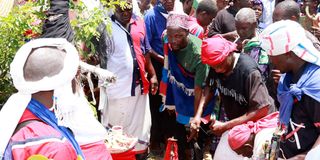
The elders emerged from the forest in a procession of song and dance, carrying objects they believe house the spirits of their ancestors.
Kaya Elders and traditional medicine men perform rites during a cultural event to relocate shrines to pave way for the Dongo Kundu Special Economic Zone in Mombasa on October 12, 2026.
Photo credit: Kevin Odit | Nation Media Group
For two and a half hours, they had performed rituals before manually carrying the sacred objects to a temporary site near homes of families displaced by the project.
Known locally as mizimu , the shrines are believed to house ancestral spirits that guide descendants. The elders say they must remain in a forested setting, rather than among homes, and require traditional rites before and after being moved.
“These shrines belong in their own forest setting, not where people live. We need land where they can be established permanently,” Mr Mwero said.
An Environmental and Social Impact Assessment study for the Dongo Kundu project identified Kaya sites as a challenge in relocating people affected by the development.
The report submitted to the National Environment Management Authority (Nema) identified 13 Mijikenda shrines within the project area and recommended that they be retained and preserved. It proposed fencing and reforestation at Kaya Miongani, Ngombeni and Mwanakuku by KPA.
The four shrines moved on Monday were identified as Mwacharo and Ngala, with the latter name referring to three of them. Each, the elders said, has a distinct role and a designated custodian responsible for its care and removal.
The objects were carried by hand because, according to the elders, tradition does not permit their transportation by vehicle. Four people carried each shrine, while its custodian supervised the process.
At the temporary site, the rituals continued with sacrifices involving three goats, 12 chickens and a cow, which Mr Mwero said were intended to settle the spirits in their new surroundings.
For Mwemed Ali Cheusi, a traditional herbalist who participated in the exercise, the relocation affects a heritage extending beyond ancestral worship to traditional medicine. He said practices associated with the shrines had been passed down through generations and that healers believed ancestral spirits continued to guide their work.
“Our forefathers practised these traditions, and after they died, we continued with them. The spirits are part of the heritage we inherited, including the traditional healing practices we carry on,” he said.
Mr Cheusi said each shrine had to be moved by the person entrusted with it, because that custodian understood how it was established and the rules governing its use. His shrine was associated with a mango tree in the forest, whose fruit he alone was traditionally responsible for harvesting before sharing it with others.
Despite the cultural significance of the sites, Mr Cheusi said the elders accepted the move to allow development to proceed, hoping the investment would create opportunities for future generations.
Kaya Elders and traditional medicine men perform rites during a cultural event to relocate shrines to pave way for the Dongo Kundu Special Economic Zone in Mombasa on October 12, 2026.
Photo credit: Kevin Odit | Nation Media Group
The exercise, however, has highlighted concerns that the cultural needs of Kaya elders and traditional healers were not adequately considered during the initial resettlement process.
Mgandi Kalinga, a coordinator involved in the Port Development Project, said KPA took responsibility for the relocation after the omission was raised.
“During the relocation of people affected by the project, the committee overseeing the process did not adequately consider traditional healers and Kaya elders from this region,” he said.
Mr Kalinga described the forest as an important source of medicinal plants for healers across Mombasa. Trees provided leaves, bark and roots used to prepare remedies, he said, and practitioners travelled from across the county to collect them.
“Healers from across Mombasa came to the Kaya forest to collect plants for their medicine. The forest had a wide variety of trees used in traditional healing, making it an important resource for these communities,” he said.
Mr Kalinga said KPA management agreed to fund the exercise after cultural concerns were brought to its attention. The Sh1 million covered relocation and materials required for the rituals. He estimated that moving one shrine cost about Sh270,000 because of the required items, including livestock, chickens and cash.
The four shrines are only a fraction of the cultural sites affected by the development. Mr Kalinga said relocation would continue in phases, depending on available funds. The elders, however, are seeking a permanent site before further arrangements can secure their heritage.
The dispute comes amid wider grievances among families displaced by the project. The government relocated hundreds of households and set aside 400 acres for resettlement, but some residents say the residential plots they received do not match the land they surrendered.
The allocated plots measure 50 by 100 feet, while some families say they previously occupied several acres. Mr Mwero said he had surrendered nine acres and considered his replacement plot inadequate.
“We hope the government will address these concerns,” he said.
Mr Kalinga acknowledged the complaints, saying discussions about the difference between land surrendered and plots allocated remained part of efforts to address affected communities’ concerns.
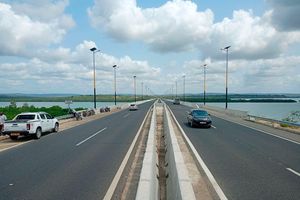
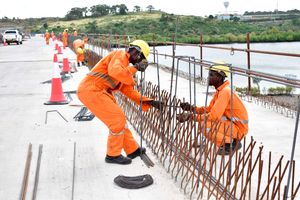
The Dongo Kundu SEZ is being developed on 3,000 acres. Planned facilities include a free port, industrial parks, free trade zones, logistics and warehousing facilities, energy projects, tourism facilities, and meeting, incentive, conference and exhibition facilities. The immediate deadline is 21 days, but the underlying issue extends beyond the four shrines moved on Monday.
The elders want a permanent forest setting, while displaced families continue to seek answers about the adequacy of their replacement land.
Both concerns place the responsibility on authorities to ensure that development does not leave affected communities bearing unresolved cultural and material costs.