Najma Ado is a single mother from Kinna in Isiolo County and a survivor of gender-based violence (GBV). She has finally found peace as she raises her children.
Her tears bring back memories of the dark chapter she endured after being married off at a young age.
By the age of 19, she was already a single mother, having experienced a marriage filled with pain, fear and violence.
"I got married at the age of 14. However, the marriage turned out to be hell. After I had my first child, my former husband became violent. Arguments were a daily occurrence,” recounts the mother of two.
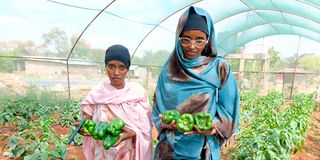
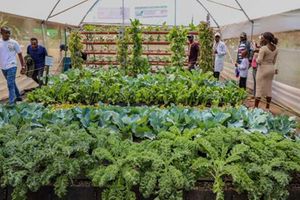
Today, the cries that once defined her life have been replaced by hope. Instead of living in fear, she spends her days tending to vegetables in a greenhouse as a member of Nasole SACCO, a community cooperative that promotes climate-smart agriculture in one of Kenya’s driest regions.
For years, Najma’s life revolved around survival. Married as a child, she abandoned her education and took on responsibilities that were beyond her years.
Instead of enjoying her adolescence, she endured emotional abuse and physical violence before eventually leaving the abusive marriage.
Left with two children and no stable income, she struggled to rebuild her life in Kinna, an arid and semi-arid land (ASAL) area where prolonged droughts, erratic rainfall and rising temperatures have made traditional livelihoods increasingly difficult.
“Climate change has intensified poverty in Isiolo County, where livestock farming has traditionally sustained many families. Shrinking pastures and dwindling water sources have left households more vulnerable, especially women who are already discriminated against and subjected to violence,” she explains. For Najma, however, the changing climate also pushed her towards a different livelihood.
Today, she is one of hundreds of women rebuilding their lives through Nasole SACCO. This organisation provides savings, affordable credit, entrepreneurship training and climate-smart agriculture to empower vulnerable households. “I am now a farmer. Thanks to the SACCO, I received a loan of Sh40,000, which enabled me to start rebuilding my life. I can now provide for my children, buy food and support my parents, as well as meeting our daily needs,” she says.
The cooperative has also introduced her to the concept of saving, giving her the confidence to believe that she can continue to improve her family’s future.
Najma Ado Mohamed from Kinna, Isiolo County, in her farm on July 23, 2026.
Photo credit: Sammy Wwaweru | Nation Media Group
“I don’t want to go back to where I came from because I suffered a lot there. My children are now living peacefully. One of them is in Grade Two, and they are able to learn just like other children,” she explains.
Najma says that she experienced gender-based violence between 2012 and 2019, having become pregnant at only 14 years old. “I was too young to become a mother. I stayed in the village for five years. During that time, I fell ill and eventually returned home. When I think back to those times, it was a painful period, but today I thank God because I have moved on.”
She believes that learning about women’s rights has been one of the greatest transformations. “Today, we know our rights. We can speak out against gender-based violence. Our parents could not do that because many of them were illiterate and did not know where to seek help.”
As well as receiving loans, members also receive training in financial literacy, entrepreneurship, leadership and climate-smart agriculture. Exchange visits to other farming communities introduce them to modern production techniques that help households adapt to changing weather patterns.
However, she believes that more investment is needed. “We need more greenhouses, irrigation pipes, water pumps, generators and farm chemicals. The support we have received has changed our lives, but there are still many women who need help.”
A few kilometres away, Mariam Mohamed is carefully harvesting tomatoes inside a greenhouse. Outside, the intense Isiolo sun beats down relentlessly on the arid landscape. Inside, however, rows of healthy tomato plants flourish under a drip irrigation system, demonstrating how simple technologies can transform agriculture in such harsh environments.
Like Najma, Mariam is a single mother whose life has been shaped by hardship. “My parents divorced when I was seven. I reached class eight before dropping out to get married. I later left the marriage with my children and had to start life all over again,” she says.
Without an education or capital, survival became a daily struggle. “I always depended on handouts. Life was very difficult.”
Determined to change her circumstances, she joined a women’s group in 2012, and later became a member of Nasole SACCO. There, she began saving whatever she could, starting with as little as Sh100 per week. “After six months, I withdrew my savings and invested them in agriculture,” she reveals.
Today, with the support of the SACCO, she grows tomatoes, spinach and capsicum in greenhouses and open fields. Water pumped from the nearby Bisanadi River and using drip irrigation enables her to continue producing vegetables even when it rains less. The vegetables earn her around Sh500 per day, helping to pay school fees, buy food and clothing for her children, and cover other household expenses.
“The project has helped me educate my children. Before, I always depended on others. Now I can support my family. Things have improved,” says the mother of four.
She says that climate-smart agriculture has become essential because conventional farming can no longer cope with the changing weather patterns affecting the region. “There are many challenges, but we are continuing to adapt to the environment while taking care of our families.”
She is also passing on her knowledge to her children. “I teach my children these farming skills because I want them to know that agriculture can change lives.”
The women are among the hundreds of beneficiaries of Nasole Sacco, a community-based cooperative which has become a pillar of economic resilience in Kinna.
According to Vice Chairperson Makai Mamo, the initiative can be traced back to the Malka community programme in 2008, before it was formally registered as a Sacco in 2019.
"It started with around 50 members, but has since grown to approximately 310, including 230 women," Mrs Mamo tells Seeds of Gold. Members pay a one-time registration fee of Sh4,000 before making monthly savings of at least Sh550.
“Their savings determine how much they can borrow, with some members now qualifying for loans of up to Sh1 million,” she states.
Repeated droughts and unreliable rainfall have forced the cooperative to reconsider farming methods. In 2013, members embraced greenhouse production and water-efficient technologies, enabling them to cultivate vegetables on small plots while conserving water.
Today, they grow tomatoes, capsicum, spinach, and other vegetables using drip irrigation, with water pumped from the Bisanadi River supplying this. The cooperative has also diversified into fish farming and beekeeping. They operate three fish ponds stocked with tilapia and catfish, and produce honey to generate additional income.
Mamo says the cooperative’s greatest achievement extends beyond agriculture. “One of our key objectives is to support women who have experienced gender-based violence. We link them with financial institutions, government programmes and organisations so that they can access opportunities and rebuild their lives,” she said during an interview at the cooperative’s farm in Guba Dida Village, Kinna.
In collaboration with partners such as Heifer International, the World Food Programme, Catholic Relief Services and the We World Kenya Foundation, the SACCO provides training to its members in areas including financial management, entrepreneurship, positive social behaviour, healthy family relationships, and climate-smart agriculture.
Dr Dianah Kamande, a gender-based violence (GBV) survivor, is the founder and executive director of the Come Together Widows and Orphans Organisation (CTWOO). She believes that initiatives that economically empower survivors, such as cooperatives, play a vital role in helping women rebuild their lives with dignity and independence.
"GBV survivors and widows often face trauma, stigma, discrimination, loss of property, economic hardship, and limited access to justice. However, with the right support, they can heal, rebuild their lives and thrive,” she says.
CTWOO supports survivors by providing counselling and legal aid referrals in partnership with FIDA Kenya and the Law Society of Kenya. The organisation also refers survivors to the national SGBV toll-free helpline 1195, which provides access to medical care, safe shelters and other specialised services. The organisation also promotes economic empowerment by linking survivors and widows to entrepreneurship training in areas such as agriculture, as well as to financial inclusion opportunities and government empowerment funds.
“Healing begins when we choose compassion over judgement, justice over silence, and empowerment over pity. Every GBV survivor and every widow deserves to live with dignity, purpose and hope, not just survive.”
For Nasole Sacco, community dialogue forums held every 15 to 30 days educate families on how to prevent gender-based violence, encouraging shared decision-making and promoting peaceful households.