How Joan Cheyech escaped child marriage and built a beadwork empire
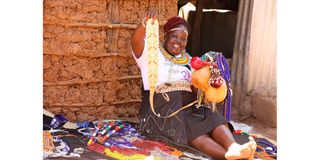
Joan Cheyech displays her beadwork items at her home in Chepararia, Pokot South, West Pokot, on April 8, 2026. She is a leading bead products trader and uses part of her proceeds to support survivors of child marriage and FGM.

What you need to know:
- Married at 12 after FGM, Joan escaped, rebuilt her life, and now rescues vulnerable girls.
- She also empowers survivors through beadwork, skills training, and steady income.
Joan Cheyech was 12, in Standard Three, and had not yet healed from female genital mutilation when she was married off to a 60-year-old man. It was 1998 in Chepararia, Pokot South. She vividly remembers that chilly evening when she tried to resist and was beaten into submission.
“I was devastated and thought that was the end of me,” Joan tells the Nation.
Luckily, she ran away. Good Samaritans found her and took her back to school. She was already pregnant when she escaped and later gave birth to a girl—her only child to date.


Hope for other survivors
When we meet Joan at her home in Kamaleni village, she is busy with beadwork, a craft she has practised for the past 15 years. Today, far from the life forced on her at 12, she runs a growing beadwork business, has rescued 31 girls from FGM and child marriage, and trains survivors to earn their own income.
After completing Form Four with no money to go to college, Joan turned to beads. She started by buying bead products and reselling them at a profit, learning the craft with time. “As I sold the bead products, I also underwent training in making bead products until I became an expert and started making my own. Today, I know how to make more than 10 different bead products,” she says.
In 2010, armed with a Sh3,000 donation from a well-wisher, she plunged into beadwork. The capital was modest, but the business has grown steadily since. During the off-season, from January to September, she makes between Sh40,000 and Sh50,000 a month. Between October and December, the peak season, her monthly sales climb to between Sh100,000 and Sh120,000.
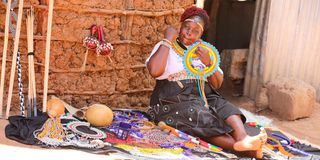
Joan Cheyech displays her beadwork items at her home in Chepararia, Pokot South, West Pokot, on April 8, 2026. She is a leading bead products trader and uses part of her proceeds to support survivors of child marriage and FGM.
Her products range in price from Sh100 to Sh30,000, depending on the type and decoration. Joan runs her business from her home in Kamaleni, where she also has a workshop and a safe space where she trains survivors of child marriage and FGM. Her catalogue is wide. Walk into her workshop and you find jewellery—necklaces, cuff bracelets, earrings, beaded collar necklaces, dancing dangle earrings, and leather-beaded bracelets.
She has accessories too: beaded sandals, handbags, passport holders, luggage tags, tassel keychains, and dog collars. She makes home décor, beaded coasters, napkin rings, Christmas ornaments, and beaded animal sculptures. And then there are the cultural pieces: intricate collars and headbands that carry meaning, marking social, marital or ethnic identity in ways that plain jewellery cannot.
She sells across markets in West Pokot County and secures exhibition space at events such as the devolution conference, International Women's Day, and the Changamka Shopping Festival organised by the Kenya Association of Manufacturers.
From her earnings, Joan has bought two pieces of land and built a home on one of them. Every day, she turns beads into a livelihood. But success has not come without struggle. The biggest obstacle is finding enough market for her products. “Sometimes I have a lot of stock that is not moving. If I can be helped with the market for my products, I will be happy. I have the capacity to make as many as the clients require,” she says.
Expanding the business has also been difficult, as much of her profit goes towards her upkeep, transport costs, and supporting the survivors she works with. Joan is a beneficiary of the United Arab Emirates Strategic Partnership Framework (UAE-SPF) UN Women Kenya Programme, which supports women entrepreneurs through capacity-building on gender-responsive procurement, women's empowerment principles, and access to finance and trade.
The training opened her eyes to e-procurement and what it could mean for her business. “Before the training, I did not know anything about e-procurement. I am now able to register for the Access to Government Procurement Opportunities programme, where I hope to secure contracts. I also seek to apply for tenders so that exporters can access the international market,” she says.
The training also introduced her to digital marketing. “I now use my phone for digital marketing, which I hope will help me get more customers. The only challenge I have today is that my smartphone is damaged, but once I fix it, I will market my products online as I have the skills to do it.”
Antonia N'Gabala Sodonon, the UN Women Representative in Kenya, says the organisation is committed to enhancing women's economic empowerment as a pathway to gender equality and sustainable development.
“Gender-responsive procurement creates enabling ecosystems for women entrepreneurs and women-owned businesses to thrive, compete, and drive economic development. The UAE-SPF programme provides much-needed momentum by expanding economic opportunities for women entrepreneurs in Kenya, including through making procurement policies and practices more gender-responsive,” she says.
For Dorcas Cheyech, also a child marriage survivor from Chepararia, Joan's intervention changed the course of her life. “I was being married off but decided to run away. I looked for Joan, whom I used to hear was rescuing girls being married off or undergoing FGM. She embraced me like her own child and took me to a local school to continue with my education.”
Joan trained Dorcas and other survivors in beadwork during school holidays. “I am now an expert in beadwork and have even started my own bead business. In a bad month, I make at least Sh5,000, while in a good month, I usually make Sh10,000 or more—money helping me take care of myself,” she says.
Joan's story is part of a much bigger picture. Beadwork, once purely a cultural craft in pastoralist communities, has grown into a structured, income-generating industry. Over 50,000 artisans are engaged in it—the majority being women. Kenyan beadwork draws heavily from Maasai, Samburu, Pokot, Marakwet, and Turkana traditions, featuring hand-beaded jewellery, leather accessories, and home décor.
The Ushanga Initiative has established more than 60 cooperatives and trained thousands of women, helping move the craft from a pastime into a serious economic activity supporting families and keeping girls in school.


