How Phoebe Asiyo's 'ridiculous' 33 pc women quota became the bedrock of Kenyan gender equality
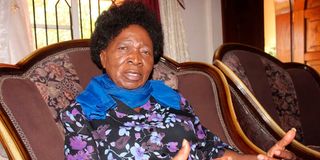
Phoebe Asiyo in this photo taken on August 14, 2017. She died in the US on July 16, aged 93.

What you need to know:
- Phoebe Muga Asiyo, Kenya's first African woman prison superintendent and only female MP for Karachuonyo, died aged 93.
- Her 1997 parliamentary motion for 33 per cent women's representation, though initially defeated by male MPs, became entrenched in Kenya's 2010 Constitution.
- Her visionary work now guarantees at least 47 women in Parliament.
She has been described as a trailblazer for women’s rights in Kenya. That is Phoebe Muga Asiyo(1932–2025), who died on July 16, in the United States of America aged 93. She was a pioneer in many respects - going to school when few girls did; serving as Kenya’s first African woman Senior Superintendent of Prisons (1963) where she instituted the separation of male and female prisoners; leading the premierwomen’s organisation, Maendeleo Ya Wanawake, as its first African President (1958) through which she engineered women’s empowerment; becoming the first and so far only female Member of Parliament for Karachuonyo (1979, 1992); and becoming the first woman to be declared a Luo elder (2009). Her trail is aptly summarised in the 2018 memoir It Is Possible.
This illustrious life contains several lessons about equality in Kenya. One, formal education is a game changer. It transforms women’s and girls’ attitudes and outlooks, creates opportunities for and makes them engines of development for the entire society. Two, women can scale the heights of professional life and careers stereotyped as masculine. Becoming the superintendent of prisons in the immediate post-independence days is a testimony that Asiyo had talent that could not be ignored by anybody.


Three, leading Maendeleo in 1958 shows that she was a dyed-in-the-wool women’s rights liberator ready to push Africanisation. Her liberation credentials were again illustrated when she mobilised women to pay homage to the six freedom fighters detained by the colonial administration in Kapenguria. Four, her decision to contest the Karachuonyo, and going ahead to defeat the titan of the then ruling Kenya African National Union, the late Okiki Amayo, demonstrates that women can if they dare.
But what will be permanently etched in Kenya’s history is that Phoebe Asiyo was the parliamentary originator of affirmative action in leadership. She did this in 1997 through a motion seeking to have women occupy at least 33 per cent of all positions in Parliament and local authorities. The bill was defeated by the male-dominated parliament using (ridiculous) arguments such as that: male MPs represented everybody; there was already one female assistant minister (for culture and social services); and the law did not bar women from joining Parliament. These arguments conveniently avoided the fact that structural factors constrained women from being elected.
Much as the defeat was a set-back, it galvanised Kenyan women to fight even harder. Thus the Kenya Women’s Political Caucus was formed in 1998 as a platform for pursuing Asiyo’s dream. The bill also stimulated other minority groups to agitate for inclusion
Beth Mugo reintroduced the bill in 2000. This time, it was referred to the Constitution Review Commission of Kenya and the ideas were accommodated in what became known as the Bomas Draft. The idea eventually made its way into the Constitution of Kenya 2010, which entrenches the principle that not more than two thirds of members of appointive or elected bodies should be of one gender.
Numerical strength
This supreme law creates the position of county woman representatives, ensuring that there will be at least 47 women in the National Assembly even if no other woman is elected. It requires that 16 women be nominated to the Senate by political parties in proportion to their numerical strength. It also mandates the nomination of persons with disability and youth to the legislature in gender balanced proportions. County assemblies that do not realise the principle at election must nominate the underrepresented group in enough numbers to achieve the threshold.
The concept of affirmative action is attributed to President John F Kennedy of the United States of America (1961-1963) who, through Executive Order 10925, decreed that federal contractors must treat applicants equally regardless of race, colour, religion, sex, or national origin. In the Civil Rights Act of 1964, this order was extended to non-governmental contractors.
President Lyndon Johnson (1963-1969) advanced the idea to enable African Americans join mainstream American life. At a graduation ceremony at Howard University, he stated that “freedom is not enough” and must be embellished with deliberate and decisive actions to “open the gates of opportunity”. Thus affirmative action became the default means for achieving equality and diversity.
Current data shows that 138 countries use affirmative quotas to increase the number of women in legislatures. This has resulted in the proportion moving from 11.3 per cent in 1995 to 27 per cent today.
Given projections in the Global Gender Gap Report 2025 that it will take another 162 years to close the gender imbalance in political leadership, it is obvious that affirmative action will continue to be used. Based on this alone, Asiyo must be regarded as a visionary and certainly the mother of affirmative action in Kenyan politics.
The writer is a lecturer in Gender and Development Studies at South Eastern Kenya ([email protected]).


