The death of Phoebe Muga Asiyo on July 17, 2025 at the age of 93 years, removes from our midst another pioneering woman in the history of independent Kenya. Asiyo joins a number of other courageous trailblazing women leaders, who have died in the recent past.
Indeed, she left to the other world, in a manner of speaking, alongside Catherine Nyamato, the first Gusii woman nominated Member of Parliament. They were preceded by Grace Onyango and Orie Rogo Manduli. Before these had gone Margaret Kenyatta, Philomena Chelagat Mutai, Priscilla Abwao, Wangari Maathai, Wambui Otieno, Pamela Mboya, Ruth Habwe, Grace Ogot, among others.
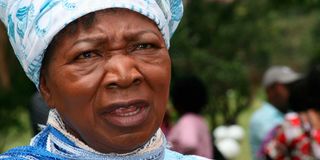
Former Karachuonyo Member of Parliament, the late Phoebe Asiyo.
Photo credit: File | Nation Media Group
Kenya is still blessed to have among us courageous traiblazing female public figures — the likes of Jael Mbogo, Nyiva Mwendwa, Zipporah Kittony, Charity Ngilu, Ruth Oniango, Julia Ojiambo and Annritta Karimi, among others. These women crossed boundaries — and breached social, economic, cultural, political and even spiritual conventions to become firsts in their communities and even in the country. Asiyo was a classic example of the trailblazing women in Kenya in the postcolonial period.
She was not even a native of South Nyanza, Karachuonyo, where she practiced and lived her politics. Her ancestry was in Nyakach, Kisumu District then (now Kisumu County). Her parents had migrated to South Nyanza. She was born at Gendia Seventh Day Adventists (SDA) Mission, in Homa Bay, and grew up among the missionaries of the church.
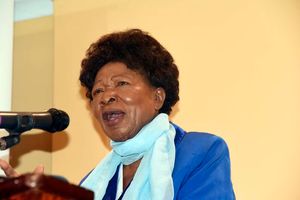
President Uhuru Kenyatta confers the Chief of Burning Spear Award to Phoebe Asiyo at State House, Nairobi on August 23, 2018.
Photo credit: File | Nation Media Group
She studied at the local school and attended Kamagambo Girls' School in Migori. She later acquired professional skills — trained as a teacher at Kangaru Teachers' College in Embu in 1950. She ended up working in Nairobi, working at Pumwani School in 1952, as a social worker in 1953 and is elected Maendeleo ya Wanawake Chairperson in 1958. She would later join the Prison Services and later changed jobs when she joined the Child Welfare Society of Kenya as a director.
Her political journey could probably have begun earlier as she learnt at the feet of her parents how to face the troubles of everyday life. But it is significant that together with Priscilla Abwao and other women, they visited Jomo Kenyatta in Lodwar in 1960 to discuss women's involvement in Kenya's public life after independence. Was this not building early political capital at the national level?
Yet, it would not have been easy for Asiyo. Even when she joined politics, Asiyo would still have been expected to be a “good girl”, a respectable woman, a hardworking housewife, caring for her husband and raising her children. Politics then, as it still is today, was a man's world. Yet, Asiyo cut her own path in life at a time when seemingly insurmountable obstacles would have deliberately been placed in the path of a woman.
Winning the Karachuonyo Constituency Parliamentary seat in 1979 wasn't easy. The election would later be overturned but Asiyo triumphed in the by-election. She served her constituency productively and was reelected in 1983, not an easy feat for a woman at the time. But how did she manage to beat the better funded and connected men in Karachuonyo?
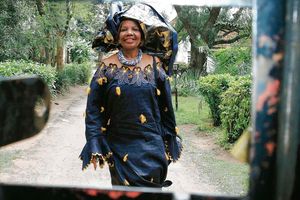
Then Deputy President William Ruto receives copy of the book 'It is Possible: An African Woman Speaks' from the author Phoebe Asiyo during the book's launch at State House, Nairobi on August 23, 2018.
Photo credit: File | Nation Media Group
The name Kanu may be fading from public memory. But this political behemoth was 'father and mother' of the nation, a genderless monster that was really a men's club. The then ruling party decided who would be elected in municipal and parliamentary offices. Though a pretence of competition was allowed, rarely would a man or woman who wasn't in 'good standing' with the party get nominated to view. It was a men's club, with women shunted to a peripheral outfit, Kanu had swallowed up Maendeleo ya Wanawake, the women’s association whose roots were in the colonial era, and in which Asiyo and many other prominent politicians had served.
But relying on her social networking skills and connections with women, she successfully served Karachuonyo twice as an elected MP on a Kanu ticket. She would be elected again in 1992 on a Ford-Kenya ticket, as a member of an opposition party. Asiyo was also the grandchild of a warrior family head — grandmother Odede Magunga Nyar Olonde. Asiyo describes her as 'the family engine and fighter,' attributes that could describe Asiyo.
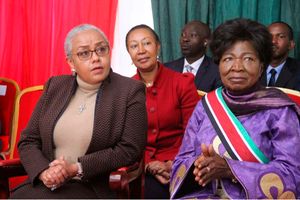
Then First Lady Margaret Kenyatta (left) with Phoebe Asiyo during the launch of the book 'It is Possible: An African Woman Speaks' at State House, Nairobi on August 23, 2018.
Photo credit: File | Nation Media Group
Asiyo and her generation refused to be silenced the way the postcolonial government ignored and excluded women from the mainstream of economic and political life in Kenya. She and her generation juggled wifehood, motherhood, professional careers or political office but still remained sober enough not to seek to remain in office forever or use the offices for personal gain.
They may not have lasted long in politics or obstinately remained on the public political stage, but their politics was more deliberate, peaceful, constructive and progressive. That's why whenever one met Asiyo, like I did, she always had a smile on her face. Maybe she lived her father's wisdom all her life: the tongue is a weapon that can destroy or build. One wishes that current Kenyan politicians would absorb such a lesson from Mama Asiyo.