How Turkana women turned traditional weaving into a Sh3m business
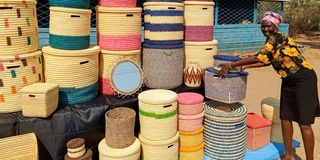
Turkana Handcraft Women group official Josephine Lobur displays basketry products made by members for local and international markets in Lodwar on July 22, 2026.

What you need to know:
- More than 150 Turkana women are turning traditional weaving and beadwork into profitable businesses.
- Training in design, value addition and market access has helped raise annual sales from less than Sh1 million to Sh3 million.
Lodwar's easily visible Christ the Redeemer statue in Turkana County, which was erected by the Catholic Diocese, sits atop a 700-metre hill overlooking the arid town with a busy airstrip with daily flights.
For anyone walking up the hill to reach the 15‑foot statue that resembles Rio de Janeiro’s iconic monument in Brazil, the journey begins next to The Blue Container. Nicknamed ‘Taste of Turkana,’ it serves as the Turkana Women Handcraft Shop, where quality woven products are stored before being transported to customers across the country and for export.
The compound has more than 150 women who weave colourful products daily, ranging from laundry baskets, fruit baskets, small rectangular boxes for pens and jewellery, table mats and shopping bags.


A section of women has specialised in making more unique products like customised woven wall mirrors and beaded woven bags with vibrant beadwork that can be used for summer vacations or evening outfits.
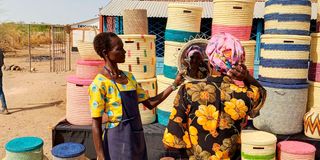
A group member, Veronica Awesit, holds a handcrafted mirror as Josephine uses it at the group’s Blue Container in Lodwar on July 22, 2026.
Martha Lemuya is one of the newest members of a group formed in 1992. The group was created to help women who had practised basket weaving as a hobby for many years turn their traditional skills into a source of income. It also aimed to preserve and pass down indigenous knowledge and techniques through generations
"After completing high school last year, I didn't know what to do at home rather than join women to engage in weaving and beadwork. When there were many orders, I was among the girls who were being hired to make the products so that they could be delivered to the clients on time. I was only being paid for labour, taking home at least Sh100 a day," Lemuya recalls.
Being passionate and ready to learn new skills, she was part of a group of women trained on value addition and unique designs, especially for beaded products.
A men’s hat that retails at Sh1,000 has been beaded and is now worth Sh5,000. I have unique necklaces, bracelets from most countries in the world, earrings, steering‑wheel covers, wine glasses, key holders and more. We hope to cash in during the 2027 General Election campaign period by making customised products for aspirants and parties, including matching ties, caps and bracelets,” Lemuya says.
Josephine Lobur, an official of the group, says their turning point came through support from development partners, which helped them sell their products in international markets. The women are among the beneficiaries of the project Promoting Sustainable Socio‑economic Development and Creating Market‑Based Livelihood Opportunities for Refugees and Host Communities in Kenya, implemented by the International Trade Centre with funding from the Korea International Cooperation Agency (Koica).
The project adopts a market-driven approach to strengthen livelihoods by equipping refugees and host communities with commercially relevant skills, promoting entrepreneurship, strengthening local business ecosystems and connecting enterprises to sustainable market opportunities.
"We have been supported through enterprise development and market access through strengthened entrepreneurship, business development services and improved market linkages. We have been trained to make quality products suitable for international markets as well as exposed to potential buyers across the world through exhibitions in Nairobi," Josephine says.
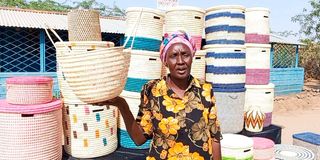
Josephine displays some of the group’s handcrafted products at their Blue Container in Lodwar on July 22, 2026.
At the exhibitions, they were linked to The Basket Room (TBR), which sources striking, traditional lidded laundry baskets handwoven from doum palm by women’s cooperatives in the arid Turkana region of north‑western Kenya. They also connected with Crafts With Meaning Limited, which creates global economic opportunities by exporting local products to America.
"The July order by TBR destined for America comprised 210 laundry baskets and 105 short baskets worth Sh661,000, a Sh85,000 order for waste paper baskets by Crafts with Meaning and a Sh320,000 order for 50 flower baskets, 100 coaster holders, 150 sewing baskets and 70 laundry baskets for African modern," Alice Ikaal, who is in charge of marketing at the Blue Container, notes.
The group now has five potential customers abroad, in Rome (Italy) and Geneva (Switzerland). Each year, they place at least three orders, with sales rising from less than Sh1 million three years ago, to Sh3 million today.
"The improved sales have assured members of a sustainable income, enough to take their children to school, pay hospital bills, buy new clothes and provide a variety of nutritious foods. Before, they would make products and give them away as gifts to relatives and friends or sell them locally at throw‑away prices. With the current support through training, exhibitions and market linkages, they have changed how they weave their products and expanded their market reach," Josephine adds.
Alice says that when they get many orders, they engage women in remote villages along Lake Turkana.
“We see it as our responsibility to train rural women on how to make quality products and combine colours properly. With support from Koica and the International Trade Centre, we have taught traditional weavers to create new items such as creative fruit bowl designs that enhance table décor in modern homes. These innovations are important in bridging the gap between health, aesthetics and food preservation," Alice says.
Rural women are also making side tables defined by high‑quality materials, timeless design and multifunctional appeal, as well as lampshades. The challenge has been that for years they specialised in heavy weaving, using large amounts of material, which made transportation costly.
Our training has introduced light weaving and quality products, so clients get value for money when transporting by air, where weight is a key factor,” Alice adds.
To include more rural women across the county and link their unique products to international markets, she says they are seeking support to acquire vehicles. These would help not only in training women but also in transporting products from as far as 300 kilometres away to the container for market linkages.
Value addition
International Trade Centre National Coordinator Halkano Jilo Boru adds that their initiatives aim to promote sustainable socio‑economic development, self‑reliance and market access for micro, small and medium‑sized enterprises. They do this by creating opportunities for artisans and entrepreneurs from remote regions to showcase and sell their products at major events, such as international trade fairs in Nairobi.
"Through the project, local artisans and entrepreneurs are focusing on value addition, branding and compliance with international trade standards to reach foreign markets. For Turkana women, this has meant improving the quality of their products and shifting their mind-set from hobby to income opportunity. They are now going beyond local markets in Lodwar to the national level in cities such as Nairobi and Mombasa, through exhibitions that have also seen their products shipped to Geneva and Rome," Halkano says.
Philip Ebei, a trade officer from the Turkana County government, appreciates the efforts of development partners in building market systems in both refugee camps and the county’s main towns, noting that the move is driving socio‑economic development.
“As a devolved unit, we have also invested in markets across the county and created an enabling environment for such businesses to thrive, so that more products can be produced locally and reach international markets. We are also working with partners to secure foreign markets to increase traders’ income,” Philip says.
Koica Country Director Wankyu Park is impressed by evidence of women transforming their lives through making quality products that are now sold in Nairobi and international markets. He notes that such value chains should be strengthened for sustainability.
“We are promoting sustainable socio‑economic development and creating market‑based livelihood opportunities for refugees and host communities in Turkana. The project contributes to the county’s priorities on enterprise development, job creation, economic inclusion and market systems strengthening,” Park says.


