Inside the lives of mothers raising children with cerebral palsy
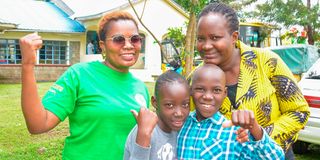
Esther Ojudi (right) celebrates World Cerebral Palsy Day with her nine-year-old son Charles Caleb and daughter Becky. They are with Doreen Obondo (left) of Holistic Nurturing Health Hub at Ojola Sub-County Hospital in Kisumu on October 6, 2025.

What you need to know:
- Across Kenya, mothers raising children with cerebral palsy live lives of endless devotion and resilience.
- From Kisumu to Emuhaya, women like Esther, Immaculate, Sarah, Naomi, and Dorothy share a quiet strength.
- Their daily battles—stretching limbs, administering medicine, and navigating hospitals—tell stories of love that never sleeps.
The world is still dark when Esther Ojudi's day begins. No alarm clock needed—her body knows the rhythm by heart. Before dawn breaks, before the first bird calls, before the rest of Nairobi stirs, she is already moving through the quiet of her home. Gentle stretching. Measured medication. Soft humming for her son. This is the ritual that defines her life, a routine she will repeat until she closes her eyes again, long after the city has gone to sleep.
"It's like raising the sun with your hands," she says softly. "Every day begins with a prayer and patience. You never rest—and you never give up."


Across Kenya, countless mothers like Esther begin their days in similar silence—women whose strength holds together children living with cerebral palsy. They are the unseen hands, steady and loving, often trembling, holding together children whose bodies fight them at every turn. They sleep long after the rest of the world has gone quiet. They wake before dawn. They are unseen and unsung, yet they embody resilience in its purest form.
"A child is a mother's heartbeat walking outside her body," goes a saying. For women like Esther, whose children suffer from cerebral palsy, that heartbeat is both fragile and fierce.
The weight of worry
Immaculate Awino has not worked since 2018. A trained P1 teacher, she has yet to secure a job. But her most demanding job is one no one ever formally offered her: round-the-clock care for her child with cerebral palsy.
Caring for her child is not only a physical struggle but also a financial one. She spends sleepless nights worrying about the cost of medication. "The anticonvulsants alone are too expensive," she says.
Each month, she must find money not just for food, but also for therapy sessions, hospital visits, and drugs that can cost more than some people earn in a week. "If I had a job, I would at least have medical cover," she says. "That would help me take care of my baby better."
Leaving everything behind
When Naomi Ongachi Ndati gave birth to her daughter, her world shifted in ways she never anticipated. "I had to stop working," she says. "I left my job in Thika and went home to Emuhaya because my child needed full-time care."
At first, she sought help locally. "A doctor in Emuhaya attended to my child, but I saw no improvement," she recounts. "Then someone told me about Chulaimbo Hospital."
At the hospital, Naomi found something rare—consistent therapy and a doctor who not only treated her daughter but also educated her. "Before, my child couldn't walk. Now she can," she says. "The only challenge is speech and hyperactivity. But I thank God that she can walk."
The journey, however, remains complicated. "I can get a job, but who would I leave her with?" she explains. "She can't ease herself without help. She has to be monitored all the time. It's hard to find someone who truly understands."
In her eyes flicker exhaustion and triumph—the triumph of a mother who has seen progress where doctors once saw limits. The progress is measured not in milestones but in moments, small victories that remind her that healing is a journey, not a destination.
The double shift
For Sarah Akoth Oluoch, a public school teacher and mother of a six-year-old, life is a delicate balance between duty and devotion. The struggle comes with balancing her profession and a life that demands round-the-clock care.
"I teach other people's children during the day, then rush home to care for mine through the night," she says.
Sarah has learned to grade exams with one hand while feeding her son with the other. "I realised he had cerebral palsy at nine months," she says. "He has not attained any milestone. He can't feed himself, can't sit or walk. He has to be under care 24/7."
Each morning, she leaves for school knowing that at home, her son, Christian, depends on a house help. But finding one willing and patient enough is a challenge in itself. "They demand more pay, which I understand because the child has to be spoon-fed, bathed, dressed—I mean, everything," she says. "That is quite demanding, so eventually they grow tired and leave. It's hard."
Even with a steady salary, the costs are immense. "I'm lucky because I have insurance, but most parents don't," she says. "When therapy at Jaramogi Oginga Odinga Teaching and Referral Hospital was raised from Sh350 to Sh600 per session, I saw so many mothers give up. They just couldn't afford it."
Sarah pauses, her eyes fixed on a distance. "It's sad because consistency in therapy is what helps these children progress. But if a mother can't pay, she stays home, and the child suffers."
Her voice carries quiet authority, the kind forged in struggle. "You need an understanding employer," she says. "Without that, even keeping a job becomes impossible."
Unheeded warning signs
Dorothy Atieno remembers the moment everything changed. Three days after birth, her baby, Grasha, was diagnosed with jaundice. The doctors advised her to put the child in the phototherapy machine. "They assured me that everything would be fine," she says. "But a month later, when we were discharged, nobody warned me of what would follow."
Two weeks later, she noticed that her daughter's neck was weak. Dorothy immediately took the child to Kisumu County Hospital, where medics told her that her baby was not okay. The jaundice had affected her brain.
The diagnosis hit like a storm. "They said it was kernicterus bilirubin encephalopathy," she explains, the words rolling off her tongue with the precision of a mother who has had to educate herself out of necessity. "It means the bilirubin—the yellow substance from jaundice—built up to toxic levels and damaged her brain."
At first, Dorothy was overwhelmed. "No one had told me this could happen," she says. "If I had known, I would have acted faster."
Therapy helped. "By seven months, she began to sit, but she was supposed to sit at three," she says. "It's been a long journey."
Her message to other mothers is clear: "Don't take jaundice lightly. It can cause permanent damage." And to the government, she pleads: "Tell mothers the truth early, educate them, and help us—the mothers who are struggling silently."
Unspoken sisterhood
These stories form an unspoken sisterhood of struggle and grace. These mothers meet in therapy rooms, online groups, and church benches, exchanging tips and prayers. They have learned to measure time not in months but in milestones—a hand unclenched, a sound formed, a muscle that finally responds. Their laughter often carries tears, but it is laughter nonetheless, the kind that refuses to disappear.
Health experts say their devotion is both heroic and necessary.
Olive Oudu, an occupational therapist, says the foundation of progress for children with cerebral palsy lies in early and continuous intervention. "Occupational therapy improves daily functioning, physiotherapy enhances mobility, and speech therapy builds communication," she explains. "At the heart of it all are the caregivers—they are the therapists at home, the ones who make progress possible."
She adds that mothers looking after children suffering from cerebral palsy are trained and guided to perform exercises correctly at home to avoid harm. "Managing disability is expensive," Olive says. "Families pay for multiple therapies, specialist consultations, and medication. The cost varies because every child is unique, each presenting different challenges requiring different interventions."
Speech therapy, she notes, is particularly scarce. "There are few speech therapists in the country, mostly in private hospitals," explains Olive. "Sessions cost between two and five thousand shillings, which many families cannot afford."
Early intervention is everything, she says. "The brain develops fastest between zero and three years. When children get help early, they have a better chance to develop milestones and live more independent lives."
She urges expectant mothers to seek proper antenatal care and watch for early warning signs—absence of reflexes, delayed smiling, inability to sit or crawl at the right stages. "When we act early, we give the child a chance to rewrite their story."
Still, as Olive admits, the road is not easy. Kenya has few specialists, and most public hospitals lack rehabilitation units. The system depends heavily on love—the kind that mothers like Esther, Immaculate, Naomi, Sarah, and Dorothy give freely and fiercely.
"A multidisciplinary approach is vital, but so is compassion," Olive says. "These mothers are not just caregivers; they are lifelines."
Before the dawn again
In the silence of their homes, between therapy sessions and night vigils, the women hold on to faith stronger than medicine.
Esther, who started the day adjusting her son's limbs, ends it by singing to help him sleep.
Immaculate prays for the day anticonvulsant drugs will be free for all children with neurological disorders.
Sarah hopes the government will introduce flexible work policies for caregivers.
Dorothy wants her daughter's laughter to outlive her own.
And tomorrow, before the world wakes, they will begin again.


