As a young girl, Farhyo Dahir often imagined living in a lively home filled with the laughter and footsteps of her many children. She dreamed of little ones running up and down, calling out “Mummy! Mummy!” from every direction. When she finally said “I do”, those dreams felt within reach.
“We had a beautiful wedding. During that period, my husband and I were on very good terms,” Farhyo remembers. But the vows she believed would last a lifetime came to an abrupt and painful end.
“One day, my husband said he was going on a long journey. When he came back, he divorced me,” she says.
Farhyo Dahir in Eastleigh, Nairobi on September 26, 2025.
Photo credit: Tebby Otieno | Nation
At the time of divorce, Farhyo was expectant. She did not know how she was going to walk the pregnancy journey alone.
“I was in shock and very depressed for a long time after that separation,” she recalls.
Jobless and expectant, Farhyo’s pregnancy was far from what she had envisioned. She remembers it as one of the toughest and longest journeys of her life.
“My body was swollen, including my face, due to the pregnancy,” says the soft-spoken Farhyo through a translator during the interview with Nation Lifestyle .
When she finally held her newborn daughter in her arms, her heart overflowed with joy. But a year later, that joy turned into deep concern.
“One day, when she was a year old, I took her to the hospital since she had been crying a lot. That is when I was told my daughter is deaf. She was put on hearing aids* that cost more than Sh100,000, but I did not have the money.”
To date, Farhyo has never acquired specialised treatment for her daughter due to financial constraints. Despite seeking help from relatives, including the child’s father, she has not yet received support. Today, 14 years later, Farhyo’s daughter is in Grade Three.
“At first, it was very difficult to communicate with my daughter. We could only use signs. Now that she is grown and is in school, communicating has become easier, though I am still a single mother,” says 40-year-old Farhyo.
Finding her voice through her daughter
At another corner of the city, Fozia Mohammed Omar, 34, tells a similar story. Her 10-year-old daughter is deaf – a discovery she made when the girl was just a year old.
Fozia Mohammed Omar in Eastleigh, Nairobi on September 26, 2025.
Photo credit: Tebby Otieno | Nation
“When I went to the hospital, the doctors confirmed to me that she cannot hear. Even after a year, I hadn’t realised that she was deaf because she is my firstborn. Doctors told me it was possible to do a corrective operation, but I am still unable to pay for it,” says Fozia. The surgery, estimated at Sh6 million, is to be done in India.
“Raising a deaf child is just as normal as raising other children. The only difference is that she does not hear. We communicate through sign language.”
At first, her daughter could only point or show what she wanted, or even hold her mother’s hands and direct her to what she wanted. However, when she started school, Fozia enrolled in a sign language course. She started by learning basic sign language communication skills like greetings, welcome and sleeping. These new communication skills have made it easier to parent her daughter.
“Communication has gotten easier, especially now that she knows how to read, write and use sign language. She is in Grade Four now,” says the mother of one.
Fozia is happy that because of her daughter, she now has an additional skill – sign language. This skill comes in handy, especially with the Competency-Based Curriculum that requires parents to have more practical lessons with their children.
Fozia, now aged 34, once dreamed of having six children by age 30.
“I have been married for 16 years but I have not had any other children. I have only one daughter whom I am very proud of,” she says with a bright smile.
Her advice to other parents raising deaf children is simple yet powerful: “Take them to school. Let them learn and live their dreams. Through education, they can achieve anything without feeling discriminated against.”
A mother’s fight for sound
Nasra Diriye, 27, had a smooth pregnancy and normal delivery. Her joy was short-lived when, at three months old, her baby accidentally fell from the bed.
Nasra Diriye in Eastleigh, Nairobi on September 26, 2025.
Photo credit: Tebby Otieno | Nation
Because there were no physical injuries, she did not take the baby to the hospital for any check-up. Days turned to weeks, then months and later years.
“The baby continued to grow normally. At the age of five, when I took him to school, the teacher noticed that my son was struggling to talk. Also, he only seemed to understand conversations when the other person was facing him. He also liked playing a lot,” Nasra shares.
“I was told that my son is not completely deaf. He can hear and talk to some extent. The doctors said one of his ears was weak while the other was okay. We bought hearing aids, but they were very expensive — Sh90,000 for each ear,” she says.
The device’s battery is also quite costly, and the hearing aids caused discomfort.
“He always complains that it brings a lot of noise in his ears and he demands that we remove it. He does not use the device all the time.”
Now a single mother after losing her husband, Nasra balances hawking with parenting two young children, aged 10 and 7.
“His teacher is deaf, so his signing is good because he signs with his classmates. I talk normally to him because he can understand what I am saying when he looks at me. Since his dad died when he was still young, as a single parent, I can only work when he is in school.”
“I feel so happy and proud when I am called a mother. It reminds me that I have a purpose. My daughter helps too. She knows sign language better than I do and she communicates very well with her brother,” Nasra says.
The schools filling the silence
Finding suitable schools for deaf children has been one of the toughest challenges for Farhyo, Fozia, and Nasra. They wanted institutions that balance special education with Islamic religious studies.
“We established our special school to create a safe and supportive environment where deaf students feel valued, understood, and cared for. Here, they are given the chance to discover their strengths, build confidence, and pursue education with dignity,” says Abdirahman Adani, the director of Rabbani Group of Schools.
Abdirahman Adan, the director of Rabbani Group of Schools that has created a safe and supportive environment for deaf students.
Photo credit: Pool
Currently hosting 55 deaf students, Rabbani aims to ensure no child is left behind.
“The abilities, dreams, and potential of deaf children are often overlooked, yet they too deserve equal opportunities to learn, grow, and succeed. Every child is gifted in their own way, and with the right support, they can achieve greatness,” he adds.
Integrating deaf children with the hearing ones allows deaf children to better interact with the hearing people in the community, say Wakio Njeru, a sign language interpreter who is also a disability advocate.
“When deaf and hearing learners share the same space, there’s peer learning and better understanding,” she adds.
Wakio emphasises the need for accessible classrooms and teachers trained to communicate inclusively.
“When a teacher knows how to reach a deaf learner, everyone benefits. It also teaches hearing children about empathy and awareness,” she says, noting that many deaf children end up isolated at home simply because family members don’t know sign language.
“Sometimes it’s the children who teach their parents to sign. But when no one else learns, the child feels left out,” Wakio says.
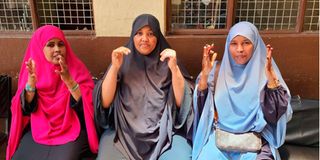
Farhyo Dahir, Fozia Mohammed Omar and Nasra Diriye during an interview in Eastleigh, Nairobi on September 26, 2025.
Photo credit: Tebby Otieno | Nation
She adds that sign language should be recognised as the first language of deaf children — and national examinations should reflect that.
“Deaf learners are taught in sign language but tested in written English, which has a completely different grammar. It is unfair. The grammar setup of sign language is different from English. It may take a deaf child a while to understand English because it is not their first language; sign language is their primary language. It is not strange to see a deaf child getting a grade A in sign language and a D in other subjects,” she says.
Despite the hurdles, mothers like Farhyo, Fozia, and Nasra remain resilient, their stories echoing a shared truth—love speaks every language—including silence.