Livestock, honey and onions: The female entrepreneurs powering change in Samburu and Laikipia
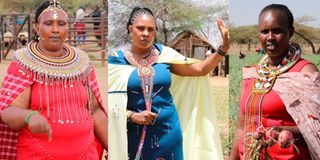
Livestock trader Christine Leseewa, Beekeeper Rosemary Mosiany, and crop farmer Ruth Lengosek on February 26, 2026.

What you need to know:
- Three women in Samburu and Laikipia defy tradition, building thriving livestock, honey and irrigation farming enterprises despite drought.
- Backed by training and digital marketing, northern Kenya’s women entrepreneurs are expanding into national and international markets.
In Samburu and Laikipia, where drought is a way of life and tradition has long kept women on the margins of economic activity, three women decided the rules no longer applied to them. One sells goats to buyers from Nairobi. One exports honey to the United Arab Emirates. One grows onions on land that was, until recently, considered too dry to farm.
It is 10am at Kisima Livestock Market in Samburu West and despite the early morning rains, the place is alive. Goats bleat from every corner. Buyers move quickly between the pens, sizing up animals with practised eyes. Farmers and herders who have travelled in from across the county stand their ground, waiting for the right offer.
Among the sellers this Wednesday morning is Christine Leseewa. In a market that has for decades been the exclusive domain of men, she is one of the very few women who have ventured into the livestock business in Samburu County.


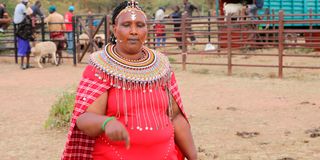
Christine Leseewa at Kisima Livestock Market in Suguta, Samburu West on February 18, 2026. She is a renowned livestock farmer in Samburu, selling animals to businessmen in Nairobi, Nakuru and Thika. She is among few women in the male-dominated field.
Christine tells the Nation she sources her animals from across the county, from Wamba, Baragoi, Archers Post, South Horr and Suguta Marmar, and brings them to Kisima every Wednesday when buyers from Nairobi, Nakuru and Thika come to the market.
On a good week, she sells about 210 goats across three different markets, making an average profit of Sh3,000 per goat. That adds up to more than Sh600,000 a week, and when the business is running well, more than Sh2 million a month. Her profit margins normally range between Sh2,000 and Sh5,000 per goat depending on the season.
Today, with the drought having taken its toll on the animals, the numbers are lower.
"Today I have managed to sell 40 goats at a profit of Sh2,000 per goat, giving me Sh80,000 in a matter of minutes. The profit would have been much higher but the drought has affected the animals and they cannot fetch better prices because they are a bit smaller," Christine says.
Getting to this point was not easy. When she started, the men around her were vocal about their doubts.
"Many people, mostly men, dismissed me at first, saying I could not make it in a business that is purely male-dominated. I stayed put and proved them wrong. Today they applaud me for being among the leading livestock businesswomen in the county," she says.
Beyond the livestock trade, Christine has opened one of the biggest bookshops in Maralal town and bought a lorry which she uses to transport goats and sheep to Nairobi, Thika and Nakuru. The business has enabled her to take care of her family and pay school fees for her children. She says she has never regretted venturing into livestock trading.
Her main challenges are the perennial drought that affects both the volume and prices of animals, and the lack of proper market linkages that limit the growth of the business.
Daniel Lekuchula, the chairperson of Kisima Livestock Market, tells the Nation he has watched the change with satisfaction. "In the past, women never participated in buying and selling livestock as it was purely a men's affair. In recent times, however, women have come into the industry and I must say they are doing a wonderful job. The business is helping raise the economic standards of women," he says.
Lekuchula adds that the market committee and elders are open to mentoring women who want to join the trade. "When women are able to earn a living, they empower their families and the community at large. That is why we are going to support them so that they can take care of their families," he says.
On a normal Wednesday, about 5,000 goats and sheep pass through the market. The ongoing drought has reduced both the numbers and the prices.
More than 200 kilometres away in Kimenchu village, Laikipia North, Rosemary Mosiany is out early this morning inspecting her beehives, unbothered by the buzzing around her. With the rains now arriving, she tells the Nation, the trees will soon flower and the hives will fill up.
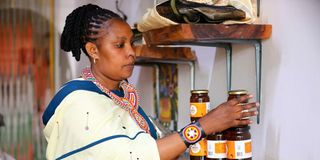
Rosemary Mosiany, an apiculture farmer specialising in organic honey, arranges packaged honey at her shop in Nanyuki town on February 26, 2026. She harvests one-and-a-half tonnes of honey every season, and makes and sells beekeeping equipment.
Rosemary started bee farming in 2018 with five hives. After seeing the potential, she expanded to 80 hives in 2022. Today she manages 618 hives spread across Ilmotiok, Loshaiki, Musul, Soit Oitashe and Karrum villages. Each hive yields an average of eight to 12 kilogrammes of honey per harvest. With three harvests a year, she produces approximately 1,500 kilogrammes of honey per harvest.
Her honey travels far. From her shop in Nanyuki town, which brings in between Sh80,000 and Sh100,000 a month, it moves to other parts of the country and beyond, sold at Sh1,500 per kilogramme, Sh750 for half a kilogramme and Sh450 for 400 grammes. In a good season, when all of it moves, she makes more than Sh2 million.
"Our honey fetches higher prices because we refine and repackage it ourselves. We sell throughout the country and also export to countries like the US, the United Arab Emirates and Türkiye. All I can say is that beekeeping is a good farming venture," she tells the Nation.
The demand, she adds, regularly exceeds what she can supply. "The demand for organic honey is very high and the market is there. I recently received an order for five tonnes of honey from Dubai, but I was unable to meet it," she says.
To meet the rising demand, Rosemary plans to expand her hives to 3,000, which would allow her to harvest at least 20 tonnes per harvest. Her business extends well beyond the honey itself. At her workshop in Nanyuki town, she makes Langstroth, Kenya Top Bar and traditional hives, which she sells to individual farmers, community groups, NGOs and government agencies at between Sh4,500 and Sh6,500 each.
She also sells the by-products of honey refining, among them beeswax, propolis, bee pollen, bee venom and royal jelly. "I currently have a tender to supply 180 beehives to an NGO at Sh6,500 each. Selling beekeeping equipment is also a source of income for me," she says.
She attributes a surge in sales to digital marketing through TikTok, Instagram, Facebook and LinkedIn, as well as her own website. Her main challenge is access to the financial capital needed to scale up and export at volume.
Rosemary has also trained more than 200 women in beekeeping and is currently working with 15 women's groups drawn from different villages. "I have been able to buy one acre of land where I intend to build my home and put up a modern workshop for making beekeeping equipment and a honey refinery. Proceeds from the business have also helped me take care of my family, including paying school fees," she says.
Her husband, Piranto ole Mosiany, says he has stood with her throughout the venture. "Women are also good in business. What they need is support and mentorship and they are good to go. They should not be left behind in matters of economic empowerment," he says.
Both Christine and Rosemary are beneficiaries of the UAE Strategic Partnership Framework programme, implemented through UN Women Kenya, which supports women entrepreneurs through capacity-building initiatives on gender-responsive procurement, the Women's Empowerment Principles, access to finance and trade. The programme aims to strengthen women-led enterprises, build resilience and expand their participation in economic value chains.
Antonia N'Gabala Sodonon, the UN Women Representative in Kenya, says women's economic empowerment has been central to the organisation's mandate since it was established in 2010.
"Gender-responsive procurement creates the right environment for women entrepreneurs and women-owned businesses to thrive, compete and drive economic development. The UAE Strategic Partnership Framework programme provides much-needed momentum by expanding economic opportunities for women entrepreneurs in Kenya, Chile and globally, including by making procurement policies and practices more gender-responsive," she says.
As a result of the Gender-Responsive Procurement training by UN Women, Rosemary embraced e-procurement and obtained Kenya Bureau of Standards certification, which has helped her make more sales. She also registered for the Access to Government Procurement Opportunities programme and has since supplied equipment to the Laikipia County Government and six NGOs.
"After the training, I registered for AGPO and as a result I have supplied equipment to the Laikipia County Government and six NGOs. The training was an eye-opener. It taught us how to register for AGPO and how to obtain the certifications needed to export to East African countries," she says.
Christine says the training she received covered record keeping, AGPO registration and how to navigate e-procurement, including tendering for government contracts. She has not yet secured a government or private sector tender but says she is optimistic that she will.
Ruth Lengosek does not wait for the day to warm up. When the Nation arrives at her farm in Mauneri village, Poro Ward, about 50 kilometres from Maralal town, she and a group of women are already deep in one acre of onions, weeding in the early morning cool.
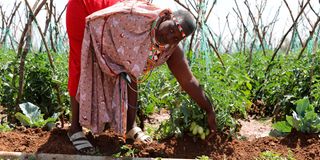
Ruth Letirok Lengosek tends tomatoes on her farm in Mauneri village, Poro, Samburu West, on February 19, 2026. Ruth is a renowned farmer in Samburu. She grows tomatoes, onions, cabbages, maize and water melon.
Her farm stands in sharp contrast to the land around it. Her fields are lush and green while the neighbouring tracts are dry, characterised by withering vegetation. Her farming is supported by a modern irrigation system that draws water from a nearby dam constructed by the Samburu County Government a few years ago.
She says her farming journey started in 2021 when she began with three acres of tomatoes and one acre of watermelon. "I got 10 tonnes of tomatoes per acre, which translates to about 30 tonnes from the three acres. I was lucky because the price of tomatoes was high at the time and I made sales of more than Sh4 million. I could not believe my eyes. It was an eye-opener that farming could pay that much. From that time, I have never looked back," Ruth says.
Since then, she has diversified into tomatoes, onions, watermelon, maize and cabbages. Currently she has seven acres of potatoes, five acres of onions and three acres of cabbages. Last year she farmed seven acres of onions, harvesting at least ten tonnes per acre, and one acre of maize, harvesting 23 bags which she sold at Sh4,200 per bag.
That shift, she says, has changed what ends up on the tables of families across the region. "In the past, all farm produce coming to Maralal and other towns in Samburu, including cabbages, potatoes, onions and tomatoes, used to come from Nyahururu. Now, after embracing irrigation farming, we are able to supply food to our local towns ourselves," Ruth tells the Nation.
Digital marketing has opened doors she did not anticipate. "Through Facebook, TikTok and Instagram, I have been able to get customers as far as Mombasa, Nakuru and Nairobi. Whenever I post my farm produce, I get a lot of interest. I am now scaling up my farming so that I can export to neighbouring countries, where I have been receiving a lot of inquiries," she tells the Nation.
Ruth employs 40 seasonal labourers, the majority of them women, and has trained 15 women and young people in climate-smart agriculture. Using income from the farm, she is also currently pursuing a degree in Agricultural Management at Mount Kenya University.
The road into Mauneri village becomes impassable when it rains, cutting her off from markets and causing losses she cannot always recover. Perennial drought is the other constant battle.
What Christine, Rosemary and Ruth have each encountered along the way points to challenges that go well beyond their individual circumstances.
Albert Wanjohi, Samburu County Director in charge of Gender, identifies culture as the key barrier to women's economic empowerment in the county, alongside low literacy levels among women, lack of capital and insufficient political goodwill.
"It is very impressive to see that things are changing and more women are now venturing into business and farming, which is uplifting their economic standards. The biggest challenge that women face remains lack of capital to start investments of their choice," he says.
He adds that the adoption of the Samburu County Gender Policy is also helping to enhance gender equality in the county.
Nyandarua Governor Kiarie Badilisha, who chairs the Trade Committee of the Council of Governors, says access to affordable capital remains the most significant barrier facing women entrepreneurs. He points to additional constraints including limited access to larger contracts, collateral requirements, capacity gaps in business management and market linkage challenges, and says addressing these barriers requires deliberate policy alignment and coordinated institutional support.
The governor is calling for the institutionalisation of gender-responsive budgeting across all counties to track and scale investments in women-owned enterprises, the establishment of integrated County Women Enterprise Hubs combining business incubation, access to finance, digital training, certification support and market linkages, and the development of an inter-county digital women supplier registry to expand market access beyond county boundaries and create a national marketplace for verified women-owned enterprises.


