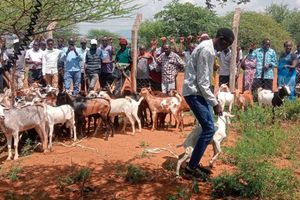
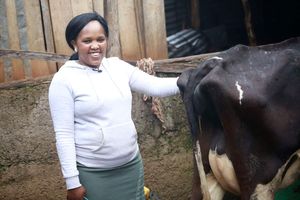
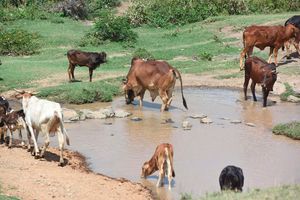
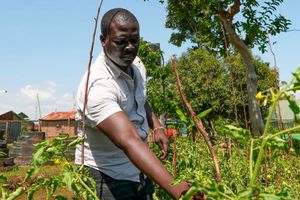
When a group of women in Makueni County came together 26 years ago to help one another acquire kitchen utensils, they had no idea they could play bigger roles in developing the community. Today, members of Utheu wa Aka self-help group have become award winning goat farmers.
Members of the group, which started with table banking were basking under the glory of their celebrity status after stunning challengers to scoop 26 awards at the Nairobi International Trade Fair several weeks ago when a Seeds of Gold team visited them at the sleepy Siembeni Village.
Maria Muthoka poses with a kid at Siembeni Village in Makueni County on September 22, 2025.
Photo credit: Pius Maundu | Nation
“We are elated for scooping four champions, four reserve champions and 18 other assorted awards at the Nairobi International Show,” said Janet Kataa, a champion goat farmer who is the chairperson of the self-help group which draws membership from the semi-arid region. She referred to the top most awards awarded to livestock farmers at the agricultural show.
Although members of the group raise the goats individually, a set of strict rules make the ventures a communal responsibility. The group’s constitution bars a member from selling a goat on a whim. The group’s winning streak started in 2018 when it showcased their animals at the inaugural Makueni Agricultural Show. “Winning at the Nairobi International Show for the first time in 2018 came as a surprise. We have won at all the subsequent Nairobi International Shows. This year we bagged the highest number of awards in various categories,” Ms Kataa said.
Janet Kataa Kiminza poses with a kid at Siembeni Village in Makueni County on September 22, 2025.
Photo credit: Pius Maundu | Nation
Mathenge Nyaga, a livestock judge at the Ministry of Agriculture and Livestock, says goats compete at the agricultural show based on their types, sex and age. “The belly of a dairy goat should sag so that it can carry a lot of feed for enhanced production of milk. The productivity of dairy goats is key when it comes to assessing them. A well-fed she goat is expected to produce a kid when it is between 15 and 18 months. Therefore, a dairy goat which has two teeth and above but has not produced a kid raises serious questions,” Mr Nyaga told Seeds of Gold .
“A meat goat breed should have a straight backline. Its legs should be sturdy to support its weight. The breast must be wide and the bone configuration blocky so that it accommodates a lot of meat. You can improve your herd by acquiring a male goat of desirable characteristics,” he added.
The awards by the Agriculture Society of Kenya crowned Utheu wa Aka’s long journey in community development. “Very few of us could afford plastic plates when we started. This is the problem we decided to address. Each member would raise Sh5 per week which we used to buy utensils for members. Within no time, we graduated to plastic chairs,” Ms Kataa said.
Ms Kataa was among the first beneficiaries of the group’s expanding role in the community. “When my husband died in 1998, the women's group came to my rescue. They helped me to set up a house which had collapsed. They also ensured my children remained in school,” she said.
Through discipline and grit, members of the group have turned around their economic fortunes. They have also transformed themselves into agents of sustainable development in a region which receives erratic rainfall. When they are not growing indigenous tree seedlings which they sell to individuals, government agencies and organisations running climate action programmes, they are keeping bees in modern beehives and promoting kitchen gardens to address food insecurity.
Jane Vaati prepares to feed goats at Siembeni Village in Makueni County on September 22, 2025.
Photo credit: Pius Maundu | Nation
A Sh120,000 grant which the group received from the Food and Agriculture Organisation (FAO) in 2016 changed its economic trajectory significantly. The group used the money to acquire Toggenburg goats to enhance milk production. Over the years, they switched to an interbreed of the Galla and the Small East African goat breeds which turned out to be a superior breed in terms of meat production and their adaptation to harsh climatic conditions.
“Zero grazing has ensured that our goats are in good shape. Although goats are highly resistant to drought, it is advisable to provide them with water and feed to ensure that they do not lose weight. We also deworm them regularly,” said Charles Mutie, whose wife is a member of the group. Among the fodder trees which members of the group introduced at Siembeni Village is Lucerne, a leguminous fodder shrub whose leaves are a big source of protein for livestock. The exotic plant has become handy when it comes to sustaining their goats during the dry spell.
Winning at the agricultural show translates to increased business for Utheu wa Aka members. “We cannot meet the growing demand for goats. We are currently serving two big orders in Kajiado and Embu counties. On average, a mature he-goat goes for 25,000,” said Jane Vaati, the secretary of the group of 13 members. This growing business has translated to increased household income for the group members. “Today, we borrow as much as we want from our group to take our children and grandchildren to school and support our families,” she added.
Jane Vaati poses with a kid at Siembeni Village in Makueni County on September 22, 2025.
Photo credit: Pius Maundu | Nation
It is the group leadership which has the final say on the planned transaction after evaluating the pressure of the pressing need. “Sometimes we allow a member to go ahead and sell a goat after evaluating the pressing need. However, we cap the price below which the member cannot sell the animal. This is our way of protecting the market,” Ms Vaati said. The group has embarked on promoting goat keeping among the youth who are reluctant in embracing the business.
According to Lawrence Matolo, the chairman of the Agricultural Society of Kenya in Kitui, Machakos and Makueni counties, Utheu wa Aka’s success points at regions' untapped potential in goat farming. “Every household in Ukambani should embrace goat rearing on a commercial scale. They are highly adaptive to drought which is associated with climate change,” he said.