NGAAF explainer: What is the National Government Affirmative Action Fund, and who does it help?
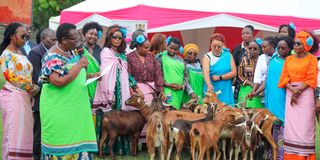
County Women Representatives, led by Nakuru's Liza Chelule, pose with goats donated through the National Government Affirmative Action Fund (NGAAF) at Kunste Hotel in Nakuru City on July 3, 2025.

What you need to know:
- NGAAF's primary mission is to bridge the poverty gap and advance gender equality by fostering socio-economic empowerment at the grassroots level.
Ruth Wangari was elated when she recently received a bursary from the local National Government Affirmative Action Fund (NGAAF).
Ruth, from Lari in Kiambu, is a student pursuing a technical, vocational education and training (TVET) course at Thika Technical Training Institute. She was among 1,000 students from secondary schools, colleges, and universities who received bursaries that day.
She, along with other college and university students, received Sh10,000 each, while secondary school students were awarded Sh8,000 from the fund under the patronage of the local Woman Representative.


The bursary came as a huge relief to Ruth, whose parents could not afford to pay her plumbing course fees.
"Many families are struggling to pay for their children's education because of the high cost of living. As someone from a humble background, my parents are struggling to pay school fees for my siblings and me. This bursary will go a long way in alleviating their suffering," Ruth told Nation.
So, what is NGAAF and what is it meant to do?
NGAAF is a critical funding mechanism instituted by the government under the patronage of Women Representatives to implement socio-economic programmes that support women, youth, and persons with disabilities across Kenya. The fund enables grassroots initiatives ranging from economic empowerment and health projects to bursary programmes and shelter provision for vulnerable groups.
NGAAF's primary mission is to bridge the poverty gap and advance gender equality by fostering socio-economic empowerment at the grassroots level.
Its key mandates include economic empowerment by providing grants to registered community groups to boost small-scale businesses, value-addition initiatives, and Table Banking savings programmes.
The fund also provides education support by issuing bursaries and scholarships to students from disadvantaged and marginalized backgrounds.
It is also meant to equip the youth who are not in education, employment, or training with essential financial literacy and entrepreneurial skills.
The fund was enacted through Legal Notice No. 24 of the Public Finance Management Act, 2012, and was officially launched in February 2015 during the 2014/2015 financial year.
Since its inception, the fund has directly supported over 18,500 women's groups and funded thousands of value-addition and socio-economic initiatives across Kenya's 47 counties.
NGAAF has supported over 217,000 vulnerable students with bursaries and provided specialised training or vocational scholarships to thousands of out-of-school youth.
The fund has also helped establish Gender-Based Violence (GBV) rescue centres and shelters across multiple counties to aid vulnerable survivors and rehabilitate them through business startups.
Among the counties where NGAAF has constructed safe shelters for SGBV survivors are Vihiga and Bungoma. In Vihiga, the shelter has a holding and accommodation capacity of up to 50 survivors.
According to the Kenya National Bureau of Statistics (KNBS), 33.8 per cent of women aged 15–49 in Vihiga have experienced physical violence since age 15. Furthermore, the sexual violence prevalence rate among women in the county stands at 11.9 per cent, while intimate partner violence affects about 43 per cent of ever-married or partnered women. Luanda and Hamisi sub-counties record the highest cases of sexual violence.
Arthur Lisimba, Vihiga County director in charge of Gender, says the shelter has been instrumental in providing survivors of sexual violence and GBV with a haven.
"Before we had the shelter, we used to take our survivors all the way to Kisumu. We are now happy that the shelter is nearby, which has reduced the distance and also the transport expenses," says Lisimba.
Kiambu Woman Representative Ann Muratha says NGAAF has been very instrumental in helping break the cycle of poverty and create sustainable livelihoods. Through NGAAF, Muratha says many women and youth have benefited from tents, chairs, hair dryers, blow dryers, welding machines, chafing dishes, shaving machines, juicers, business umbrellas, and trolleys.
"The fund has made it possible for people to reach their full potential, earn money, and provide dignified support for their families. We give our people the opportunity to start enterprises, generate jobs, and make significant contributions to the economy by providing them with tools and resources," the MP adds.
The national budget for NGAAF is approximately Sh2.7 billion. While there is no standard flat rate for all 47 counties, allocations per county are typically determined by the NGAAF Board using a poverty and population index, with counties historically receiving between Sh40 million and Sh50 million each.
Data from the State Department of Gender shows the fund has cumulatively disbursed Sh14.6 billion to Kenya's 47 counties since its inception.
The fund undergoes a rigorous, multi-level audit process to ensure that funds reach the intended groups.
The audit entails internal checks by county committees comprising NGAAF finance and procurement departments, county coordinators, and committees.
Externally, the Office of the Auditor-General, headed by Nancy Gathungu, serves as the supreme independent auditor. The Auditor-General legally verifies whether all NGAAF funds are utilised effectively and lawfully. Once the audit reports are completed, they are submitted directly to Parliament, which examines them. Parliament then summons
NGAAF management to respond to audit queries such as unsupported or flagged expenditures, and recommends action if money was misused.
There are several known, highly publicised cases of mismanagement and delayed disbursements within NGAAF across Kenya. The latest Auditor-General reports reveal systemic
weaknesses, poor oversight, and a lack of accountability in managing public resources.
Gathungu has flagged constituencies and counties for issuing bursaries without requisite application forms, missing official school confirmation or acknowledgment receipts, and lacking proof of valid beneficiary admission numbers.
Auditors have also questioned disbursements that breached fund guidelines. For instance, some NGAAF county offices were flagged for paying university school fees, which is not permitted under general vocational training guidelines, without explicit authorisation from the central NGAAF board.
Performance and compliance audits revealed instances where multiple students shared identical admission numbers or used duplicated student records to receive bursary allocations.
Who qualifies for NGAAF funding?
To qualify for NGAAF funding, one must be a registered group such as women’s, youth, or PWD groups or vulnerable individuals seeking economic empowerment or education bursaries.
Groups are required to have an active bank account and a valid registration certificate
If a group is seeking funding for an income-generating project or table banking activities, it's required to provide a valid group registration certificate that is at least six months old.
The group is also required to provide an active group bank statement and minutes from their group's meeting discussing the request for funds held within three months before application.
A duly signed list of members' names as they appear on their National IDs, phone contacts, and copies of ID cards of at least three group officials and records proving undertaking table banking or any other enterprise is also required from a group.
Any group is also needed to give duly signed NGAAF County Committee meeting minutes recommending their project.
The NGAAF funds are allocated across Kenya's 47 counties and are overseen politically by the elected County Women Representatives.
The fund operates as a Semi-Autonomous Government Agency with County Coordinators handling the daily implementation of proposals and disbursements.
It is strictly governed by the Public Finance Management and the National Government Affirmative Action Development Fund regulations.
[email protected]