One in every three women exposed to conflict globally lives in Sub-Saharan Africa
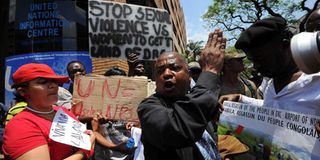
Congolese stage a protest in Pretoria, South Africa, against UN peacekeeping troops in Goma, for not protecting women and children against the M23 rebels. Women are often the victims of conflict.

What you need to know:
- More than 240 million women in sub-Saharan Africa lived near deadly conflict in 2025, five times the number recorded in 2010.
- A new PRIO study links rising conflict exposure to disrupted healthcare, education, food insecurity and worsening conditions for women.
More than 240 million women in Sub-Saharan Africa were living within 50 kilometres of deadly conflict in 2025, accounting for about a third of all women exposed to violence globally and marking a five-fold increase since 2010, a new study has found.
The findings are contained in a new policy brief by the Peace Research Institute Oslo (PRIO), which examines women's exposure to armed conflict between 1990 and 2025. The study defines women as being exposed to conflict when they live within 50km of at least one fatal conflict event.
Globally, about 756 million women, nearly one in five women worldwide, lived within that distance of a deadly conflict event in 2025. This is the highest number and proportion recorded since the 1990s. PRIO research director Siri Aas Rustad notes that conflict today is reaching more women than at any point since the end of the Cold War.


“These figures are more than a measure of violence; they reflect millions of lives shaped by insecurity, disrupted healthcare, lost education and fewer opportunities,” said Ms Rustad, the author of the report.
The analysis identifies Sub-Saharan Africa as the epicentre of the crisis, with more than 40 per cent of women in the region living in conflict during the preceding year, compared to about 15 per cent in the rest of the world.
The figures reinforce the Internal Displacement Monitoring Centre’s 2026 Global Report on Internal Displacement, which found that Sub-Saharan Africa recorded 17.3 million internal displacements in 2025, primarily driven by persistent conflict and violence.
Conflict uprooted millions across the region, with the Democratic Republic of the Congo recording 9.7 million internal displacements, followed by Sudan with 1.7 million and South Sudan with 864,000.
PRIO notes that conflicts vary in duration, with some being intense but short-lived, while others are protracted and marked by persistently lower levels of violence. Viewed through this lens, Sub-Saharan Africa still bears the greatest burden.
About 19 per cent of women in Sub-Saharan Africa had experienced continuous conflict for at least five years by 2025, compared with 6.6 per cent in the rest of the world. For conflicts lasting at least a decade, the gap was also substantial. Some 8.8 per cent of women in Sub-Saharan Africa had lived through such prolonged conflict, more than twice the 3.7 per cent recorded elsewhere.
This sharp increase in the number of women exposed to conflict in Sub-Saharan Africa since 2010 has largely been driven by a rise in state-based conflicts, alongside an increase in non-state conflicts that has disproportionately affected Africa.
The report shows that in 2025, Africa recorded 34 non-state conflicts, more than any other region in the world. The danger of prolonged conflict is that it deepens food insecurity, disrupts healthcare and education, and exposes mothers and children to greater risks, with girls being particularly likely to miss school. Its effects can last for generations, leaving lasting physical, cognitive and psychological scars on individuals and communities.
A fortnight ago, a Médecins Sans Frontières/Doctors Without Borders survey of 888 households across 14 displacement sites in Baidoa, Somalia, found that one in two children was acutely malnourished and one in four was severely malnourished. The sharp rise in the number of women in Sub-Saharan Africa living in close proximity to deadly conflict comes against a backdrop of weakening international support for peace and development in the region.
PRIO notes that while 15 United Nations peacekeeping missions were launched between 2000 and 2013, only one new mission has been established since 2013 despite the resurgence of conflict. At the same time, development assistance has fallen sharply.
Bilateral official development assistance to Sub-Saharan Africa declined by 26.3 per cent in 2025, according to the analysis, with the reduction coming as the region faced rising conflict and growing humanitarian needs.
For instance, the United States, one of Somalia's leading donors for years, including in 2025, has fully halted its support this year, while the United Kingdom has cut its funding by nearly half compared with 2025 levels. “This year, we have admitted 22,000 nutrition cases, an increase of more than 80 per cent from last year. At a time when we need a massive scale-up, we are seeing less support from donors,” said MSF Health Adviser Dr Mitchell Sangma.
The combination of increasing conflict, declining peacekeeping engagement and falling aid has created what PRIO describes as devastating consequences, particularly for women. PRIO's analysis further points to a close relationship between conflict exposure and broader outcomes for women.
Close to conflict
Its comparison of Sub-Saharan African countries found that those where more than 30 per cent of women lived close to conflict in 2025 had an average Women, Peace and Security Index score of 0.466, substantially below the 0.631 average among countries that experienced no conflict that year.
The index measures broader dimensions of women's inclusion, justice and security. The findings suggest that the consequences of conflict extend well beyond deaths and displacement, as they may weaken the foundations on which women's economic participation, education, access to justice and security depend.
The regional crisis is unfolding within a wider deterioration in global security, with 2025 recording the highest number of state-based conflicts since records began in 1946. It was also the fifth deadliest year for conflict since the end of the Cold War, with approximately 255,000 fatalities across all types of conflict.
Worldwide, the number of women living close to deadly conflict has almost tripled since 1990. In 2025, nearly 19 per cent of the world's female population was living within 50km of a fatal conflict event, compared with a much smaller share in the early 1990s.
The global picture, however, varies considerably by region, with South Asia experiencing an increase in conflict, whereas Latin America and the Caribbean recorded a decline. The Middle East and North Africa region saw a slight overall decrease over the longer period examined, although conflict has risen over the past five years. Conflict levels in Europe and Central Asia have remained comparatively stable.
The analysis found that the most prominent conflicts attracting global attention, including those in Ukraine and Gaza and tensions involving Iran and the United States, tend to overshadow several conflicts in Africa.


