The claim of the modern woman and man is that they are more civilised than before. Today, people claim that they no longer live at the mercy of nature, bloodthirsty rulers or invaders from across the borders of their communities.
Today’s civilisation cites technological innovation, which has made life easier and more predictable for a significant part of the human population, as proof that it is better off than ever before because humans eat better, live in good housing, move around faster, can treat most diseases, can resolve conflicts diplomatically, and so on.
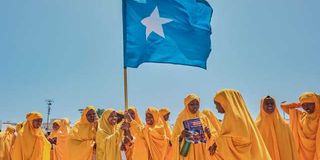
Yet the disintegration of a previously functional and stable society such as Somalia provokes several questions about modern civilisation and its claims.
How did a country that speaks one language — if we accept that assumption — fail to find peaceful resolutions to differences? Why has Somalia been unable to reconstitute itself as a modern nation-state?
When will the different ‘clans’ in Somalia agree to live together in peace, the way they had lived for millennia before? What does Somalia’s disintegration and its rebuilding efforts teach the rest of humanity about the fragility of societies?
Ali Said Ali tells the story of the collapse and reconstruction of the Somali state so acutely that the reader is left feeling as though they were right in the drama.
Born Into Battle: A Life That Had Every Reason to Fail (Longhorn, 2026) is a close-up account of how Somalia progressed from what would then have been described as a ‘developing postcolonial state’ into a state engulfed by conflict and war, a situation that is yet to be fully resolved.
Ali, who was born in 1984, has lived through Somalia’s ‘crises’ and survived to tell his version of the sorry tale. At his birth, Somalia was ruled by Siyaad Barre.
Just about seven years later, the then strongman fled Mogadishu. Ali captures the moment in a few words: “One Sunday morning, in early 1991, I saw two helicopters flying low over our house. People whispered that the president and his family were aboard. Whether it was true or not, the fear in their voices was real. By midday, everything changed. The government had collapsed. Order disappeared. Somalia descended into chaos and anarchy.”
What did it mean for a child for his country to collapse around him; for his father to lose his civil service job; for his family to suddenly lose its privileges and stability; for gunshots to determine everyday life? What did it mean for the child to grow into a boy, then a young man, with the uncertainties of lack, the destruction of property, insecurity, lawlessness, chaos and death? What did it mean for Ali to become an internally displaced person seeking safety and comfort from relatives hundreds of kilometres away from Mogadishu, only to discover that even his relatives could be less helpful because of their own helplessness? Ali’s life story relives the daily nightmare that life became after the fall of Siyaad Barre, but, most importantly, it demonstrates the undying spirit of humanity.
It is easy to read Born Into Battle as just another account of war and a failed state. However, this memoir is more than a tale of dystopia. Ali shows, almost on every page, that every moment in one’s life offers some lesson for a different time, day, activity or life.
Indeed, there are several ‘lessons’ in the whole story. Living, surviving deadly experiences, attempting to escape from the tragedy of a life lived on the edge for so long that a child matures into a married man must offer lessons along the way. For, if every encounter, interaction, conversation, whisper, threat or good deed isn’t a lesson about surviving the vagaries of war, how would one survive a war that lasts almost a lifetime?
Ali’s life could be described as having gone a full cycle by the time of writing the memoir. Yet he’s barely 40 years old at the time of writing his story. This is a man who’d seen his family separate. His father left Somalia. He, himself, left Somalia for Saudi Arabia. But the fortune he sought in the Middle East was elusive. He returned to a war-ravaged Mogadishu in 2010. He calls this homecoming, ‘From Exile to Mogadishu’s Hopelessness’. But Ali doesn’t give up hope.
He becomes a journalist who weathers several storms, including the killing of his colleagues and threats to his life. Eventually, he becomes a civil servant and joins the team of Somalis who ‘refused to give up hope’ and chose to reconstitute their country. At the end of his story, Ali is today what you can call an international civil servant — one of the men and women who silently keep sensitive processes that guarantee safety, security and life for billions of ordinary citizens.
This is a tale of knowing how to navigate hostile terrain; how to dream strategically; how to read the signs of the times; how to walk the streets and what posture to adopt; how to share trust with others; how to become a survivor and witness. This is a story of how the illusion of a modern nation-state can be confirmed in a single, simple moment to be just that: an illusion.
Politicians, ever chasing the dream of lording it over the rest of the citizenry, wouldn’t know, as Siyaad Barre and his people didn’t, when the whole quicksand structure comes tumbling down. What about the rest of the world? Do they owe any war-torn country assistance, empathy or friendship? Ali’s story suggests that, in the end, everyone has to fight their own battles and survive the consequences. He writes, ‘This book ends without triumph, without certainty, without guarantees. It ends with honesty. It ends with endurance.’ This is Ali’s testimony. But how many Somalis would agree with him or see the (hi)story of Somalia through similar lenses?
How can one measure success or happiness in a state that continues to destroy its own daughters and sons? How can a country recover when its best human resources continue to migrate to other parts of the world? Who will silence the guns in Mogadishu and other parts of greater Somalia? How can Mogadishu reconstitute itself as a welcoming seaside city, as depicted by Nuruddin Farah in his fiction? What can the likes of Ali, today working in the peacemaking and peacebuilding sector, do to restore long-term peace to Somalia, as the politicians continue to disagree over power? What lessons can the world learn from the resilience of one man, in this case, Ali Said Ali?
Probably not much, but his story is instructive, for he lived to tell the tale of ‘a life that had every reason to fail.’
Tom Odhiambo is an Associate Professor of Literature at the University of Nairobi. He teaches literature, performing arts and communication, and writes on literature, arts, culture and popular media.