Positive parenting: How Kilifi pilot programme is ending child neglect and abuse cases

National Positive Parenting programme officials. From left: Salma Kalume (Konjora 1 village elder), Geoffrey Kenga (Kibokoni Nyumba Kumi ambassador), Denis Kitsao (programme coordinator), Apopo Warren (Kilifi North Sub-County children's office), and Georgina Dulu (county director of gender and affirmative action).

What you need to know:
- Despite resistance from some residents and logistical limits, trained village elders, Nyumba Kumi ambassadors and counsellors are leading community sensitisation efforts, encouraging parents to actively participate in their children’s development.
- The programme has equipped over 1,000 parents and dozens of community leaders with skills in positive discipline, peaceful homes, child development, and family financial planning.
Officials say modern parenting skills, such as communication and involvement, are essential for protecting children from abuse, truancy and early marriage.
Poor parenting and retrogressive culture have always been cited as a major factor in the rise of gender-based violence cases in Kilifi. However, players in the child protection and justice system, including village elders, have welcomed the introduction of the National Positive Parenting Programme by the government as a game-changer.
The programme was launched in 2023. Kilifi—in Magarini, Ganze and Kalolen—was one of its pilot counties. Despite the resistance by some residents, the programme has broken the gender equality barrier and reduced cases of child neglect. The third cohort of parents and their girls will graduate in November 19.
Kilifi North Sub-County Children's Officer Apopo Warren says parenting is among the many child protection problems in the 21st century. He states that parenting a modern child requires modern parenting.



Kilifi North Sub-County Children's Officer Apopo Warren during the interview at Kibaoni Social Hall in Kilifi town on June 4, 2025.
“Gone are the days when we used to discipline children by caning them. We advise parents that the best way to discipline the gens Z and Alpha is sitting them down, discussing issues and giving them an opportunity to explain themselves,” he said, noting that neglect has led to many cases of defilement, child pregnancy, and child marriage.
Apopo says Kenya is grappling with absentee parenting. “Parents are absent and this is one of the serious things we are trying to fight. Some spent even more than one week away without knowing how their children are faring.”
He says that even with the Competence-Based Education (CBE), which requires their engagement, parents are still absent. “Our parents have neglected our children and they are perpetrators of abuse,” he added.
Apopo says positive parenting has halved cases of child neglect. “That is not enough; we need to make follow-ups to understand how far parents are equipped with modern parenting skills.”
Before the programme, Kilifi would record over 1,000 cases of child neglect in a financial year. And many more cases were not being reported. “An average of 30 children in every village in Kilifi are not in school and we are continuously doing the operation back to school.”
Apopo cites Kiwapa village in Kibarani, Kilifi North, where 92 children aged between 4 and 14 have never set foot in school. However, the programme faces logistical challenges. “We are not able to reach out to every area, yet the programme was not piloted in all the nine sub-counties.”
In 2023/24, Kilifi North recorded 513 (246 boys and 267 girls) cases of neglect out of a total of 890 cases—434 boys and 456 girls. The department handled a total of 878 children—429 boys and 449 girls. Nine-one neglect cases of girls were aged 11–18. “Because of the hardship, most of these girls accompany their mothers to earn a living, but some of the boys are allowed to go to school. The majority of them, aged 11–18, have been allowed to get married.”
Apopo says children’s officers who were trained in positive parenting, like himself, sensitise the community. To strengthen child protection, the Department of Children’s Services agreed with the Judiciary and other child justice players to dig deeper into cases where children have been abused. They are supposed to screen and understand the push-and-pull factors within the family. “If we realise that the parents or caregivers have played a role in this child getting abused, we recommend child negligence charges to deter similar incidents.”
The officer says they will use the positive parenting manuals to sensitise key partners in child protection and duty bearers, including government administration officers led by the county commissioner. “In the next few years, we need to have reached every family and trained them in how best they can take care of a modern child.”
He says child gangs, defilement, truancy, drug and substance abuse are some of the problems hurting children in Kilifi. “The problems facing our children start at the family level where there are so many dysfunctional families.”
The programme has trained volunteer counsellors and child protection volunteers in all 35 wards to train parents in positive parenting. Geoffrey Kenga, Kibokoni Nyumba Kumi ambassador in Kibarani, Kilifi North, says key people in society lack proper knowledge on proper child development and how to address conflicts. “If it were not for the training of positive parenting, we would not intervene in arising matters. We were not aware of the best ways to bring up our children to be productive,” he says.

Kibokoni Nyumba Kumi ambassador Geoffrey Kenga during the interview at the Kibaoni Social Hall in Kilifi town on June 4, 2025.
He states that implementing the programme is challenging given the cultural beliefs deeply rooted in residents’ mindsets. However, the community is embracing it slowly. “In the beginning there was a lot of resistance, but as time went by, we realised it was a good programme that has come to help our community,” he says. “Culture is still a challenge in Kilifi; there are families who still do not see the importance of educating a girl child.”
Village elders have dedicated themselves to sensitising the community to positive parenting. “We address discrimination among persons with disability, suicide and stigma among victims of gender-based violence,” Geoffrey says, calling on the government to scale up the programme.
Training
Salma Kalume, Konjora 1 village elder in Kibarani, is a graduate of the 14-week National Positive Parenting Programme. Learners are taken through 14 different topics—two-and-a-half hours weekly. These topics include an introduction to positive parenting and family relationships, which highlighted the role of families in raising better children.
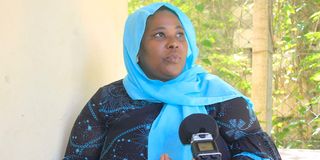
Konjora 1 village elder Salma Yusuf Kalume during the interview in Kilifi North on June 4, 2025.
Further, community leaders learn about the roles of a parent in child development, including building stronger and secure attachments, caring for themselves and others, and positive communication. Salma says positive communication changed the perception of children. “We came to understand that positive communication is crucial and really matters in child development.”
The other lessons included positive play and preparing to learn, positive discipline, and positive male involvement. “In the past, men left all the responsibilities to women, but we are glad that after the training, they have changed and are now supporting their wives,” she noted.
In addition, they learned about keeping peaceful homes, addressing disputes, positive and protective communities, family health and nutrition, and family financial planning. Programme coordinator Denis Kitsao says engaging Nyumba Kumi ambassadors and village elders is one of the components of investing in children and their societies and their role is mobilisation and raising awareness.

National Positive Parenting program coordinator Denis Kitsao during the interview at the Kibaoni Social Hall in Kilifi town on June 4, 2025.
He states that positive parenting is subject to community cultural and social norms, which village elders are conversant with. Community leaders are also first responders. “The community will say if our leaders are embracing the programme then it is good for us. Now to win this, they are the ones leading the campaign,” he says.
Denis says local administrators were given key messages to impart to the community and the principles to follow when handling cases or giving advice. He terms it encouraging that a year after they were trained in positive parenting, community leaders are still incorporating what they learned in their day-to-day assignments like during chief baraza, church services and school meetings, among other forums. “The programme has reduced violence against children and intimate partner violence. It is strengthening the families,” he says.
Denis states that the programme has brought on board religious leaders to reach out to more parents. Others are frontline workers, including those under the Directorate of Social Development, community health promoters and child protection volunteers.
Georgina Dulu, the county director of Gender and Affirmative Action, says they have reached over 1,000 parents. “The programme has taken a different angle and strategy for prevention of gender-based violence, which was on the rise due to inadequate parenting models,” she says.

Kilifi County Director for Gender and Affirmative Action Georgina Dulu during the interview at Kibaoni Social Hall in Kilifi town on June 4, 2025.
The programme is domiciled in the State Department of Social Protection and Development. Georgina says it has shaped the approach to matters and community engagement by village elders and Nyumba Kumi ambassadors. It has also improved their level of confidence and knowledge. She says that previously, they engaged the community based on the basic knowledge they acquired while growing up, learning from social media and casual talks from the public. “The community sees itself as learned, giving factual information and not doing guesswork.”
Georgina echoes the call by village elders and Nyumba Kumi ambassadors to scale up the programme and incorporate more players countywide. “Many of us are raising children the way we can, but we need to enhance our skills considering the times we are in now.”