Power, politics and public scrutiny: The price of leadership in an era of online abuse
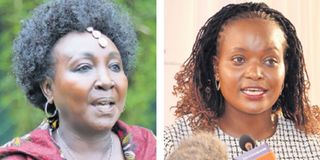
National Assembly Deputy Speaker Gladys Boss Shollei, who urged leaders to rise above online abuse and stay focused, and Women's Rights Adviser Harriette Chiggai, who called for greater political participation and stronger mentorship.

What you need to know:
- Gladys Boss Shollei revealed how she overcame public scrutiny following her divorce while urging women leaders to rise above online gender-based violence and remain focused on service.
- At the Women Achievers Conference 2026, women leaders called for greater political participation, mentorship and voter support to increase women's representation in Kenya's leadership.
Gladys Boss Shollei, the National Assembly Deputy Speaker and Uasin Gishu Woman Representative, was attending a function in her county when she found herself at the centre of a public storm.
“I had the scandal of my divorce. I remember I was the number one trending topic in Kenya and I was like, my God, I mean, what has it got to do with who I am and what I do?” she shared during the Women Achievers Conference & Awards 2026 held on July 28, 2026. The conference was hosted in Nairobi by the Office of the President’s Women’s Rights Adviser.
In sharing her experience, she was encouraging the women leaders who had gathered at the conference to rise above the violence and harassment they are subjected to online and in their physical environments.


“What's happening now... gender-based violence before was physical, but now it's in social media and so on. They judge women more harshly than they judge men... but it just tells you that it's harder for women. But my advice is just grow a thick skin.”
She recalled that her sister showed her the breaking news while she was at the function, but she asked her to tell her how bad it was after she had finished the event.
“But I remember I was encouraged by a lady who came on stage and decided she was addressing us. So she came on stage, then I saw her crawling to the stage and I said, but I thought I bought this lady a wheelchair. But you see, she came on stage and she talked about how I changed her life,” she said.
“And then she had the wheelchair brought dramatically to the stage and then she got on it. So after that I told myself, who cares what's on social media? And that's when I told people I'll never talk about it again because if it were men they wouldn't say anything about it.”
She shared practical tips for women seeking to climb the ladder of elective and appointive leadership. Referring to advice that Supreme Court Judge Njoki Ndung'u gave her years ago, she said women should actively participate in political party activities because that is how they put themselves on the table. “If you're not useful to the political party, it's very difficult to get any support from them,” she said.
She encouraged women to run for political seats regardless of whether they win or lose because that is one of the gateways to earning an appointive position. “Why? You're putting your name on the map. And one day when they'll be discussing who to appoint where, even if you didn't win the election, your name shall be on the table,” she said.
“But if you don't put yourself out there, it's very hard to be able to move forward. Then remember most political parties are actually controlled by men.”
She acknowledged the role the late Orange Democratic Movement leader Raila Odinga played in catapulting women into Parliament. “In fact, one of the things that we can thank the late Raila Odinga for is that he actually was a feminist,” she said. “If you think of how many women he managed to have elected in single-member constituencies, they are quite a number.”
But women cannot remain on standby if the country is to have more women in leadership, according to President’s Women’s Rights Adviser Harriet Chiggai.
Mentorship
She said experienced women have a responsibility to mentor others and, if that happened, Africa would never suffer a shortage of leaders. However, she said that vision cannot become a reality if women remain spectators during elections.
“I, therefore, call upon every woman in this country to take a vote,” she said. “Go and register, go and vote for your chosen leaders. Support competent women. We don't have a shortage of women in leadership. Encourage young women to seek elective positions.
“Campaign for inclusive leadership. It's not a one-man show or a one-woman show. Democracy works best when women participate fully, not only as candidates, but as voters, organisers, decision-makers and changemakers.”
She said the courts would never save the country from the failure to implement the two-thirds gender principle. Instead, she urged women to begin achieving it “in our homes, in our communities, in our mentorship circles, at our workplaces and, ultimately, at the ballot box”.
“I challenge you to go and vote for women leaders. It's your job to vote. If you wake up in the morning to go and vote, why are you not electing women who have positioned themselves?” she said.
She said Kenyans should stop “yelling at the government on the two-thirds” gender principle and instead “get it done and make it so easy for the next government to have women leaders.”
She, however, recognised the power of women supporting one another. “Without anyone holding your hand and creating a space for another young girl or woman, we are doing a disservice to this nation,” she said.
“Gladys Boss Shollei gave me my first job, and I did it pro bono until I earned some good money. She doesn't give up on her students. To date, she holds my hand. I will call Gladys Boss Shollei anytime and she'll tell me, 'Soldier on,'” she said.
She also recognised Dr Nancy Baraza, the former Deputy Chief Justice, who chaired the 42-member Technical Working Group on Gender-Based Violence, including femicide, for the role she played in shaping her professional future.
“As a student, Nancy Baraza gave me my first mic. And this I'm telling you, women, create that space for others,” she said. “There are those who will stick with you. There are those who will hold a knife to your back. There are those who will walk the journey with you to the end, no matter how hard it is. But that's life.”
Elizabeth Koskei, the Chief Executive Officer of MaMa Doing Good, an organisation that advances the vision and flagship programmes of First Lady Rachel Ruto, also encouraged young women to fearlessly pursue leadership.
“To the young women listening today, please don't wait until someone tells you that you are ready. No one will. You probably never will hear it,” she said. “Dream anyway. Apply anyway. Lead anyway. Start anyway. Because confidence doesn't come before courage. It is courage that comes before confidence. So be confident.”
Betty Adera, chairperson of the conference, urged the women to commit themselves to creating opportunities for other women to rise, stand alongside them and be seen. “The measure of our leadership is not found in the titles we hold, but in the opportunities that we create for others to lead,” she said.
In 2020, Kanu fronted her for the Nairobi governorship after the Senate upheld the impeachment of Mike Sonko.
Then, in 2021, she was one of the two women who sought the Jubilee Party ticket for the Nairobi gubernatorial seat. However, the by-election, which the Independent Electoral and Boundaries Commission had scheduled for February 18, 2021, was suspended by the High Court following legal challenges filed by Mr Sonko.


