What it takes to lead: Top women share lessons they learned the hard way
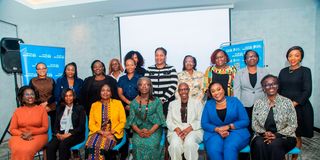
Some of the women leaders who attended a high-level roundtable convened by UN Women Kenya on July 8, 2026 at Novotel Hotel, Westlands, Nairobi.

What you need to know:
- What made this particular roundtable different was not the presence of powerful women in one room; Nairobi has no shortage of panels featuring the same.
- It was the decision, made collectively and early, to speak plainly about the costs of leadership, not only its rewards.
It was just past 8am on a Wednesday at the Novotel Nairobi, Westlands, and the room was already full. Corporate executives sat beside senior government officials, while telecom directors shared a table with civil society leaders. On the long table, small cards bore the name of the day's gathering: The High-Level Roundtable on Women's Leadership in Kenya, convened by UN Women.
In the room sat women from banking, insurance, telecoms, and manufacturing. Risper Ohaga of Apollo Group was there, as were Elizabeth Wasunna of Absa Bank, Njeri Jomo of Jubilee Health Insurance, Beatrice Kirubi of Safaricom, and Juliana Wanjiru of KWFT. Wambui Gaitha, CEO of Women on Boards Network Kenya, and Anne Mureithi of Ecobank Kenya sat among them too.


Everyone in the room already knew Kenya has made progress on gender equality. They have lived it. Some of them have been the ‘first woman’ in a boardroom, as an organisation CEO, or an industry association, at some point in their careers. What brought them together that morning was a harder question: decades into that progress, why do very few women still reach the apex, and what does it cost the ones who do?
As the morning progressed, participants spoke candidly about bias, missed opportunities, weak mentorship and the importance of making women more visible in leadership. They also warned that unless more women are equipped with digital and AI skills, they risk being left out of industries shaping our future. The conversation was brutally honest, punctuated by moments of laughter and thoughtful silence - an honest account of what leadership demands of a woman in Kenya today.
The warning behind the welcome
Zuhura Odhiambo, the CEO of New Revenue Resolutions Africa, kicked things off with a picture of where things actually stand: real progress for women in education and business, but almost no movement once you get up to the executive floor and the boardroom table.
UN Women Kenya's Country Representative, Antonia N'Gabala-Sodonon, sharpened that picture in her welcome. According to her, Kenya has made genuine progress, with new laws, new policies, and real commitment on paper. But patriarchal attitudes remain one of the biggest barriers standing between qualified women and the top job. The problem, she argued, is no longer whether women are capable, but whether they can access opportunities and finance, and be in rooms where decisions are made.
That warning had an edge to it. She also pointed out that Kenya could end up shutting women out of the industries that will actually shape its future: AI, digital tech, and innovation. Build those sectors now without women at the table, she warned, and the country will spend the next 10 years trying to fix a gap it saw coming.
Then two women stood up and showed exactly what it takes to close a gap like that.
"You've got to be comfortable in this game": Dr Gilda Odera's journey
Gilda, now vice chair of the Salary and Remuneration Commission, took the room back to where her career began: in marketing services, running promotions for what was then East African Industries (Unilever). It was there, decades ago, that she met a young saleswoman negotiating the price of pickup trucks for a competition prize. That saleswoman was Rita Kavashe, who would go on to become one of Kenya's most recognised corporate chiefs, and whose own path would run alongside Gilda's for the next 30 years without either of them planning it that way. Gilda's career took her from marketing into the male-dominated world of ICT, then into entrepreneurship, then onto the board of the Federation of Kenya
Employers; a journey she described as proof that a leader does not need to stay in one lane. Adaptability, she said, is what got her through. She had no technical background when she moved into ICT; what she had was a marketing head, a willingness to learn fast, and enough nerve to show up anyway.
She was also candid about a detail many leadership stories leave out: the men who backed her. From her husband at home to colleagues at nearly every stage of her career, she said, it was men, almost entirely, who recognised something in her worth investing in. She did not offer that observation as flattery. She offered it as a challenge. If women want to be seen that way, she argued, they have to make themselves visible, because invisibility lets a handful of highly publicised bad examples define how an entire gender in leadership gets judged.
The personal cost of standing out became clear during her years on public boards. Not long after her term at the National Hospital Insurance Fund ended, Gilda found herself summoned by Kenya's Directorate of Criminal Investigations, on what was called Kamata Kamata (arrest) Friday — arrest day, when prominent names were picked up and held over the weekend. Colleagues from her own board were driven in from as far as Kilifi and held through to Monday. Gilda was allowed to go home, on the strength, she believes, of her own credibility with the officers who came for her. She was teaching a Bible study class on Monday, she told them, and they let her keep the appointment.
Her point was not that public leadership is safe. It plainly isn't. What keeps many capable women from putting their names forward, she said, is fear of exactly that kind of exposure. Her advice: build your integrity early, and let it carry you when the pressure comes. "Fear is what holds you back from your destiny," she told the room, and pointedly, not the system, not the men in it, but fear itself.
By the time she became the first woman in 65 years to lead the FKE, Gilda had already decided what she would do with the position: serve one term only, rewrite the organisation's constitution, and leave. The les- son she wanted the room to take from that was about impact, not titles. A leadership seat that changes nothing, she said, is just a feather in a cap.
"I am the managing director": Rita Kavashe's journey
If Gilda's story was about persistence inside institutions, Rita's was about persistence in getting a hearing at all.
Rita, now managing director of Isuzu East Africa, began her career not in business but in a classroom, a trained teacher of literature and Kiswahili who set aside her Teachers Service Commission posting to try her luck in the city instead. She landed at a motor company's sales floor, with no engineering background and, by her own account, a long list of things she did not yet know. What she decided to do about that gap became the through-line of her entire career: she asked to be the one moving between departments, purchasing, finance, engineering… instead of staying fixed at her desk, because she wanted to understand the whole business, not just her corner of it.
That curiosity nearly didn't pay off. She recalled being turned away three times by a finance director when she tried to bid for a government tender the company had never pursued before, because the sales data needed to build the bid simply did not exist yet.
On the fourth attempt, he relented and later told a room full of colleagues that he wished he had more employees like "that new girl." She did not win the tender. But the sentence followed her into the rest of her career, and it was, she said, the moment that pivoted her from being a good salesperson into being developed, deliberately, as a leader.
Rita was equally candid about what changed once she became the company's managing director and started stepping outside its walls into industry bodies like the Kenya Association of Manufacturers, where she met other business leaders, built her network, and, in one case, was pursued for two years before agreeing to join the board of British American Tobacco, after a fellow CEO noticed her advocating hard for her industry at a State House roundtable.
Visibility had a price, too. She still remembers the calls asking to speak to "the Managing Director," and the pause on the other end when she said that was her. She never tried to shield herself against it. "I decided to be me," she said. "Rita will remain Rita." She stayed reachable instead; to journalists, to young women coming up in her industry, to anyone trying to picture what a woman running a motor company even looks like. She couldn't very well tell a younger woman to aim for a seat that looked locked from the outside. Rita ended her testimonial with the model she still uses: commitment, adaptability, responsibility, relationships, and empowerment.
Commitment earns respect, she argued, because it must be proven through delivery, in whatever role a woman holds. Adaptability meant being willing to jump — teaching, then sales, then the executive suite. Responsibility meant owning whatever chance came her way, instead of waiting to feel ready for it. Relationships are the networks women build with each other and, she stressed, with men too, since no leader, in her view, gets to lead entirely alone. And empowerment is the obligation to extend the same opening you were given to the next woman coming up behind you.
Real gaps
The testimonials gave way to a guided roundtable discussion, led by Antonia, on the links between the private sector and public leadership, and it was here that the room's collective experience turned into something closer to a diagnosis.
One thread ran through nearly every voice at the table: women are still underrepresented in the rooms where they are needed most, not because they lack competence, but because too few put themselves forward and too few are actively pulled forward by those already inside. Rita had made a version of this point in her own testimonial; many capable women in Kenya's middle and senior management simply need someone to name them as ready and coach them into the next level, rather than assuming they will apply for a stretch role on their own.
Participants also acknowledged a harder truth about how leadership pipelines actually work in practice: it is rarely a straight promotion up a single ladder. Both Gilda and Rita had taken sideways, unlikely routes; a teacher into a motor company, a marketer into telecoms and then a statutory commission; and both credited that willingness to pivot, more than any single qualification, for getting them where they eventually landed.
There was also a shared insistence on separating capability from access. As Antonia put it in framing the discussion, the women in that room were not short on skill or ambition. What they lacked, again and again, was access to mentors willing to vouch for them, to capital, to land and productive assets for women running their own enterprises, and to the informal networks where opportunities are quietly discussed long before they are ever advertised.
Way forward
Participants then focused on what needs to change. They agreed that female professionals cannot be expected to rise through the ranks without deliberate support. They called on organisations to invest more in mentorship, boards to widen the pool from which they recruit leaders instead of relying on the same familiar names, and both the government and private sector to invest in digital and AI skills for women. Several speakers warned that unless women are prepared for industries shaping the future, today's gender gap could become even wider.
Gilda added a broader point about the stakes involved. Kenya's investor confidence and its standing as East Africa's anchor economy depend on stable institutions and inclusive leadership, she argued, which makes women's fuller participation in governance not a fairness issue alone, but an economic one.
Business, she said, thrives on stability, and stability depends on the kind of consensus-building that women, in her experience, do particularly well.
Both she and Rita urged women to be more intentional about pursuing leadership opportunities. They encouraged them to put themselves forward for senior roles, take on unfamiliar assignments and open doors for other women coming behind them.
Gilda left participants with one final piece of advice: "Leadership, at its core, is what you choose to do with the seat once you have it."
Honest conversations
What made this particular roundtable different was not the presence of powerful women in one room; Nairobi has no shortage of panels featuring the same. It was the decision, made collectively and early, to speak plainly about the costs of leadership, not only its rewards. Fear and bias, whether in a phone call, a boardroom, or a Friday arrest sweep, were all named. And still, every woman who spoke that morning had stayed in the arena.
By the time the room gathered for its closing photograph, just before 10am, nobody was claiming the barriers had disappeared. What had changed was the forthrightness. Women who had broken those barriers spoke openly about how difficult the journey had been.


