The high cost of political ambition: Why money is shutting women out of 2027 election
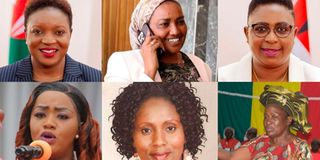
Some of the women leaders aspiring to governorship in 2027.

What you need to know:
- Campaign spending limits run into millions of shillings as women continue to face deep economic inequalities.
- Women candidates say party support and grassroots networks can help overcome the high cost of political campaigns.
Dr Juliet Kimemiah describes campaign financing limits for elective seats, from the presidency down to county wards, as “humongous”.
She has tested the waters before, vying for the Kiambu senatorial seat in 2017 and the governorship in 2022, and is now eyeing the county's top seat again in 2027 on a Kanu ticket. She knows exactly what a huge financial investment in campaigning means, and how it can knock a candidate off balance, even to the point of ruining their business.
“I can tell you for sure, I'm going for the governor's seat, but I don't have that kind of money, and neither did I when I vied in the previous elections,” she says.


But her lack of money did not stop her from securing the Kanu ticket. Dr Kimemiah says the party gave her the gubernatorial nomination certificate without requiring her to pay the Sh1 million nomination fee.
"I didn't pay a cent," she says, describing the party's support as one of the interventions that allowed her to enter the race despite lacking the financial resources her competitors had.
Having gone through the campaign cycle before, she says she witnessed the scale of spending by male gubernatorial candidates in Kiambu, with one spending about Sh600 million and another more than Sh300 million.
The financial burden, she says, can have devastating consequences. One of the candidates who spent more than Sh300 million eventually saw his company collapse.
Navigating a lack of campaign financing
Dr Kimemiah says support from her political party, women's rights organisations, the church and the media enabled her to compete. She says they gave her a platform to gain visibility among locals.
"Kiambu has 60 wards. It's logistically expensive to visit all of them, so I had to leverage every available platform, including funerals and church functions," she says.
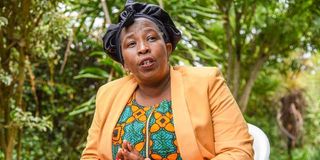
Dr Juliet Kimemiah, who aspires to the Kiambu governorship after unsuccessfully vying in 2017 and 2022.
"There was also a grassroots women's rights organisation that really came through for me. They would organise forums at the grassroots and invite me to sell my agenda. Although I didn't win, that was a huge lesson for me in navigating the lack of the huge financial resources needed for campaigning."
Other women's rights organisations, she says, also helped with campaign materials, including posters, easing some of the financial pressure. But security was one cost she could not avoid. She says she had to cover the cost of her own security detail because "security is a must" for anyone pursuing political office.
Highest ceiling, widest gender gap
The price of entering Kenya's political arena runs into hundreds of millions of shillings in some counties, yet the communities where these races are fought are marked by sharply unequal economic opportunities for women. Kiambu is one of them.
The Independent Electoral and Boundaries Commission, in a gazette notice published on 7 August 2026, set the campaign contribution and spending limits for the General Election scheduled for 10 August 2027, covering both candidates and political parties.
The limits apply to expenses including campaign venues, publicity and advertising, campaign personnel, transport, communication, nomination fees, security, accommodation and administrative costs.
Nairobi City has the highest campaign spending ceiling at Sh181.3 million, and the widest gender gap among the 10 counties with the highest campaign financing ceilings.
Data from the Kenya National Bureau of Statistics show that in 2019, 30.3 per cent of young women aged 15 to 24 were not in education, employment or training, compared to 16.9 per cent of young men, a gap of 13.4 percentage points. The female rate was almost twice the national figure of 16.2 per cent.
The gap was also pronounced in Kiambu and Kajiado, where the difference between young women and men stood at 8.6 percentage points in each county. In Kiambu, 21.3 per cent of young women were outside education, employment or training, compared to 12.7 per cent of young men. In Kajiado, the corresponding figures were 21.4 per cent and 12.8 per cent.
Highest overall exclusion
The counties with the highest overall levels of exclusion, however, are largely among the vast arid and semi-arid lands (Asals). Garissa, with a spending limit of Sh106 million, has 841,353 people spread across 44,175 square kilometres. Almost half, 49.8 per cent, of young women were outside education, employment or training in 2019, compared to 44.4 per cent of young men. The female rate was more than three times the national figure.
In Turkana, the spending ceiling is Sh142.1 million, while its 926,976 residents occupy 68,680 square kilometres. The rate among young women was 40.3 per cent, compared to 36.5 per cent for men. Wajir, with a spending limit of Sh120.8 million, has 781,263 people across 56,686 square kilometres. There, 39.1 per cent of young women were outside education, employment or training, compared to 36.3 per cent of young men.
In Marsabit, which has the third-highest spending limit at Sh127 million, just 459,785 people occupy 70,961 square kilometres. Yet the rate among young women was 33.1 per cent, compared to 30.4 per cent among young men.
There are also Asal counties where the level of exclusion is lower. Kitui, for instance, covers 30,497 square kilometres and has a campaign spending limit of Sh97.6 million, but only 5.8 per cent of young women and 5.2 per cent of young men were outside education, employment or training. The gender gap was just 0.6 percentage points, the narrowest among the 10 counties.
Nakuru and Kakamega dynamics
Nakuru, a major agricultural and commercial hub in the Rift Valley, and Kakamega, one of western Kenya's most populous counties, each present candidates with the challenge of mounting campaigns across large and diverse constituencies.
Nakuru, with 2.16 million people spread over 7,495 square kilometres and a spending ceiling of Sh107.1 million, recorded a rate of 14.8 per cent among young women, below the national female rate. But young women still fared worse than men, whose rate was 8.7 per cent.
Kakamega, with 1.87 million people and a Sh88.5 million spending limit, recorded rates of 7.2 per cent among young women and 5.2 per cent among young men.
Sarah Muhoya, chief of party at the Echo Network Africa Foundation, which prepares women for elective leadership through training and material support, says money, political party backing and name recognition can improve a woman's chances of winning an election, but none guarantees victory.
“We have seen women with a good name, but they are defeated,” she said on 24 July 2026 during a national multi-stakeholder dialogue and sensitisation forum on gender-responsive electoral governance ahead of the 2027 General Election, organised by the foundation in Nairobi.
Good name not enough
She cited the late Nobel laureate Wangari Maathai's defeat in the 2007 parliamentary election in Tetu constituency as an example of why public recognition alone does not translate into electoral success. “So is a good name enough? No,” she said.
She also cautioned against assuming that securing a major political party's ticket guarantees victory, pointing to cases of women winning nominations in constituencies where they were expected to prevail, only to lose to candidates running on smaller party tickets.
She identified a lack of coordination among organisations working to increase women's political representation as one of the biggest weaknesses in efforts to advance women's leadership. “We do not have a common front for dealing with the matter of women's leadership,” she said, arguing that organisations continue to tackle the issue in fragmented ways.
She called for a strong lobby movement to bring together organisations working on women's political participation, allowing them to coordinate advocacy, pool resources and exert greater pressure for change.
Do your game, do your math
“We need to form a clear, proper, strong lobby movement that will tackle the question of women's leadership,” she said.
She, however, urged women seeking elective office to conduct political due diligence before deciding where to contest, assessing their local support, networks and prospects of winning. “Sometimes we overestimate ourselves. And in doing so, we lose,” she said. “Do your game, do your math, and then run from there.”


