Violence against women fuels Kenya’s HIV crisis
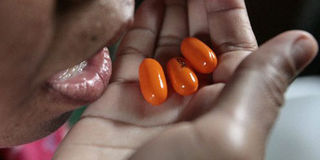
A woman living with HIV/Aids takes her dosage of antiretroviral drugs. Survivors of sexual violence face heightened HIV risk amid weak justice systems and persistent gender inequality.

What you need to know:
- Survivors of sexual violence face heightened HIV risk amid weak justice systems and persistent gender inequality.
- New data reveals alarming HIV infections among young women driven by violence, inequality, and limited healthcare access.
Mary Syombua* was living in one of Nairobi's informal settlements when chaos broke out following the announcement of the 2007 presidential election results. She was gang-raped by five men in the violence that followed.
Mary says she had been left behind when her neighbours fled; she was too unwell to move.
"It was around seven o'clock in the evening. The violence had already erupted, and my neighbours had fled, but I felt powerless and had no place to escape to, so I figured that if I secured the house and remained silent, they might assume it was unoccupied," she recalls.

Even with the door locked, five men forced their way in and raped her in turn until she lost consciousness.
A week later, she went to hospital for examination and treatment. "I got treatment and a devastating result. I had contracted other sexually transmitted infections. I felt like it was the end of the world for me."
After a while, she went back to hospital again and tested positive for HIV.
She reported the case to the police. Nearly two decades on, the case has never been prosecuted.
Mary's story is not isolated. Gender inequality has been identified as a major driver of sexual and gender-based violence, and, in turn, of rising HIV infections among women and girls.
The latest UNAids data shows that in 2024, around 4,000 adolescent girls and young women acquired HIV every week globally. Of these, 3,300 live in sub-Saharan Africa, where women and girls account for about two in every three new infections.
The UN body also notes that nearly one in four adolescent girls experiences physical or sexual violence before the age of 20, and that fewer than half of women worldwide can make independent decisions about sex, contraception, and healthcare, a gap the agency says directly fuels new infections.
Punitive laws have also been cited as a barrier to sexual and reproductive health and rights, and as a factor that accelerates HIV infections.
"When a girl cannot stay in school because of violence, when a woman cannot negotiate safer sex, when a survivor of violence cannot access healthcare and justice, HIV risk rises. HIV thrives where gender inequality persists," says Winnie Byanyima, UNAids Executive Director.
Byanyima has called for stronger community leadership and outreach, particularly by women leading such efforts.
"Let us reform unjust laws, protect services, and defend rights because ending Aids and building a just world begin with rights, justice, and action for all women and girls. Together, we can build a world where every woman and girl, including every woman and girl living with and affected by HIV, lives free from violence, fully in control of her rights, choices, and future," she said.
In Kenya, the situation is no different. According to the National Syndemic Disease Control Council, roughly 44 to 55 new HIV infections occur daily among females, with about 80 per cent of the 55 to 60 new daily infections recorded among girls and young women.
Unequal access
Young women aged 15 to 24 are disproportionately affected, with infection rates often twice as high as those among their male peers. Counties with the highest new female infections include Nairobi, Migori, Kisumu, Homa Bay, and Busia. Key drivers include gender-based violence, unequal access to education, and limited ability to negotiate safe sex.
The Kenya Demographic and Health Survey 2022 found that just over half of young people, 54 per cent of women and 55 per cent of men, know about HIV prevention.
In 2024, the government unveiled a comprehensive plan to eradicate what it termed the "triple threat" of new HIV infections, gender-based violence, and teenage pregnancy by 2027. Former Health Cabinet Secretary Susan Nakhumicha launched the initiative in Bungoma during the Western Kenya Women Summit.
"The journey to eliminate the triple public health crisis of HIV/Aids, teenage pregnancies, and sexual and gender-based violence has started. This is in line with our commitment to national and international conventions," she said.
Adolescent girls bear the heaviest burden of this triple threat. Despite a significant global decline in new HIV infections overall, adolescent girls and young women remain up to 14 times more likely to be infected than their male counterparts. In sub-Saharan Africa, 67 per cent, or 280,000, of new annual HIV infections among young people occur in adolescent girls and young women.
According to Unicef, adolescent girls in Eastern and Southern Africa are six times more likely to acquire HIV than boys, in a region where rates of early pregnancy and gender-based violence are among the highest in the world.
*Name changed to protect medical privacy of the rape survivor.


