Were you born by a fellow man? The anti-femicide gospel Baba preached
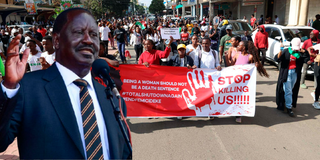
Demonstrators take part in the "End Femicide Kenya" nationwide march in Nairobi on December 10, 2024.Former Prime Minister Raila Odinga (inset) declared femicide a national emergency.

What you need to know:
- As femicide cases surged across Kenya, Raila Odinga emerged as the strongest political voice condemning the killings and declaring them a national emergency.
- His repeated calls for justice filled a leadership void that many felt had failed the nation’s women.
When Kenya was reeling from a worrying rise in femicide cases, all eyes turned to one person: President William Ruto. Kenyans wanted him to declare femicide a national emergency.
What concerned many was his silence. On social media, users kept asking: "Why the silence?"
In that void, Raila Odinga stepped in. The man with a massive following—as later seen in the huge turnout at Kasarani and Nyayo stadia for the viewing of his body and funeral—became the loudest political voice calling for an end to the murder of women.


He repeatedly spoke out against femicide whilst the silence from State House remained deafening.
One influencer captured the public mood when they tagged President Ruto in a tweet sharing Mr Odinga's video condemning the killings and added: "Now could we have President @WilliamsRuto say even one word, or can he explain?"
Long before Kenyans took to the streets on 27 January 2024 to protest against the brutal killings of women, Mr Odinga had already raised his voice.
On 17 January 2024, he issued a strong statement declaring the murder of women a national emergency.
"It is sad to see a troubling increase in the deaths of young women, leaving a trail of grief for families and friends," he said.
He went on to caution: "The abnormality of these murders cannot become the new normal. Murder is and will always be wrong, and there is no excuse. It is a threat to homeland security. It must come to an end."
On the day the anti-femicide protests were held, Mr Odinga was in Mombasa County, officiating the issuance of National Government Affirmative Action Fund cheques at Tononoka Grounds. There, he addressed the crisis once again.
"I am deeply saddened by the violent incidents that have happened to women recently. We have witnessed disturbing scenes: women being cut as if they were chickens being butchered," he said.
Moral call
"We have seen cases of gender-based violence, and we strongly condemn them. Secondly, we want action to be taken to prevent such cases from happening. We do not want to be forever mourning the death of a woman. We want prevention so that women can be safe in their homes."
A week later, whilst meeting Azimio members in Meru County, Raila reinforced his message, framing it as a moral and national call.
"I will preach a gospel that unites Kenyans so that they become one people," he said.
"Discrimination: when someone starts behaving like this, they begin with tribalism, then it extends to gender. They say, 'Oh, what is a woman?' And that is what leads to the killings of women, because someone has been raised to think that women are inferior."
He posed a piercing question to men who devalue women: "I ask that person, 'Were you born by a fellow man? Don't you have a mother?'"
He then spoke with emotion about the struggles and sacrifices of women.
Also read: Kenya loses Sh41 billion to GBV annually
"A woman's work is not easy. A mother is the one who suffers. She carries a pregnancy for nine months. Sometimes her head aches, her stomach hurts, and she vomits until she gives birth. Then she starts breastfeeding, the child starts teething, later starts walking, and then you turn round and insult women? Utter foolishness!"
In those weeks of pain and anger, Mr Odinga's words echoed what many Kenyans felt: that silence in the face of femicide is complicity, and that leadership means standing up for the lives of women.
President Ruto only broke his silence nine months later during the swearing-in of Deputy President Kithure Kindiki on 1 November 2024, and later established the taskforce on gender-based violence, including femicide.