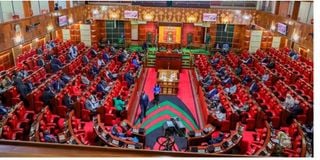
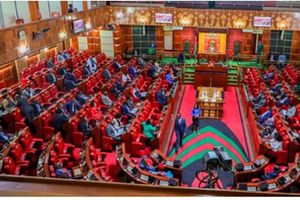
Parliament is considering removing the legal requirement for the livestreaming of election results from the statute books instead of fixing the provision that was declared unconstitutional by the courts.
The proposal is contained in the Elections (Amendment) Bill, 2024, which has been approved by the Senate and is now before the National Assembly for consideration and concurrence.
The Bill seeks to repeal and replace Section 39 of the Elections Act, which governs the transmission, determination and declaration of election results. The proposed changes would remove provisions requiring the Independent Electoral and Boundaries Commission (IEBC) to establish a mechanism for live-streaming results as announced at polling stations.
The move comes after the High Court declared unconstitutional amendments to the Elections Act that required live-streamed results to be treated as information for the public only, rather than as a basis for declaring the final results.
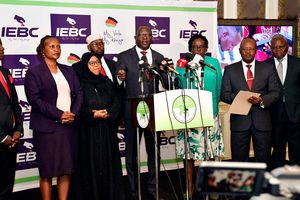
IEBC denies plan to ban live election result streaming
The ruling, delivered on April 6, 2018, by then High Court judge Chacha Mwita and subsequently upheld by the Court of Appeal, found that the provision undermined transparency and accountability in the electoral process. Parliament now proposes to remove the live-streaming requirement altogether.
In the amended Elections Act of 2011, Parliament had introduced Section 39(1G), which required the IEBC to establish mechanisms for live-streaming results as announced at polling stations.
However, the provision added that “the results so streamed shall be for purposes of public information only and shall not be the basis for a declaration by the commission”.
“The import of the new subsection is to make live streaming of results from polling stations of no value when it comes to the finality of the declared results,” he ruled.
The judge found that the amendments weakened, rather than strengthened, the electoral process.
“Looking at the effects of the amendments introduced by section 39 (1C) (a), 39 (1D), 39 (1E), 39 (1F) and 39 (1G), I am persuaded that they have the effect of weakening rather than strengthening our electoral process,” he said.
He declared the provisions constitutionally invalid, warning that any amendments that circumvent constitutional principles could not stand.
Justice Mwita said live-streamed results from polling stations were not separate from the final results declared by the commission but were the primary source from which those results were derived.
“You cannot have results that are streamed live from polling stations but which are of no value when it comes to declaration of final results. The results streamed live from polling stations are the primary source of those finally declared,” the judge said.
High Court Judge Chacha Mwita.
Photo credit: File | Nation Media Group
He added: “Final results are a product of the same process. One process cannot have two different results. Live-streamed results play a significant role in determining the final results. Those results should be as correct as those finally declared.”
The judge questioned the logic of investing in technology to transmit results if the information was not to count in determining the final outcome.
“If the intention of the legislature was that results streamed live from the primary source should not matter when it comes to the final tally, why should the country invest heavily in the technology?” he posed.
He added that live-streaming enabled citizens to compare results announced at polling stations with those declared at the constituency and national tallying centres, helping establish whether the final figures were accurate.
“I am persuaded that sub-section (1G) is a mockery of the requirements for free, fair and credible elections. It violates the principles of electoral systems in the Constitution. In that regard, therefore, this amendment cannot hold in our transformative constitutional dispensation,” he ruled.
The court's decision followed arguments that the amendment would render live transmission useless and circumvent previous decisions by the Court of Appeal and the Supreme Court on electoral transparency.
Under the proposed Bill, clause 22 provides for the repeal and replacement of Section 39, which governs the determination and declaration of election results.
The changes would also remove the provision stating that failure to transmit or publish election results electronically would not, by itself, invalidate results as announced and declared.
The live-streaming requirement was introduced as part of electoral reforms intended to prevent discrepancies between results announced at polling stations and those subsequently declared at constituency and national tallying centres.
The results announced at polling stations form the basis of subsequent declarations, making their transmission and verification a critical element of electoral accountability.
Former Attorney-General Justin Muturi, who is also a former Speaker of the National Assembly and former Cabinet Secretary for Public Service, has defended the role of live-streaming in safeguarding the credibility of elections.
“Live streaming of the election results as announced at the polling stations enhances transparency, strengthens public confidence in the electoral process and enables citizens to witness democracy in action,” Mr Muturi said.
He added: “Darkness and democracy are not synonymous. Transparency is the lifeblood of free, fair, and credible elections.”
He said, “Any proposal to ban the live-streaming of election results is not only unconstitutional and offensive to the principles of open governance, but also a stain on the democratic conscience of the Kenyan people.”
Mr Muturi cited countries including Germany, France, the United Kingdom, Canada, Australia, the United States, India, South Africa, Ghana and Nigeria as examples of jurisdictions that embrace media participation in election coverage.
The debate over live-streaming is not new. In 2022, the National Assembly's Justice and Legal Affairs Committee, then chaired by Kangema MP Muturi Kigano, rejected an IEBC proposal to repeal the legal requirement for live-streaming presidential election results.
The commission, then chaired by Wafula Chebukati, had sought to have the requirement removed. However, the committee argued that doing so would undermine transparency in the announcement and declaration of results.
“The commission shall establish a mechanism for the live-streaming of the presidential election results as announced at the polling stations,” the committee recommended in its report to the House.
It added that live-streaming was a means of upholding the constitutional principles of transparency and accountability.
“Kenyans should be able to compare the live-transmitted results with the final declared results to confirm the accuracy of the election results,” the committee said.