What top-performing Woman Reps are getting right
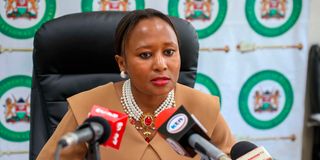
Kirinyaga Woman Representative Njeri Maina addresses the media at Parliament Buildings in Nairobi on February 12, 2026.

What you need to know:
- In the latest ratings for Woman Representatives, Njeri Maina topped the list with 67 per cent, ahead of Rael Kasiwai of West Pokot (61 per cent), Pauline Lenguris of Samburu (60 per cent), and Elsie Muhanda of Kakamega (60 per cent).
- Yet these remain the lowest top scores among all categories of elected leaders.
On March 6, 2025, the National Assembly debated the adoption of a joint report by the Departmental Committee on Justice and Legal Affairs and the Senate Standing Committee on Justice, Legal Affairs and Human Rights. The report examined the findings of the National Dialogue Committee and the Multi-Sectoral Working Group on the realisation of the two-thirds gender principle, tabled earlier that year. It was during this debate that a memorable exchange unfolded.
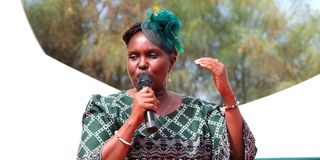
Samburu Woman Representative Pauline Lenguris speaks at Mutomo Township in Kitui County on June 9, 2025.
Kirinyaga Woman Representative Njeri Maina rose to commend the working group's efforts. She acknowledged the progress but also voiced the scepticism she hears from ordinary Kenyans.


"At times when we speak about women's representation, we realise that the concern among Kenyans is how these gender top-up positions can be arrived at," she said.
"There was a general feeling that these positions might be a preserve for wives and girlfriends, or for people who are connected, rather than for the grassroots woman who understands the needs of the common mwananchi."
She insisted that gender top-up seats must be filled by women with the capacity to champion real issues.
"As we agitate for this, I often say that I will always back a woman who is worth backing. I know the veracity of that statement may not sit well with radical feminists," she said.
"If we are to justify an extra budget and the cost for gender top-up positions in this House and the Senate, then it is important to bring in women who have the capacity to push for women's issues."
Her remarks drew a warm response from Temporary Speaker Omboko Milemba, MP for Emuhaya.
"You are a promising young legislator. De-whipping from committees notwithstanding, continue doing your work strongly from where you are," he said.
Njeri has not shied away from sensitive subjects. In November 2024, she sought a statement on the status of investigations into the death of Derrick Gachoki, who was killed in May that year. She pressed for clarity on whether police officers involved had been identified and what measures the government was taking to curb extra-judicial killings and excessive force.
In March 2025, during debate on the Budget Policy Statement for the 2025/2026 financial year, she again spoke forthrightly.
"As we agitate for equal distribution of resources, we must also ensure that we hold leaders, who are given taxpayers' money, accountable," she said.
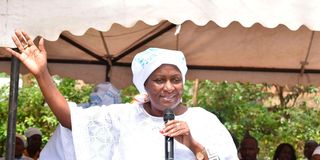
Kakamega Woman Representative Elsie Muhanda during church service at Lukhumbi P.A.G.Church on February 2, 2025.
She pointed to a viral image of a child drinking muddy water in one of the Arid and Semi-Arid Lands counties.
"That child did not apply to be born there, just as a child born in Kirinyaga or Kisumu did not choose their birthplace. We know we have the Equalisation Fund and more than 12 years of devolution. Water is now primarily a devolved function. What do we have to show for it?" She asked.
High performance
This vocal presence in Parliament, she said, has contributed to her high performance ranking by Infotrak. In the latest ratings for Woman Representatives, she topped the list with 67 per cent, ahead of Rael Kasiwai of West Pokot (61 per cent), Pauline Lenguris of Samburu (60 per cent), and Elsie Muhanda of Kakamega (60 per cent). Yet these remain the lowest top scores among all categories of elected leaders.
Njeri attributed this to widespread misunderstanding of the role of the Woman Representative. "I do believe there was a lack of intentional civic education on the role of county MPs, what they are supposed to do, and the budget allocation they have," she said.
She said many voters assume they command large development budgets because they represent entire counties. In reality, their allocations are smaller than those of constituency MPs.
"In comparison to single constituency MPs, county MPs only get a standard Sh7 million per constituency. A single constituency MP has around Sh159 million. What I can do with Sh7 million in terms of development, compared to what a constituency MP can do with Sh159 million, is not even comparable," she explained.
This mismatch between public expectations and available resources makes it difficult to demonstrate tangible projects. "It's really hard to sell the agenda you have for the people. You have to find one single thing and zero in on it, because if you try to do everything, it's spread too thin to be quantifiable," she said.
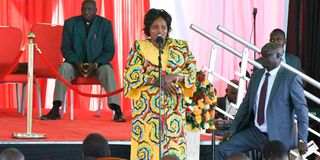
West Pokot Woman Representative Rael Kasiwai at a past event.
To bridge this gap, she said, she regularly educates constituents about the mandate of a Woman Representative and how it differs from that of governors and constituency MPs.
Njeri said she has rolled out a flagship Tupange Kesho programme, which provides full secondary school scholarships to students from child-headed households, orphaned children, and vulnerable families. This runs alongside a youth and women economic empowerment programme, offering seed capital to youth-led organisations and women's groups. She also runs a social welfare project supplying water tanks to households without reliable access to clean water.
Beyond development, she emphasised that Woman Representatives perform the same legislative functions as other MPs.
"The county MP is like any other regular Member of Parliament. They can initiate bills, bring statements and petitions, and do everything a single constituency MP can do. The only difference is their allocation," she said.
She said they have a constitutional responsibility to champion the interests of women, youth, and persons with disabilities. However, she urged women in politics to take bold positions. "Women need to be more decisive and more fierce in politics. Women need to be more politically pronounced and more fearless," she said.
Pauline Lenguris
Pauline has also made her voice heard. On April 3, 2025, during debate on banditry and insecurity in Samburu North, she spoke with urgency.
"Every day we are losing lives. We are not satisfied with the responses we are getting from the Departmental Committee on Administration and Internal Affairs because we are always told the same thing every time," she said. "Even as I speak here, some are still lying in mortuaries waiting to be buried. We want to see the security agencies doing their work. Those bandits have terrorised the whole region. We always get responses from the security forces three or four hours after the incident. We are not seeing any actions to prevent the attacks."
On March 12, 2026, she requested a statement on a human-wildlife conflict in Kisima Location, where three women were killed by an elephant while fetching firewood near Miyai Dam.
Despite ranking among the top-performing Woman Representatives, Pauline said she works under severe financial constraints in one of Kenya's most marginalised counties. "For us women representatives, we get six to seven million per constituency, and the MPs get about Sh170 million to Sh187 million per constituency. We are running across whole counties, so our workload is more, and the money we get is little," she said.
Education for girls
She said she has prioritised programmes targeting women and girls, including education, sanitary towel distribution, and interventions against child marriage and female genital mutilation. "I focused on the education of our girls because we are a pastoralist county where many girls have not gone to school," she said.
She said she has leveraged partnerships with various non-governmental organisations to supplement limited resources. But insecurity is giving her the greatest headache.
"We have a big challenge with insecurity in the county. People fight over the little resources available, like grass and water. We always get conflict, animals are stolen, and some families are left vulnerable because all their livelihood has been taken away," she said.
Recurring attacks, she said, have eroded public confidence in the state's ability to restore order. Aware of the specific challenges faced by widows and women affected by violence, she said she has prioritised them in the empowerment programmes by providing grants, table banking initiatives, and income-generating projects.
She said she also engages men to shift their attitudes towards women's empowerment. "When the women get empowered, they support in solving family issues. The men have seen women owning property, building homes and buying livestock. The mentality is changing drastically," she said.
Governance and security specialist Stella Agara argued that the Woman Representatives who have performed strongly owe their success to a combination of leadership capacity and the expectations of constituencies that demand accountability. "One similarity I've observed is that they are people who, even before being elected, had excellent analytical skills and the ability to think through strategies for development, and it seems to be paying off," she said.
She stressed that effective performance is not simply about resources but about the ability to strategise, plan, and deliver within limited means. Constituencies that demand accountability, she said, push their leaders to rise to the challenge.
Role of Woman Representative
She, however, noted that many Kenyans still misunderstand the constitutional role of Woman Representatives. "The county woman representative is effectively a Member of Parliament. The position was created as affirmative action, to add the voice of women into every conversation in the National Assembly and ensure their interests are taken care of," she said.
She also highlighted the harsher scrutiny women face compared to men. "Women have been judged very harshly compared to their male counterparts. Many have practically been put on the guillotine for mistakes their male colleagues commit and survive. The measure by which women are judged in leadership is fundamentally different," she said.
She cautioned against using performance debates to question the existence of the Woman Representative office. She insisted that affirmative action seats were created to address historical exclusion from leadership. "Those seats were created because the balance of voice in the Assembly did not exist. The balance of voice in our national governance did not exist," she said.
"There are certain things that even if you left a man in the room for 100 years he would not think about in the same way as women. That is why diversity in decision-making is extremely important."
Stella responded to calls to abolish the position, insisting that the real issue is corruption, not women's representation. "Follow the money that is getting lost in corruption. Do not sacrifice women's representation on the table of corruption just because you refuse to face the real problem," she said.
We reached out to the other top Woman Representatives, Rael and Elsie, but they did not respond.


