Why forced male circumcision audits violate the Constitution
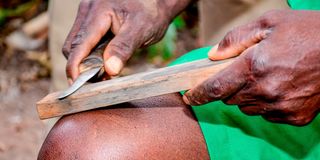
A Ngariba (traditional circumciser) sharpens a Lukembe, the ceremonial circumcision knife, ahead of the Bukusu male circumcision in Bungoma on August 1, 2026.
What you need to know:
- Article 12 of the Universal Declaration of Human Rights states that "no one shall be subjected to arbitrary interference with his privacy, family, home or correspondence, nor to attacks upon his honour and reputation”.
- Exposing a fellow elder for not being circumcised is defamatory and can lead to reputational damage.
On October 25, the Daily Nation reported that Kiama Kia Ma, the council of Gikuyu, Embu and Meru elders, requires its members to bare themselves to one another inside traditional shrines within three months for verification that they are circumcised, failure to do which would lead to de-registration or treatment as suspects.
While announcing the resolution passed at a meeting of 63 elders held in Kiambu County on September 28, the council’s national patron, Kung’u Muigai, argued that having uncircumcised members has made the entity “a council of abominations”. He declared that “circumcision to us is not only cultural; it is biblical”. What he forgot to state is when the Bible became the reference for traditional African practices in the Mt Kenya region.


Muigai’s standpoint was echoed by the Chairman of the Kikuyu Council of Elders, Wachira Kiago, that “without circumcision in our community, we have no men”. Joseph Kaguthi, the convener of the elders, noted that a man who had not undergone the rite could not participate in decision-making, slaughter livestock for ritual purposes, pay bride wealth or establish a homestead, and was considered a minor and an effeminate outcast. It would have been more useful to hear that the members identified as non-compliant have not done any of these things and to outline the calamities that befell those who have.
Muigai further revealed that they are working with mortuaries to circumcise people posthumously, clearly indicating that this initiative is a theatrical cross-breed of low comedy and absurdity.
Claiming, as he did, that uncircumcised elders “have indeed cursed their lineage” is primitive scaremongering that is as ridiculous as it is anachronistic in the contemporary cultural milieu. A commentator on social media credibly observed that this exercise is probably a ploy to administer a secret oath to galvanise support for a specific political position in the forthcoming 2027 general elections, a suspicion given credence by Muigai’s remarks that “we have uncircumcised men who have participated in the coronation of kingpins” and others “who are grooming leaders for political transitions”.
Male circumcision as a rite of passage falls within the matrix of creating masculinities in which men are defined by the ability to bear pain hence imbue courage. In traditional society, it was not merely a physical surgical procedure but also an ideological mentorship into the mores and ethos of the community. Obsession with the physical procedure without the software is clearly misplaced.
Furthermore, culture changes progressively. Hunting of lions as a rite of passage among the Maa does not happen anymore. Kalenjins no longer perforate their earlobes. Luos do not remove their sixth lower teeth, except in some cultic faiths. Payment of bride wealth in livestock is rapidly being replaced by cash.
Traditional worship has been replaced by Christianity and herbal treatment is giving way to modern medicine. Moreover, cultural practices must today conform with human rights principles of privacy, bodily integrity, choice and freedom from degrading treatment.
Article 12 of the Universal Declaration of Human Rights (UDHR) states that "no one shall be subjected to arbitrary interference with his privacy, family, home or correspondence, nor to attacks upon his honour and reputation”. Exposing a fellow elder for not being circumcised is defamatory and can lead to reputational damage. The proposed invasion will also compromise the security of the “suspects” because cultural zealots can physically harm them in the name of enforcement, in the process violating Article 3 of the UDHR on the right to life, liberty and security of the person. The activity also breaches Article 5, which states that "no one shall be subjected to torture or to cruel, inhuman or degrading treatment or punishment." Coercive circumcision and exposure as a cultural traitor constitute cruel and degrading treatment.
Article 31 of the Constitution of Kenya guarantees everyone the right not to have their person searched, and information relating to their family or private affairs unnecessarily required or revealed. Moreover, compelling individuals to disclose this information is tantamount to self-incrimination. What the council is proposing to do is expressly prohibited in Article 44(3) which states that "a person shall not compel another person to perform, observe or undergo any cultural practice or rite." Kiama Kia Ma should probably tell us which part of this article is beyond comprehension.
The fact is this: there is no empirical connection between the foreskin of the male sexual organ and the ability to do anything. Muigai and his circle cannot force anyone, notwithstanding that they belong to the same community, to undergo circumcision. Excluding non-compliant individuals is also discriminatory. The council should find something else to make itself relevant; re-registration as a side show is an excellent option. Before then, lawyers should get ready for work.
The writer is a lecturer in Gender and Development Studies at South Eastern Kenya ([email protected])