Why Kakuma’s refugee mothers struggle to make ends meet despite running businesses
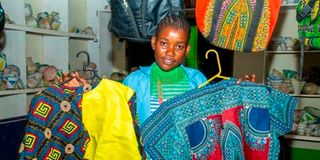
Bella Hakizimana displays some of her products at Kakuma Refugee Camp in Turkana County on September 16, 2026. Bella, a tailor from Burundi, makes bags and dresses, among other items, and also does repairs.

What you need to know:
- Despite faulty machines, rising electricity costs and exclusion from food rations, women like Nyanichew Gatkuoth and Bella Hakizimana are building businesses and feeding their families.
At her barbershop in Kakuma Refugee Camp, Nyanichew Gatkuoth is down to one working shaving machine. The other two are faulty, and she cannot afford to fix them.
“I do not know what I will do if the one machine I have left breaks down,” she says.
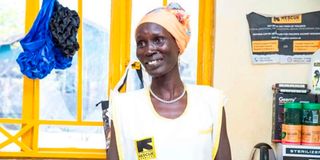
Nyanichew Gatkuoth in her barbershop on September 17, 2026. She is among the few female barbers at Kakuma Refugee Camp.


On a sunny morning, the South Sudanese is busy giving a young boy a haircut. When she finishes, she takes a few minutes to speak to the Voice about her journey into a trade that has made her stand out in the camp. She has six children who depend solely on her.
Nyanichew never planned to become a barber. She had enrolled on a hairdressing course but later changed her mind after finding it too difficult.
“I first wanted to become a salonist, but the training proved so difficult for me. I then decided to train as a barber, which was a bit easier,” she tells the Voice.
She says barbering was easier because the tools were cheaper and within her reach, and the training was less demanding.
Her path to Kakuma began in 2014, when she fled renewed fighting in her native South Sudan and joined thousands of others seeking safety across the border. With her children and a few belongings, she walked for about a week, spending some nights in shopping centres along the way.
“I remember travelling in a group made up mainly of women and children. The journey was marked by exhaustion, hunger and thirst. We reserved the little food we had for our children. Occasionally, well-wishers would offer us food, which helped sustain us for a few more days,” she says.
Reaching Kakuma brought immense relief.
“We felt safe and at home. At least we had escaped the fighting and no longer had to worry about whether we would survive the war,” she says with a sigh.
After settling in the camp, she started small-scale trading, selling vegetables to residents as a Mama Mboga. Later, an opportunity arose, and with support from a well-wisher, she enrolled in a barber training course. After the training, well-wishers gave her three shaving machines, giving her the tools she needed to start earning an income.
She has been operating her barbershop since 2024. Business was slow in the first months, but it picked up after about four months. As one of the few women barbers in Kakuma, she has attracted attention from residents, and her shop is now a familiar spot in the camp.
Nyanichew earns between Sh4,000 and Sh6,000 a week, charging Sh30 for young boys and Sh50 for adults. The business has its challenges, however. Machine repairs are a heavy cost, and she says electricity is another.
“Repairing a single machine whenever it breaks down costs at least Sh1,000. This is a lot of money, considering that my earnings are low,” she says.
Rising electricity costs have added to the strain, especially since she was required to pay her electricity bill directly. In the past, the cost was usually covered on her behalf.
She has turned to solar power, which she says has helped her save some money. Business also slows during school holidays, when many of her young customers no longer need regular haircuts.
She has been classified under category four in the refugee food rationing system because she runs a business, which means she does not qualify for food rations from the World Food Programme (WFP).
“I am both the father and mother of my household because my husband is in South Sudan. I have to work extra hard to make ends meet. I have to ensure that my children eat, have clothes to wear, and go to school,” she says.
A few kilometres from her barbershop, Bella Hakizimana, a refugee from Burundi, is busy at her sewing machine.
She also remembers the difficult journey she made to Kakuma after fleeing conflict in her home country. She spent several days on the road before arriving at the camp, which, according to government records, hosts more than 300,000 refugees of different nationalities.
“We spent many days on the road until we finally reached Kakuma. It was nice being in a place where we knew there was peace and we did not have to worry about whether we would see the following day,” she tells the Voice.
Life in the camp was not easy, and she had to find a way to feed her family.
“Starting a new life in a foreign country was not easy. There was the culture shock and the language barrier. However, I am glad that we were able to adjust and learn quickly,” she says.
Determined to provide for her family, Bella drew on her tailoring skills. She applied for a job at Don Bosco Technical Institute, a technical and vocational education and training (TVET) institution owned by the Catholic Church in Kakuma. There, she improved her skills and learnt to operate modern electric sewing machines.
She now runs a tailoring station at the institute, making clothes and repairing garments for customers. Her products include school uniforms, dresses, blouses, shorts, bags and pouches.
She earns between Sh200 and Sh400 a day, depending on the number of clients she receives. She has four children.
“Feeding a family of four on my own is not easy. I also have to pay school fees and buy clothes for my children. What I earn is not enough to meet all these needs, but I have to make do with what I have,” she says.
She says her husband left her after “life became unbearable”. Like Nyanichew, she has been placed in category four under the WFP food rationing system because she operates a small business. The classification leaves her responsible for meeting her family’s basic needs despite her modest earnings.
Access to water is another challenge. Kakuma, in Turkana County, periodically experiences severe drought, and Bella says water shortages often force residents to buy water, which further strains their limited resources.
Despite the difficulties, she hopes to expand her business into a larger tailoring enterprise that will create jobs for her and other refugee women. She is also calling for a review of the food rationing policy so that refugees earning meagre incomes are not left without adequate support.
Both women are optimistic that their businesses will continue to grow. They are beneficiaries of the Women’s Leadership, Access, Empowerment and Protection (Leap) project, implemented by UN Women with support from the Government of Japan. The initiative in Kakuma Refugee Camp and Kalobeyei settlement helps women acquire technical skills and improve their ability to earn a living, opening up new opportunities for economic empowerment and self-reliance.
UN Women Kenya Country Representative Antonia Sodonon says investing in women and girls in refugee and host communities in Kakuma and Kalobeyei is delivering tangible results, with beneficiaries transforming their livelihoods and taking on greater roles in their communities.
“Through vocational training, entrepreneurship support, leadership development, protection programmes and social cohesion initiatives, women and young people are building resilience, strengthening their economic independence and becoming more self-reliant. Many are emerging as entrepreneurs, employers, community leaders and mentors, helping drive positive change and foster stronger ties between refugee and host communities,” Sodonon says.
Women are increasingly taking the lead in sustaining their households in Kakuma amid economic hardship and declining humanitarian assistance. Most households in the camp are headed by women, and many are responsible for providing food, shelter, education and other essential needs for their families.
A study commissioned by the International Finance Corporation (IFC) and conducted by MarketShare Associates, titled Gender Assessment of Kakuma Refugee Camp and Town, found that women head 60 per cent of refugee households in Kakuma and 80 per cent of households in the neighbouring Kalobeyei settlement. It identifies poverty and limited access to resources as some of the key factors shaping the economic and social circumstances of these households.
The study further finds that female-headed households are generally more economically vulnerable than other households. They tend to be larger, have higher dependency ratios and face greater shortages of essential resources when humanitarian assistance declines.
Even so, refugee women have shown considerable adaptability in finding ways to support their families. According to the study, they are more flexible than men in the types of work and businesses they undertake to meet household needs.
Their participation in business, however, remains constrained by several barriers. Women account for only 32 per cent of registered business operations in the area.
The assessment also points to high levels of informal financial inclusion among refugee women, suggesting that many have found alternative ways to access and manage money despite the obstacles.
Like many of the women who head households in Kakuma, Nyanichew and Bella run small businesses to keep their children fed, clothed, and in school, without food rations from the WFP.