From curse to currency: The weed that stole Turkana land is now paying families' bills
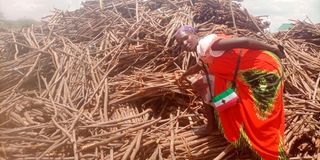
Ms Selina Lobuin delivers dried mathenge wood to Sanivation enterprise in Kakuma town, Turkana West, on October 19, 2025. The invasive weed has been a nuisance to their Nayanae Angitira village grazing fields, farmland and roads.

What you need to know:
- Women are turning Prosopis juliflora into a source of income by supplying the wood to Sanivation, a company that converts it into eco-friendly briquettes.
Through partnerships with Sanivation and Swisscontact, they are transforming a destructive plant into a clean-energy solution and a source of empowerment.
For more than four decades, a thorny invader has ruled the arid landscapes of Turkana West. Prosopis juliflora—locally known as mathenge—was once hailed as a saviour against desertification in the 1970s. But the same plant that was meant to heal the land has become its most destructive force—choking grasslands, swallowing pastures, and driving families off ancestral land.
Yet in Nayanae Angitira village in Kakuma, women are turning the problem into profit. Selina Lobuin and her neighbours have stopped lamenting and started cutting the weed down—for cash.
“When Kakuma Refugee Camp was established in 1992, we hoped that with the ever-increasing refugee population, we would sustainably manage the thorny plant by maximising it as firewood and charcoal,” Selina recalls.


“Mathenge is, however, still thriving in our harsh and arid conditions, displacing most of us from our ancestral land and forcing our husbands and sons to migrate to grazing fields that are not invaded.”
The plant, initially introduced to combat desertification and fuelwood shortages, has since turned invasive—upending livelihoods and disrupting pastures and croplands. Its relentless spread has made it one of the greatest ecological and social threats in Turkana.
Through the Kalobeyei Women’s Group, which brings together 35 members, Selina and other women have been finding new ways to live with the weed. They cut it for fencing and house construction, make charcoal for sale in Kakuma and Kalobeyei towns and refugee camps, and sell mature trees as building poles.
But the women’s small economy suffered when refugee populations—once their main buyers—began leaving due to drastic cuts in food aid and cash transfers.
Then came Sanivation.
“Our group members have an economic lifeline after we capitalised on available opportunities at Sanivation, a social enterprise working to address waste management while creating an environmentally friendly fuel alternative to charcoal and wood,” she says. “We are supplying dried Prosopis juliflora wood for cash.”
Sanivation Project field coordinator Phillip Mwangi says the company established a briquette-making facility in Kakuma through a public-private partnership to take advantage of the area’s abundant Prosopis juliflora.
“To ensure sustainable supply of dry wood, we are working with Swisscontact, an international development foundation that promotes economic, social, and ecological development by supporting people to successfully integrate into local commercial life, to pay more than 200 women for supplies,” Phillip says.
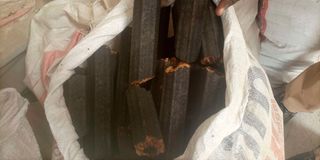
Briquettes made from dried mathenge wood at Sanivation facility on the outskirts of Kakuma town on October 19, 2025.
He explains that Sanivation uses a circular economy model, combining crushed Prosopis juliflora and processed human waste to make eco-friendly briquettes—a renewable fuel source that helps conserve the environment.
In Nakoyo, near the Sanivation facility, Anna Loturtur, 50, knows the worth of every bundle. “I am paid Sh50 for a bundle of wood that weighs 20kg when I supply,” she says. “My five children always help me to cut and dry mathenge for higher income. As opposed to overgrown trees that we used to find deeper into the thorny thickets for construction materials, production of briquettes uses readily available maturing ones that are near our homes, that have invaded our roads, grazing fields, and farms.”
Anna says they are guaranteed an income whenever they clear Prosopis thickets from their villages. She appeals for higher pay per bundle to motivate women and attract more suppliers to speed up eradication of the invasive weed.
Cynthia Wakio of Swisscontact says their focus is on private-sector-led solutions that enhance sustainable economic empowerment and improve quality of life.
“Through partnership with Sanivation, women both from the refugee camp and adjacent villages are cutting down mathenge as biomass for making briquettes and earning a living,” Cynthia says. “With ready supply of the wood, the plant is now comfortably employing seven youths in production and others earning a commission from marketing the briquettes to schools and hospitals.”
Innovation and entrepreneurship
She adds that through innovation and entrepreneurship, Swisscontact is promoting fair incomes, sustainable jobs, and functioning local markets by strengthening the income-generating capacity of both refugees and host communities in Kakuma.
For the past three years, they have collaborated with the Agency for Cross Border Pastoralists Development, Plan International Kenya, and Water Mission under the Climate Proofing WASH Services project. The initiative enhances water, sanitation, and hygiene services while creating economic opportunities and climate resilience in Turkana County.
Inside the Sanivation plant, Lucy Adelio, a refugee and one of the few women employed there, understands the importance of work. “The lack of employment or business subjects women to heightened poverty, economic insecurity, and financial dependence, reinforcing gender inequality and increasing their risk of exploitation and violence,” Lucy says.
She knows the reality too well. “Women are the hardest hit by effects of the new humanitarian assistance model. When those who used to get food are automatically eliminated from the system, their children suffer too. Vulnerable ones without any source of income who have been missing food have opted to go back to South Sudan on foot,” she says.
Lucy, now a fuel production agent at Sanivation, says women from both the camp and surrounding villages are now earning from supplying dried Prosopis juliflora stems to the plant.
“Prosopis juliflora trees are available in plenty around Kakuma, and women contracted to supply dry stems to our site are being paid. I am sure just like I do, many are helping neighbours with little food from their earnings,” she says. “I, however, challenge my fellow women to work hard, get skills, and create jobs or get employed. The mode of survival at the camp has changed, and we no longer rely on food rations.”
Mercy Nadoso says the briquettes, which burn cleaner and cheaper than traditional fuels, have found ready markets among schools and hospitals.
“I am personally using them because they are clean and have less smoke that doesn't subject one to respiratory and eye problems,” she says. “A kilogramme of briquettes costs Sh20 in Kakuma and Sh24 in other towns.”
Back in Nayanae Angitira, the thorny invader still dominates the horizon. But for Selina and the women of Kalobeyei, each mathenge branch now holds value—a 20kg bundle, a child’s school fee, and a reason to stay on their land. The weed that once stole their lives is now helping them reclaim it.


