Why your child’s schoolbooks may be fuelling gender stereotypes

What you need to know:
- Kenya has made great strides in getting girls into school, but what are they learning once they get there?
Marya’s* son is in Grade One at a school in Nairobi. She is concerned about the conversations she has with her six-year-old.
Whenever she tries to teach him how to make mandazi or help with household chores, he resists, insisting that those are girls' responsibilities.
"He tells me that in his school storybook it is the girl who helps her mother sweep, make mandazi, welcome visitors and serve them, not the boy," she says.


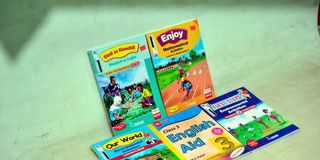
A review of the storybook Marya refers to shows a cover set firmly in a domestic environment. A bowl of mandazi sits on the table, thermos flasks are placed in one corner, and a girl looks back to welcome a visitor whose hand is visible at the door. From beginning to end, the story revolves around the girl and her mother carrying out household chores, preparing mandazi, welcoming visitors and serving them.
According to experts, this is where a long-term problem begins, one that is already becoming evident in Marya's son.
The progress
Kenya has made significant progress in getting girls into school.
In 2019, girls accounted for 47.14 per cent of candidates who sat the Grade Three Kenya Early Years Assessment, compared with 52.85 per cent for boys.
By 2022, girls made up 48.25 per cent of candidates who sat the Grade 6 Kenya Primary School Education Assessment, while boys accounted for 51.74 per cent.
In 2025, girls represented 48.81 per cent of candidates who sat the Grade 9 Kenya Junior School Education Assessment, compared with 51.19 per cent for boys.
The curriculum
Even so, an important question remains: are children receiving gender-transformative education?
A review of the Pre-Primary 1 and Pre-Primary 2 curriculum, available on the Kenya Institute of Curriculum Development (KICD) website, shows that learners at this level are expected to understand the value of social justice — that is, the importance of fairness in sharing work and responsibilities among family members.
In Sweden, one of the world's leading countries on gender equality, learning about gender equality begins in preschool.
The country's preschool curriculum requires teachers to actively incorporate a gender equality perspective so that all children have equal opportunities to broaden their perspectives and make choices regardless of gender. It also aims to help children develop norms and approaches for working and living together.
Teachers are required to work consciously and actively to promote gender equality and to integrate it into the systematic quality assurance process within schools.
This commitment is reflected in Sweden's performance on the 2025 Global Gender Gap Report by the World Economic Forum, where the country ranked sixth out of 148 countries with a score of 81.7 per cent. Kenya ranked 98th, with a score of 68.9 per cent.
What textbooks teach about gender
Dr Lydia Namatende-Sakwa, an associate research scientist at the African Population and Health Research Centre (APHRC), says access to education alone does not guarantee gender equality if the very materials children learn from continue to reinforce stereotypes about what women and men can become.
Drawing on years of research into gender representation in school textbooks, classroom practices and education systems across East Africa, she argues that the greatest obstacle facing girls is not simply getting them into school, but the deeply rooted gender norms that continue to shape their aspirations long after they enter the classroom.
"Our work consistently shows that gender norms are the key issue," she says.
"Even when girls go to school and later enter employment, there are still expectations that caregiving, marriage and domestic responsibilities should come before everything else."
Those expectations, she says, are introduced early in life and are often reinforced by the very textbooks meant to educate children.
She says their studies have consistently shown that women are portrayed differently from men — that they are less visible in textbook illustrations, have fewer speaking roles and are rarely shown occupying positions of authority or owning property.
Instead, they are frequently depicted cooking, cleaning, caring for children or welcoming visitors, while men are portrayed as decision-makers, leaders and professionals.
She warns that these repeated images do far more than illustrate stories.
"As children encounter the same messages repeatedly, they begin to see those roles as normal, while careers or responsibilities outside those expectations appear unusual or even inappropriate," she says.
The danger, she explains, is that children internalise these stereotypes before they have the opportunity to discover their own interests or abilities.
"A girl who repeatedly sees women portrayed only as caregivers may struggle to imagine herself becoming a pilot, engineer or chief executive, while boys may grow up believing leadership belongs naturally to men," she says.
Persistent stereotypes
A University of Nairobi study examining gender role portrayal in Kenyan primary school textbooks analysed 40 textbooks used in Classes One to Three and found that they largely reinforced traditional gender stereotypes.
The researchers found that female characters were overwhelmingly portrayed in domestic roles such as cooking, housekeeping and childcare, or in traditionally feminine occupations including nursing, teaching and petty trading. By contrast, male characters were mainly depicted in salaried and professional careers, with occupations requiring higher education almost exclusively reserved for men.
The study also found that male characters occupied a much wider range of professions, including doctors, police officers, reporters, shopkeepers, beekeepers and large-scale farmers.
Female characters were largely confined to teaching, petty trading, tailoring, housekeeping, traditional midwifery and unpaid subsistence farming. They were notably absent from leadership positions such as chiefs and politicians, limiting the career aspirations presented to girls while exposing boys to a much broader range of possibilities.
The pattern was particularly evident in one history textbook, where only two of the 26 occupations featured were assigned to female characters.
Men were portrayed as presidents, provincial commissioners, district officers, chiefs, pilots, train drivers and agricultural officers, among other professions. Female characters appeared only as an agricultural officer and a traditional medicine practitioner.
Another study, published in the International Journal of Education and Research, reached similar conclusions, finding that Kenya's education system continues to reinforce traditional gender stereotypes through school textbooks.
The researchers recommended that textbook authors be trained to eliminate gender bias in learning materials, teachers be equipped to identify and challenge stereotypes in the classroom, and the Ministry of Education and KICD approve only textbooks that have been assessed for gender responsiveness.
Report gender bias to KICD
KICD Chief Executive Officer Prof Charles Ochieng' said the institution is unaware of the existence of such books.
He heads the statutory body responsible for developing, approving and reviewing the curriculum and curriculum support materials used in Kenyan schools.
"We do not know of any. When KICD evaluates books for approval, we make sure the book has no gender or indeed other biases," he said in response to our query.
"If you or anybody knows any book confirmed to be approved by KICD that has any supposed gender bias, please let the CSO (Curriculum Support Officer) get a formal letter citing the book and gender-biased sections, then KICD will take up the matter," he added.
Changing textbooks is not enough
However, Dr Lydia says changing textbooks alone will not solve the problem.
During her research on gender representation in learning materials, she observed teachers using textbooks that deliberately portrayed women as pilots and professionals. Yet some educators ignored those examples or openly rejected them, insisting that women belonged in traditional roles.
"What kind of woman becomes a pilot? Who will marry her?" she recalls some teachers asking.
For her, this demonstrated that education reforms must extend beyond curriculum review to include teacher training.
She also believes solutions must extend beyond schools.
"Families, communities and workplaces all play a role in either reinforcing or dismantling gender norms," she says.
"Girls who are encouraged at school but return to homes where leadership and financial independence are discouraged receive conflicting messages that ultimately shape their choices and confidence."