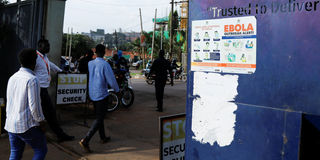
The Katiba Institute has moved to the High Court seeking to stop the government from establishing an Ebola quarantine and treatment facility for people exposed to the deadly virus under a reported arrangement with the United States.
The lobby claims the plan was negotiated secretly, without parliamentary approval, public participation, health risk assessments or disclosure of the agreement terms, raising questions over executive accountability, public health preparedness and constitutional limits on foreign agreements.
In an urgent petition filed in Nairobi, the constitutional rights organisation sued the Attorney-General and Health Cabinet Secretary, accusing the government of attempting to “convert Kenya into an offshore quarantine centre for foreign states.”
Through lawyer Malidzo Nyawa, Katiba Institute says the proposed arrangement carries grave public health, sovereignty and governance implications because Kenya allegedly lacks the specialised infrastructure needed to safely handle Ebola patients.
“Ebola is a highly severe and often fatal disease with no universally approved cure and limited treatment options,” the petition states.
The organisation argues that the government is exposing Kenyans to “avoidable loss of life” by pursuing what it describes as a non-transparent arrangement involving American citizens exposed to Ebola and other highly infectious diseases.
The petition cites international media reports and a Ministry of Health statement confirming discussions between Kenya and the United States.
It also references public remarks attributed to US Secretary of State Marco Rubio that the United States administration could not allow Ebola cases into the country.
Katiba Institute claims the reported arrangement amounts to the externalisation of America’s infectious disease management to Kenya.
“The impugned arrangement is being undertaken in a manner that is not transparent and is devoid of constitutional accountability, public participation, parliamentary oversight, or full disclosure of its health, environmental, and security implications,” Mr Nyawa says.
The lobby wants the court to immediately block the government from “establishing, operationalising, facilitating, approving or permitting” any Ebola quarantine, isolation or treatment facility linked to the arrangement.
It is also seeking orders barring Kenya from admitting or receiving Ebola-exposed persons pending determination of the case.
The petition escalates into a broader constitutional challenge over how the Executive negotiates sensitive international arrangements affecting public health and national policy.
Katiba Institute argues that the government bypassed Parliament despite the agreement allegedly carrying major fiscal, health and sovereignty consequences.
“The Executive unlawfully displaces the constitutional architecture of checks and balances and substitutes it with unilateral executive action,” the petition says.
The lobby further claims the arrangement should have undergone scrutiny under the Treaty Making and Ratification Act because it involves bilateral obligations touching on public health and the rights of Kenyan citizens.
The organisation says the government also failed to proactively disclose critical information to the public, including the terms of the agreement, biosafety assessments, environmental studies and protocols for handling Ebola patients.
“Such life-changing and public affairs matters be subject to real, not illusory, public participation,” says the petitioner.
The case revives memories of Covid-19 litigation filed during the pandemic over government decisions affecting public health and international travel.
Katiba Institute is relying on a previous High Court intervention in a coronavirus-related dispute where conservatory orders were issued over exposure to public health risks.
A central pillar of the petition is Kenya’s biosafety capacity. The organisation claims Ebola management requires Biosafety Level Four laboratories, which Kenya allegedly does not have.
It says Kenya only has Biosafety Level One to Three facilities, with only three BSL-3 laboratories currently operational nationwide.
“Therefore, what if there is an outbreak of Ebola? Can we manage to contain it?” the petition asks.
Katiba Institute argues that introducing Ebola-exposed persons into Kenya without specialised containment systems would violate constitutional rights to life, health, access to information and fair administrative action.
The lobby says the State is constitutionally obligated to adopt precautionary, evidence-based measures before exposing the public to high-risk infectious diseases.
It wants the court to compel the Health ministry to disclose all documents linked to the arrangement and file a detailed contingency plan on Ebola surveillance, prevention and emergency response systems.
The case is pending hearing directions. The dispute could trigger a politically sensitive battle touching on Kenya-US relations, public health policy and executive power under the 2010 Constitution.